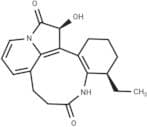
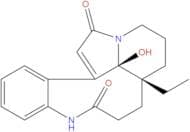
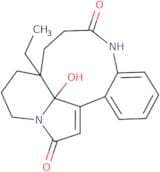
![3a-ethyl-14a-hydroxy-2,3,3a,4,5,14a-hexahydroindolizino[8,1-ef][1]benzazonine-6,13(1H,7H)-dione](/_next/image/?url=https%3A%2Fstatic.cymitquimica.com%2Fcas-image%2Fthumb-webp%2F349340-3a-ethyl-14a-hydroxy-233a-4514a-hexahydroindolizino-81-ef-1-benzazonine-613-1h-7h-dione.webp&w=3840&q=75)
CAS 93710-27-1
:3a-ethyl-14a-hydroxy-2,3,3a,4,5,14a-hexahydroindolizino[8,1-ef][1]benzazonine-6,13(1H,7H)-dione
Description:
The chemical substance known as "3a-ethyl-14a-hydroxy-2,3,3a,4,5,14a-hexahydroindolizino[8,1-ef][1]benzazonine-6,13(1H,7H)-dione," with the CAS number 93710-27-1, is a complex organic compound characterized by its unique bicyclic structure that incorporates both indolizine and benzazonine moieties. This compound features multiple functional groups, including a hydroxy group and a diketone, which contribute to its reactivity and potential biological activity. The presence of the ethyl group enhances its hydrophobic characteristics, potentially influencing its solubility and interaction with biological membranes. The stereochemistry of the compound, indicated by the specific numbering of the carbon atoms, suggests that it may exhibit chiral properties, which can affect its pharmacological profile. Such compounds are often of interest in medicinal chemistry due to their potential therapeutic applications, particularly in the development of novel drugs. However, detailed studies on its biological activity, toxicity, and pharmacokinetics would be necessary to fully understand its implications in pharmaceutical contexts.
Formula:C19H22N2O3
InChI:InChI=1/C19H22N2O3/c1-2-18-9-5-11-21-17(23)12-14(19(18,21)24)13-6-3-4-7-15(13)20-16(22)8-10-18/h3-4,6-7,12,24H,2,5,8-11H2,1H3,(H,20,22)
SMILES:CCC12CCCN3C(=O)C=C(c4ccccc4N=C(CC1)O)C23O
Sort by
Purity (%)
0
100
|
0
|
50
|
90
|
95
|
100
Found 4 products.
Leuconolam
CAS:Leuconolam is a natural product of Alstonia, Apocynaceae.Formula:C19H22N2O3Purity:98%Color and Shape:SolidMolecular weight:326.39Leuconolam
CAS:Leuconolam is a biological control agent, which is a naturally derived compound used in integrated pest management. It originates from microbial or botanical sources, taking advantage of naturally occurring processes to combat pest populations. The mode of action involves disrupting the life cycle of target pests, often through inhibition of key physiological processes or by acting as a deterrent against feeding and reproduction.Formula:C19H22N2O3Purity:Min. 95%Molecular weight:326.4 g/mol