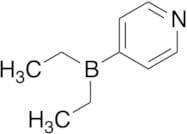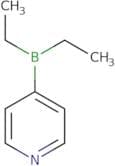
CAS 93830-58-1
:Pyridine, 4-(diethylboryl)-
Description:
Pyridine, 4-(diethylboryl)- is an organoboron compound characterized by the presence of a pyridine ring substituted at the 4-position with a diethylboryl group. This compound typically exhibits properties associated with both pyridine and boron-containing compounds. Pyridine itself is a basic heterocyclic aromatic compound known for its nitrogen atom in the ring, which contributes to its basicity and ability to act as a Lewis base. The diethylboryl group introduces unique reactivity, particularly in organometallic chemistry, making it useful in various synthetic applications, including catalysis and the formation of boron-containing materials. The presence of the boron atom can enhance the compound's reactivity towards nucleophiles and facilitate the formation of new carbon-boron bonds. Additionally, pyridine derivatives often exhibit solubility in organic solvents and can participate in various chemical reactions, such as electrophilic substitutions and coordination with metal centers. Overall, Pyridine, 4-(diethylboryl)- is a versatile compound with potential applications in organic synthesis and materials science.
Formula:C9H14BN
Sort by
Purity (%)
0
100
|
0
|
50
|
90
|
95
|
100
Found 4 products.
Diethyl(pyridin-4-yl)borane
CAS:Controlled ProductApplications Diethyl(pyridin-4-yl)borane is a powerful reducing agent used in the synthesisof non-basic compounds as factor Xa inhibitors. Diethyl(pyridin-4-yl)borane is used for the synthesis of 4-aryl- and 4-heteroarylpyridines by the palladium-catalyzed cross-coupling reaction.
References Komoriya, S. et al.: Bioorg. Med. Chem. 13, 3927 (2005); Ishikura, Minoru., et al.: Chem. Pharm. Bull., 33, 4755(1985)Formula:C9H14BNColor and Shape:NeatMolecular weight:147.0254-(Diethylboranyl) pyridine
CAS:4-(Diethylboranyl)pyridine is a nucleophilic, anticoagulant drug. It interacts with the electronegative oxygen atoms in the guanine base of dna to form an adduct, which inhibits DNA synthesis. The hexameric cavity of 4-(Diethylboranyl)pyridine contains boron and nitrogen atoms, which are important for its activity. 4-(Diethylboranyl)pyridine also has antibacterial effects against gram-positive bacteria by inhibiting bacterial protein synthesis. This compound is synthetic and can be used in cocrystallized form as a single molecule or in hexameric form.Formula:C9H14BNPurity:Min. 95%Molecular weight:147.03 g/mol