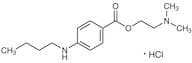
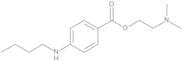
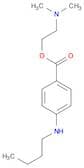
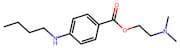
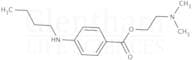
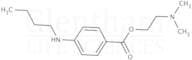
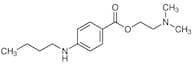
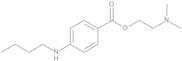
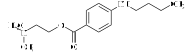
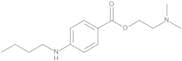
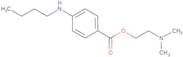
CAS 94-24-6
:Benzoic acid, 4-(butylamino)-, 2-(dimethylamino)ethyl ester
- 2-(Dimethylamino)ethyl 4-(butylamino)benzoate
- 2-Dimethylaminoethyl p-butylaminobenzoate
- Amethocaine
- Ametop
- Anetain
- Benzoic acid, p-(butylamino)-, 2-(dimethylamino)ethyl ester
- Butylocaine
- Contralgin
- Fissucain
- Intercain
- Laudocaine
- Medicaine
- Medihaler-Tetracaine
- Meethobalm
- Metraspray
- Mucaesthin
- Pontocaine
- Rexocaine
- Tetracain
- Tetracaina
- Tetracaine
- Uromucaesthin
- β-Dimethylaminoethyl p-N-butylaminobenzoate
- β-Dimethylaminoethyl p-butylaminobenzoate
- Tetracaine Base
- tetracaine usp
- Benzoic acid, 4-(butylamino)-, 2-(dimethylamino)ethyl ester
- tetracaine free base
- Dimethylaminoethylnbutylaminobenzoate
- 2-dimethylaminoethylp-butylaminobenzoate
- diaethylaminoaethanolesterderp-butylaminobenzoesaeure
- 2-Dimethylaminoethylester kyseliny p-butylaminobenzoove
- Dicain
- 2-(DIMETHYLAMINO)ETHYL 4-(N-BUTYLAMINO)BENZOATE
- LABOTEST-BB LT00772366
- 2-(Dimethylamino)ethyl p-(butylamino)benzoate
- 2-dimethylaminoethylesterkyselinyp-butylaminobenzoove
- 4-(butylamino)-benzoicaci2-(dimethylamino)ethylester
- 4-(BUTYLAMINO)BENZOIC ACID 2-(DIMETHYLAMINO)ETHYL ESTER
- beta-Dimethylaminoethyl p-butylaminobenzoate
- See more synonyms
Tetracaine Hydrochloride
CAS:Formula:C15H24N2O2·HClPurity:>98.0%(T)(HPLC)Color and Shape:White to Almost white powder to crystalMolecular weight:300.83Tetracaine
CAS:Aromatic amino-acids and their esters,other than those containing more than one kind of oxygen function for use as drugsFormula:C15H24N2O2Color and Shape:White Crystalline PowderMolecular weight:264.183782-Dimethylaminoethyl 4-(butylamino)benzoate
CAS:Formula:C15H24N2O2Purity:98%Color and Shape:SolidMolecular weight:264.3633Tetracaine
CAS:Formula:C15H24N2O2Purity:98.0 - 102.0 % (dried basis)Color and Shape:White, off-white or pale yellow crystalline powderMolecular weight:264.36Tetracaine
CAS:Formula:C15H24N2O2Purity:>98.0%(GC)(T)Color and Shape:White to Almost white powder to crystalMolecular weight:264.37Tetracaine
CAS:Controlled ProductTetracaine is a local anesthetic that causes reversible paralysis of the muscles. It also has been shown to have anti-inflammatory effects and to inhibit the production of inflammatory mediators such as prostaglandins. Tetracaine is used for anesthesia, particularly in ophthalmic surgery, because it does not cause significant vasoconstriction. Tetracaine has been shown to be effective in treating infectious diseases including HIV and malaria. Tetracaine is also used during blood sampling to prevent pain associated with venipuncture. Benzalkonium chloride (BAC), which is often used as an antiseptic, can increase the absorption of tetracaine by cells, making it more potent. This drug also inhibits calcium uptake in cells through its interaction with α1-acid glycoprotein and cytosolic calcium levels. The matrix effect can be used to study the pharmacokinetics of tetracaine by using isotonic solutions with high viscosity or low viscosity.
ENDFormula:C15H24N2O2Purity:Min. 95%Color and Shape:White PowderMolecular weight:264.36 g/molRef: 3D-FT177996
Discontinued product