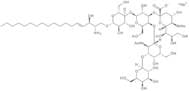
CAS 94458-59-0
:(2S,3R,4E)-2-Amino-3-hydroxy-4-octadecenyl O-(N-acetyl-α-neuraminosyl)-(2→3)-O-[O-β-<span class="text-smallcaps">D</smallcap>-galactopyranosyl-(1→3)-2-(acetylamino)-2-deoxy-β-<smallcap>D</smallcap>-galactopyranosyl-(1→4)]-O-β-<smallcap>D</smallcap>-galactopyranosyl-(1→4)-β-<smallcap>D</span>-glucopyranoside
Description:
The chemical substance with the name "(2S,3R,4E)-2-Amino-3-hydroxy-4-octadecenyl O-(N-acetyl-α-neuraminosyl)-(2→3)-O-[O-β-D-galactopyranosyl-(1→3)-2-(acetylamino)-2-deoxy-β-D-galactopyranosyl-(1→4)]-O-β-D-galactopyranosyl-(1→4)-β-D-glucopyranoside" and CAS number 94458-59-0 is a complex glycosylated compound. It features a long-chain fatty acid component, specifically an octadecenyl group, which contributes to its hydrophobic characteristics. The presence of multiple sugar moieties, including galactose and glucosamine derivatives, indicates that it is a glycosphingolipid, which plays a significant role in cell membrane structure and function. The compound also contains an amino group and hydroxyl groups, which suggest potential sites for further chemical modifications or interactions. Its stereochemistry, denoted by the (2S,3R) configuration, is crucial for its biological activity, influencing how it interacts with other biomolecules. Overall, this substance is likely to be involved in cellular recognition processes and may have implications in immunology and cell signaling pathways.
Formula:C55H97N3O30
InChI:InChI=1S/C55H97N3O30/c1-4-5-6-7-8-9-10-11-12-13-14-15-16-17-28(66)27(56)24-79-51-43(75)41(73)45(33(22-62)82-51)84-53-44(76)49(88-55(54(77)78)18-29(67)35(57-25(2)64)48(87-55)37(69)30(68)19-59)46(34(23-63)83-53)85-50-36(58-26(3)65)47(39(71)32(21-61)80-50)86-52-42(74)40(72)38(70)31(20-60)81-52/h16-17,27-53,59-63,66-76H,4-15,18-24,56H2,1-3H3,(H,57,64)(H,58,65)(H,77,78)/b17-16+/t27-,28+,29-,30+,31+,32+,33+,34+,35+,36+,37+,38-,39-,40-,41+,42+,43+,44+,45+,46-,47+,48+,49+,50-,51+,52-,53-,55-/m0/s1
InChI key:InChIKey=ARKDJZHBBZECNE-LSYRYXEQSA-N
SMILES:O([C@@]1(C(O)=O)O[C@@]([C@@H]([C@@H](CO)O)O)([C@H](NC(C)=O)[C@@H](O)C1)[H])[C@H]2[C@@H](O[C@H]3[C@H](NC(C)=O)[C@@H](O[C@@H]4O[C@H](CO)[C@H](O)[C@H](O)[C@H]4O)[C@@H](O)[C@@H](CO)O3)[C@@H](CO)O[C@@H](O[C@@H]5[C@@H](CO)O[C@@H](OC[C@@H]([C@@H](/C=C/CCCCCCCCCCCCC)O)N)[C@H](O)[C@H]5O)[C@@H]2O
Sort by
Purity (%)
0
100
|
0
|
50
|
90
|
95
|
100
Found 1 products.
GM1-Lysoganglioside sodium
CAS:GM1-Lysoganglioside (sodium salt) has the core tetrasaccharide structure (Galβ1,3GalNAcβ1,4Galβ1,4Glc) with sialic acid linked α2,3 to the inner galactose residue and sphingosine linked β to position 1 on the reducing terminal glucose residue (Ledeen, 2009). GM1 lysoganglioside has been shown that it is capable of binding amyloid-β proteins and can act as a seed for amyloid fibril formation, in early stages of Alzheimerâs disease (Chiricozzi, 2020).Formula:C55H97N3O30·xNaPurity:Min. 95%Color and Shape:White PowderMolecular weight:1,280.36 g/mol