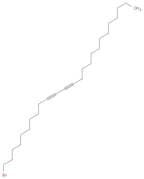
CAS 94598-32-0
:1-Bromo-10,12-pentacosadiyne
Description:
1-Bromo-10,12-pentacosadiyne is an organic compound characterized by its long carbon chain and the presence of a bromine atom. It belongs to the class of alkynes, specifically a diynes, due to the presence of two triple bonds within its structure. The compound features a linear arrangement of carbon atoms, contributing to its unique physical properties, such as a relatively high melting and boiling point compared to shorter-chain hydrocarbons. The bromine substituent introduces reactivity, making it amenable to various chemical transformations, including nucleophilic substitutions and coupling reactions. This compound is typically used in organic synthesis and materials science, particularly in the development of conjugated polymers and other advanced materials. Its structural characteristics also suggest potential applications in the field of organic electronics and photonics. However, due to the presence of bromine, it is important to handle this compound with care, as it may pose environmental and health risks. Overall, 1-Bromo-10,12-pentacosadiyne exemplifies the complexity and versatility of organic compounds in chemical research and applications.
Formula:C25H43Br
InChI:InChI=1S/C25H43Br/c1-2-3-4-5-6-7-8-9-10-11-12-13-14-15-16-17-18-19-20-21-22-23-24-25-26/h2-12,17-25H2,1H3
InChI key:InChIKey=NUDHYRYEPCJLCL-UHFFFAOYSA-N
SMILES:C(#CCCCCCCCCCCCC)C#CCCCCCCCCCBr
Synonyms:- 1-Bromo-10,12-pentacosadiyne
- 10,12-Pentacosadiyne, 1-bromo-
Sort by
Purity (%)
0
100
|
0
|
50
|
90
|
95
|
100
Found 2 products.
1-Bromo-10,12-pentacosadiyne
CAS:1-Bromo-10,12-pentacosadiyne is a monomer that has been shown to be an efficient catalyst for electrochemical polymerization. It can catalyze the polymerization of ethylene oxide in its presence. 1-Bromo-10,12-pentacosadiyne has been used as a monolayer on gold electrode surfaces and has also been used to create micelles. The monolayer is created by first depositing the bromide ion onto a glass surface, followed by deposition of the pentacosadiynyl radical onto the bromide ions. This process creates a stable layer on the surface that can be used for various reactions. Studies have shown that 1-Bromo-10,12-pentacosadiyne interacts with lectins, which are proteins found in plants that bind to sugar molecules on cell membranes. Lectins have been shown to inhibit tumor growth and cancerous cell proliferation inFormula:C25H43BrPurity:Min. 95%Color and Shape:PowderMolecular weight:423.51 g/mol