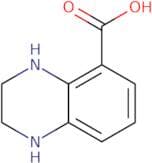
CAS 946386-72-7
:1,2,3,4-Tetrahydro-5-quinoxalinecarboxylic acid
Description:
1,2,3,4-Tetrahydro-5-quinoxalinecarboxylic acid is a heterocyclic organic compound characterized by its bicyclic structure, which includes a quinoxaline moiety. This compound features a carboxylic acid functional group, contributing to its acidic properties. It is typically a white to off-white solid and is soluble in polar solvents, such as water and alcohols, due to the presence of the carboxylic acid group. The compound is of interest in medicinal chemistry and pharmacology, as it may exhibit biological activity, potentially influencing neurotransmitter systems or serving as a scaffold for drug development. Its molecular structure allows for various chemical modifications, which can enhance its pharmacological properties. Additionally, the compound's stability and reactivity can be influenced by the presence of substituents on the quinoxaline ring. As with many organic compounds, proper handling and storage are essential to maintain its integrity and prevent degradation.
Formula:C9H10N2O2
InChI:InChI=1S/C9H10N2O2/c12-9(13)6-2-1-3-7-8(6)11-5-4-10-7/h1-3,10-11H,4-5H2,(H,12,13)
InChI key:InChIKey=YFZMIRPFVFHLCA-UHFFFAOYSA-N
SMILES:C(O)(=O)C1=C2C(=CC=C1)NCCN2
Synonyms:- 5-Quinoxalinecarboxylic acid, 1,2,3,4-tetrahydro-
- 1,2,3,4-Tetrahydro-5-quinoxalinecarboxylic acid
Sort by
Purity (%)
0
100
|
0
|
50
|
90
|
95
|
100
Found 1 products.
1,2,3,4-Tetrahydroquinoxaline-5-carboxylic acid
CAS:1,2,3,4-Tetrahydroquinoxaline-5-carboxylic acid is a versatile building block that can be used in the synthesis of complex compounds with a wide range of applications. It has been shown to be useful as a reagent in research chemicals and as a speciality chemical. 1,2,3,4-Tetrahydroquinoxaline-5-carboxylic acid is also used in the preparation of high quality pharmaceuticals and is an important intermediate for the synthesis of drugs. The compound can also be used as a scaffold for drug design.Formula:C9H10N2O2Purity:Min. 95%Color and Shape:PowderMolecular weight:178.19 g/mol