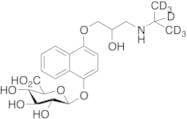
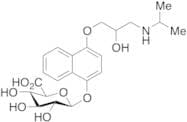
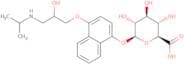
![4-[2-hydroxy-3-(propan-2-ylamino)propoxy]naphthalen-1-yl beta-D-glucopyranosiduronic acid](/_next/image/?url=https%3A%2Fstatic.cymitquimica.com%2Fcas-image%2Fthumb-webp%2F213298-4-hydroxy-propranolol-glucuronide.webp&w=3840&q=75)
CAS 94731-13-2
:4-[2-hydroxy-3-(propan-2-ylamino)propoxy]naphthalen-1-yl beta-D-glucopyranosiduronic acid
Description:
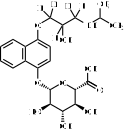
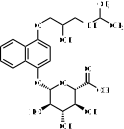
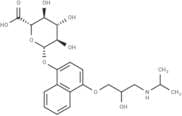
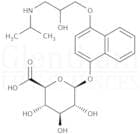
4-[2-Hydroxy-3-(propan-2-ylamino)propoxy]naphthalen-1-yl beta-D-glucopyranosiduronic acid, with CAS number 94731-13-2, is a complex organic compound characterized by its unique structural features. It contains a naphthalene moiety, which contributes to its aromatic properties, and a glucopyranosiduronic acid component, indicating it has both sugar and uronic acid characteristics. The presence of a hydroxy group and an isopropylamino group suggests potential for hydrogen bonding and interactions with biological systems, which may influence its solubility and reactivity. This compound may exhibit specific biological activities, potentially making it of interest in pharmaceutical applications. Its structural complexity implies that it could participate in various chemical reactions, including glycosylation or esterification, and may have implications in drug design or as a biochemical probe. Overall, the characteristics of this compound suggest it could play a role in medicinal chemistry, particularly in the development of therapeutics targeting specific biological pathways.
Formula:C22H29NO9
InChI:InChI=1/C22H29NO9/c1-11(2)23-9-12(24)10-30-15-7-8-16(14-6-4-3-5-13(14)15)31-22-19(27)17(25)18(26)20(32-22)21(28)29/h3-8,11-12,17-20,22-27H,9-10H2,1-2H3,(H,28,29)/t12?,17-,18-,19+,20-,22+/m0/s1
Synonyms:- 4'-Hydroxypropranolol-4'-O-b-D-glucuronide
- 4-Hydroxy Propranolol β-D-Glucuronide (Mixture of Diastereomers)
- 4-Hydroxy Propranolol -D-Glucuronide
- 4-[2-Hydroxy-3-[(1-methylethyl)amino]propoxy]-1-naphthalenyl b-D-glucopyranosiduronic Acid
- 4-Hydroxy Propranolol b-D-Glucuronide
- 4-HYDROXY PROPRANOLOL GLUCURONIDE
- 4-OH Propranolol glucuronide
- 4-[2-Hydroxy-3-[(1-methylethyl)amino]propoxy]-1-naphthalenyl -D-glucopyranosiduronic Acid
- See more synonyms
Sort by
Purity (%)
0
100
|
0
|
50
|
90
|
95
|
100
Found 8 products.
4-Hydroxy Propranolol-d5 Glucuronide (Mixture of Diastereomers)
CAS:Formula:C22H24D5NO9Color and Shape:Off-White SolidMolecular weight:456.504-Hydroxy Propranolol Glucuronide (Mixture of Diastereomers)
CAS:Formula:C22H29NO9Color and Shape:White To Off-White SolidMolecular weight:451.47(±)-4-hydroxy Propranolol β-D-Glucuronide
CAS:(±)-4-hydroxy Propranolol β-D-glucuronide is a metabolite of (±)-4-hydroxy propranolol , which is a metabolite of propranolol.Formula:C22H29NO9Color and Shape:SolidMolecular weight:451.47rac 4-Hydroxy Propranolol-d7 β-D-Glucuronide
CAS:Controlled ProductFormula:C22D7H22NO9Color and Shape:NeatMolecular weight:458.514-Hydroxy Propranolol β-D-Glucuronide (Mixture of Diastereomers)
CAS:Controlled ProductApplications A metabolite of 4-Hydroxy propranolol. Antihypertensive; antianginal; antiarrhythmic (class II).
References Walle, T., et al.: Clin. Pharmacol. Ther., 46, 257 (1989), Christ, D.D., et al.: Drug Metab. Dispos., 18, 1 (1990),Formula:C22H29NO9Color and Shape:NeatMolecular weight:451.474'-Hydroxypropranolol-4'-O-b-D-glucuronide
CAS:Propranolol is a drug that belongs to the class of beta blockers, which are used to control high blood pressure in women and neonates. Propranolol is metabolized by glucuronidation and hydroxylation into 4'-hydroxypropranolol-4'-O-b-D-glucuronide. The hydroxy group on propranolol is metabolized by hydroxylation in the liver. This metabolic pathway leads to the formation of 4'-hydroxypropranolol-4'-O-b-D-glucuronide, which is excreted through urine samples and plasma concentrations. The hydroxy group on propranolol is also metabolized by glucuronidation, leading to the formation of low bioavailability of propranolol in humans. Propranolol has been shown to inhibit platelet aggregation at higher doses, but its effects on platelet aggregation are not predictable at lower doses.Formula:C22H29NO9Purity:Min. 95%Molecular weight:451.47 g/mol