CAS 94928-86-6
:Tris(2-phenylpyridine)iridium
Description:
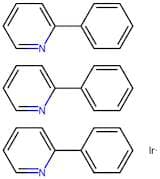
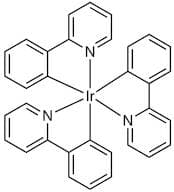
Tris(2-phenylpyridine)iridium, commonly referred to as Ir(ppy)3, is a coordination complex of iridium with notable photophysical properties, making it significant in the fields of organic electronics and photonics. This compound features three 2-phenylpyridine ligands coordinated to a central iridium atom, resulting in a stable, octahedral geometry. It exhibits strong luminescence, particularly in the blue-green region of the spectrum, due to its triplet metal-to-ligand charge transfer (MLCT) transitions. The compound is often utilized as a phosphorescent emitter in organic light-emitting diodes (OLEDs) and in various photochemical applications. Its solubility in organic solvents enhances its applicability in solution-based processes. Additionally, Tris(2-phenylpyridine)iridium is characterized by its relatively high thermal stability and resistance to photodegradation, making it suitable for long-term applications in optoelectronic devices. Safety considerations should be taken into account, as iridium compounds can be toxic, necessitating proper handling and disposal protocols in laboratory settings.
Formula:C33H24IrN3
InChI:InChI=1/3C11H8N.Ir/c3*1-2-6-10(7-3-1)11-8-4-5-9-12-11;/h3*1-6,8-9H;/rC33H24IrN3/c1-4-16-28(25(13-1)31-19-7-10-22-35-31)34(29-17-5-2-14-26(29)32-20-8-11-23-36-32)30-18-6-3-15-27(30)33-21-9-12-24-37-33/h1-24H
SMILES:c1ccc(c(c1)c1ccccn1)[Ir](c1ccccc1c1ccccn1)c1ccccc1c1ccccn1
Synonyms:- Iridium, Tris[2-(2-Pyridinyl)Phenyl]-
- Tris(2-phenylpyridine)iridium(III)
- Tris[2-(pyridin-2-yl)phenyl]iridium
- Ir(ppy)3
- Tris(2-phenylpyridinato)iridium(III)
- Lt-E504
- Tris(2-phenylpyridinato)iridium(III)(purifiedbysublimation)
Sort by
Purity (%)
0
100
|
0
|
50
|
90
|
95
|
100
Found 7 products.
Tris(2-phenylpyridinato)iridium(III)
CAS:Formula:C33H24IrN3Purity:>98.0%(HPLC)Color and Shape:Light yellow to Brown powder to crystalineMolecular weight:654.79Tris(2-phenylpyridinato-C2,N)iridium(III), 95%
CAS:Tris(2-phenylpyridinato-C2,N)iridium(III), 95%
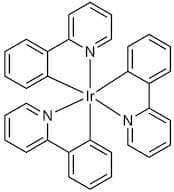
Formula:C33H24IrN3Purity:95%Color and Shape:yellow pwdr.Molecular weight:654.78Iridium, tris[2-(2-pyridinyl-kN)phenyl-kC]-, (OC-6-22)-
CAS:Formula:C33H24IrN3Purity:99%Color and Shape:SolidMolecular weight:654.7808Tris(2-phenylpyridine)iridium
CAS:Tris(2-phenylpyridine)iridiumFormula:Ir·3C11H9NPurity:95%Color and Shape: yellow powderMolecular weight:657.80g/molTris(2-phenylpyridinato)iridium(III) (purified by sublimation)
CAS:Formula:C33H24IrN3Purity:>99.0%(HPLC)Color and Shape:Light yellow to Brown powder to crystalMolecular weight:654.79Tris(2-phenylpyridine)iridium
CAS:Tris(2-phenylpyridine)iridium (IrCl) is a coordination compound that is used as a catalyst to initiate cationic polymerization of biphenyl. It is also used as an analytical reagent for determining the content of fatty acids in oils and fats. The steric interactions between the phenyl groups and the electron-rich iridium atoms lead to a high degree of conversion of ethylene oxide to ethylene glycol, which can be observed by UV absorption. The synthesis of IrCl occurs in two steps: first, the reaction of chloroacetone with phenylmagnesium bromide followed by addition of hydrated iridium chloride. The product crystallizes in red needles, which are analyzed using x-ray crystal structures. Analysis using nmr spectroscopy reveals that IrCl contains four nitrogen atoms and three oxygen atoms. Its redox potentials are -0.9 volts for oxidation and +1.3 volts for reduction, makingFormula:C33H24IrN3Purity:Min. 98 Area-%Color and Shape:PowderMolecular weight:654.78 g/mol



![Iridium, tris[2-(2-pyridinyl-kN)phenyl-kC]-, (OC-6-22)-](/_next/image/?url=https%3A%2Fstatic.cymitquimica.com%2Fproducts%2FIN%2Fthumb%2FDA00IINQ.jpg&w=3840&q=75)