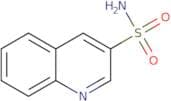
CAS 952651-46-6
:3-Quinolinesulfonamide
Description:
3-Quinolinesulfonamide is a chemical compound characterized by its quinoline structure, which is a bicyclic aromatic compound containing a nitrogen atom in the heterocyclic ring. This substance features a sulfonamide functional group, which is known for its antibacterial properties and is often utilized in medicinal chemistry. The compound is typically a solid at room temperature and may exhibit moderate solubility in polar solvents due to the presence of the sulfonamide group. Its molecular structure allows for potential interactions with biological targets, making it of interest in pharmaceutical research, particularly in the development of drugs that target specific enzymes or receptors. Additionally, 3-Quinolinesulfonamide may exhibit various biological activities, including antimicrobial and anti-inflammatory effects, although specific activity can depend on the substituents and the overall molecular configuration. As with many sulfonamides, it is important to consider its safety profile and potential side effects in therapeutic applications.
Formula:C9H8N2O2S
InChI:InChI=1S/C9H8N2O2S/c10-14(12,13)8-5-7-3-1-2-4-9(7)11-6-8/h1-6H,(H2,10,12,13)
InChI key:InChIKey=CRWDCNPQLQANDB-UHFFFAOYSA-N
SMILES:S(N)(=O)(=O)C1=CC2=C(N=C1)C=CC=C2
Synonyms:- 3-Quinolinesulfonamide
Sort by
Purity (%)
0
100
|
0
|
50
|
90
|
95
|
100
Found 1 products.
Quinoline-3-sulfonamide
CAS:Quinoline-3-sulfonamide is a 5-HT7 receptor agonist. It is an arylpiperazine that binds to the 5-HT1A receptor, dopamine receptors, and other serotonin receptors. Quinoline-3-sulfonamide has been shown to be an effective anticancer drug for tumors with metastases in mice. The drug also inhibits aerobic glycolysis in cancer cells, which may be due to its ability to inhibit the production of tumor growth factors such as IGF and VEGF. The reactive metabolite quinoline can cause DNA damage in cancer cells, resulting in cell death.Formula:C9H8N2O2SPurity:Min. 95%Molecular weight:208.24 g/mol