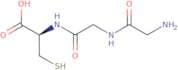
CAS 95416-30-1
:glycylglycyl-L-cysteine
Description:
Glycylglycyl-L-cysteine, with the CAS number 95416-30-1, is a dipeptide composed of two glycine residues and one cysteine residue. This compound features a unique combination of amino acids, which contributes to its biochemical properties. Glycylglycyl-L-cysteine is characterized by its ability to form disulfide bonds due to the presence of the cysteine residue, which can influence its stability and reactivity in biological systems. The peptide exhibits low solubility in non-polar solvents but is soluble in water, making it relevant for various biochemical applications. It may play a role in cellular processes, including antioxidant activity, due to the thiol group in cysteine. Additionally, this dipeptide can be involved in protein synthesis and may serve as a building block for larger peptides or proteins. Its structural properties and potential biological functions make it of interest in fields such as biochemistry, pharmacology, and nutrition.
Formula:C7H13N3O4S
InChI:InChI=1/C7H13N3O4S/c8-1-5(11)9-2-6(12)10-4(3-15)7(13)14/h4,15H,1-3,8H2,(H,9,11)(H,10,12)(H,13,14)/t4-/m0/s1
SMILES:C(C(=NCC(=N[C@@H](CS)C(=O)O)O)O)N
Sort by
Purity (%)
0
100
|
0
|
50
|
90
|
95
|
100
Found 1 products.
H-Gly-Gly-Cys-OH
CAS:<p>Glycyl-glycine is an inhibitory compound that is a synthetic analog of an endogenous amino acid. The functional theory of glycyl-glycine is based on the carbonyl group, which is in an amide form with a hydroxyl group, and the inhibitory activities are due to its ion-exchange properties. Glycyl-glycine has been shown to have inhibitory effects on the growth of bacteria by binding to DNA in vitro. This binding interferes with transcription and replication. It also binds to specific DNA sequences, which may be due to its helical structure and disulfide bond. In addition, it has been shown that this compound can be metabolized into various metabolic products such as urea and glycine. Glycyl-glycine also inhibits protein synthesis by interfering with ribosomes in bacterial cells.br>br><br>Glycyl-glycine binds to proteins in bacteria cells that are involved in transcription and translation</p>Formula:C7H13N3O4SPurity:Min. 95%Molecular weight:235.26 g/mol