CAS 957230-70-5
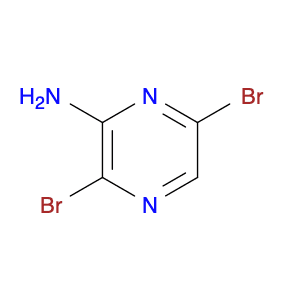
:3,6-Dibromopyrazin-2-amine
Description:
3,6-Dibromopyrazin-2-amine is a chemical compound characterized by its pyrazine ring structure, which is a six-membered aromatic heterocycle containing two nitrogen atoms. The presence of bromine substituents at the 3 and 6 positions of the pyrazine ring significantly influences its chemical properties, including its reactivity and solubility. The amino group at the 2 position contributes to its potential as a building block in organic synthesis and medicinal chemistry. This compound may exhibit biological activity, making it of interest in pharmaceutical research. Its molecular structure allows for various interactions, such as hydrogen bonding and halogen bonding, which can affect its behavior in different environments. Additionally, the presence of bromine atoms can enhance its lipophilicity, potentially influencing its pharmacokinetic properties. As with many halogenated compounds, safety considerations regarding toxicity and environmental impact are essential when handling or utilizing 3,6-Dibromopyrazin-2-amine in research or industrial applications.
Formula:C4H3Br2N3
InChI:InChI=1/C4H3Br2N3/c5-2-1-8-3(6)4(7)9-2/h1H,(H2,7,9)
SMILES:c1c(Br)nc(c(Br)n1)N
Synonyms:- 2-Pyrazinamine, 3,6-Dibromo-
Sort by
Purity (%)
0
100
|
0
|
50
|
90
|
95
|
100
Found 4 products.
3,6-Dibromopyrazin-2-amine
CAS:Formula:C4H3Br2N3Purity:96%Color and Shape:SolidMolecular weight:252.89473,6-Dibromopyrazin-2-amine
CAS:<p>3,6-Dibromopyrazin-2-amine</p>Purity:96%Molecular weight:252.897g/mol3,6-Dibromopyrazin-2-amine
CAS:Formula:C4H3Br2N3Purity:96%Color and Shape:SolidMolecular weight:252.8972,5-Dibromo-3-aminopyrazine
CAS:<p>2,5-Dibromo-3-aminopyrazine is an experimental drug with anticancer activity. It has been shown to have a high affinity for DNA and inhibit the growth of tumor cells in vivo. 2,5-Dibromo-3-aminopyrazine has undergone stability tests in vivo and in vitro and also completed clinical trials. This drug binds to DNA and inhibits the enzyme protein kinase C, leading to suppression of cellular proliferation. The pharmacokinetics of this drug were evaluated by measuring the concentration of 2,5-dibromo-3-aminopyrazine in plasma after oral administration to mice. This study found that the maximum concentration was achieved at 1 hour post dose and that there was a decrease in concentration over time. The drug has been shown to bind to the dimethoxybenzene metabolic pathway, which is involved in regulating cell proliferation.<br>2,5-Dibromo-3-aminopyrazine</p>Formula:C4H3Br2N3Purity:Min. 95%Color and Shape:PowderMolecular weight:252.89 g/mol