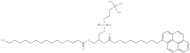
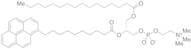
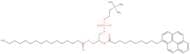
![(2R)-3-(hexadecanoyloxy)-2-{[10-(pyren-1-yl)decanoyl]oxy}propyl 2-(trimethylammonio)ethyl phosphate](/_next/image/?url=https%3A%2Fstatic.cymitquimica.com%2Fcas-image%2Fthumb-webp%2F82022-2r-3-hexadecanoyloxy-2-10-pyren-1-yl-decanoyl-oxy-propyl-2-trimethylammonio-ethyl-phosphate.webp&w=3840&q=75)
CAS 95864-17-8
:(2R)-3-(hexadecanoyloxy)-2-{[10-(pyren-1-yl)decanoyl]oxy}propyl 2-(trimethylammonio)ethyl phosphate
Description:
The chemical substance known as (2R)-3-(hexadecanoyloxy)-2-{[10-(pyren-1-yl)decanoyl]oxy}propyl 2-(trimethylammonio)ethyl phosphate, with CAS number 95864-17-8, is a complex amphiphilic molecule characterized by its dual hydrophilic and hydrophobic properties. This compound features a phosphate group that imparts a positive charge, making it cationic, while the long-chain fatty acid (hexadecanoyl) and the pyrene moiety contribute to its hydrophobic characteristics. The presence of the pyrene group, a polycyclic aromatic hydrocarbon, suggests potential applications in fluorescence and as a probe in biological systems. The amphiphilic nature allows it to form micelles or lipid bilayers in aqueous environments, which is significant for drug delivery and membrane studies. Additionally, the trimethylammonium group enhances solubility in polar solvents, facilitating interactions with biological membranes. Overall, this substance is of interest in fields such as biochemistry, nanotechnology, and materials science due to its unique structural features and potential applications in drug delivery systems and biosensing technologies.
Formula:C50H76NO8P
InChI:InChI=1/C50H76NO8P/c1-5-6-7-8-9-10-11-12-13-14-17-20-23-29-47(52)56-39-45(40-58-60(54,55)57-38-37-51(2,3)4)59-48(53)30-24-21-18-15-16-19-22-26-41-31-32-44-34-33-42-27-25-28-43-35-36-46(41)50(44)49(42)43/h25,27-28,31-36,45H,5-24,26,29-30,37-40H2,1-4H3/t45-/m1/s1
SMILES:CCCCCCCCCCCCCCCC(=O)OC[C@H](COP(=O)([O-])OCC[N+](C)(C)C)OC(=O)CCCCCCCCCc1ccc2ccc3cccc4ccc1c2c34
Sort by
Purity (%)
0
100
|
0
|
50
|
90
|
95
|
100
Found 3 products.
10-Pyrene-PC
CAS:10-Pyrene-PC, a PLA2 substrate (not for cPLA2/PAF-AH), yields fluorescent 10-pyrenyldecanoic acid upon hydrolysis.Formula:C50H76NO8PColor and Shape:SolidMolecular weight:850.1311-Palmitoyl-2-pyrenedecanoylphosphatidylcholine
CAS:Controlled ProductApplications 1-Palmitoyl-2-pyrenedecanoylphosphatidylcholine is a fluorescent phospholipid used to study the mechanism of spontaneous phospholipid transfer between single-walled phospholipid vesicles (liposomes) and other membrane interactions.
References Roseman, M.A. et al.: Biochemistry, 19, 439 (1980); Pap, E.H.W. et al.: Biochemistry, 34, 9118 (1995); Csiszar, A. et al.: Bioconj. Chem., 21, 537 (2010);Formula:C50H76NO8PColor and Shape:NeatMolecular weight:850.1141-Palmitoyl-2-(pyrene-1-yl)decanoyl-sn-glycero-3-phosphocholine
CAS:1-Palmitoyl-2-(pyrene-1-yl)decanoyl-sn-glycero-3-phosphocholine is a synthetic phospholipid analog that can be used as an acceptor in fluorescence resonance energy transfer (FRET). It has been shown to have a very broad range of excitation and emission spectra. This molecule is stable, but can be activated by the addition of silicon or germanium. 1-Palmitoyl-2-(pyrene-1-yl)decanoyl-sn-glycero-3-phosphocholine is also able to form micelles spontaneously in water.Formula:C50H76NO8PPurity:Min. 95%Molecular weight:850.11 g/mol