CAS 959-22-8
:4-Nitrophenyl benzoate
Description:
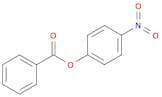
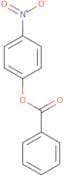
4-Nitrophenyl benzoate is an organic compound characterized by its ester functional group, formed from the reaction of 4-nitrophenol and benzoic acid. It appears as a yellow crystalline solid and is known for its moderate solubility in organic solvents such as ethanol and acetone, while being less soluble in water. The presence of the nitro group (-NO2) on the phenyl ring enhances its reactivity, making it useful in various chemical reactions, including nucleophilic substitutions. This compound is often utilized in synthetic organic chemistry as an intermediate or reagent. Its molecular structure contributes to its properties, including its melting point and boiling point, which are influenced by intermolecular forces such as hydrogen bonding and dipole-dipole interactions. Additionally, 4-nitrophenyl benzoate can be employed in studies related to enzyme kinetics and as a substrate in biochemical assays due to its ability to undergo hydrolysis. Safety precautions should be observed when handling this compound, as nitro compounds can be hazardous.
Formula:C13H9NO4
InChI:InChI=1/C13H9NO4/c15-13(10-4-2-1-3-5-10)18-12-8-6-11(7-9-12)14(16)17/h1-9H
InChI key:InChIKey=GMKZBFFLCONHDE-UHFFFAOYSA-N
SMILES:C(OC1=CC=C(N(=O)=O)C=C1)(=O)C2=CC=CC=C2
Synonyms:- Benzoic acid 4-nitrophenyl ester
- Benzoic acid, p-nitrophenyl ester
- NSC 408882
- Phenol, p-nitro-, benzoate
- p-Nitrophenyl benzoate
- 4-Nitrophenyl benzoate
- AURORA 6538
- benzoicacid,4-nitrophenylester
Sort by
Purity (%)
0
100
|
0
|
50
|
90
|
95
|
100
Found 4 products.
4-Nitrophenyl benzoate
CAS:4-Nitrophenyl benzoate is a reactive molecule that can react with oxygen nucleophiles and hydroxyl groups. 4-Nitrophenyl benzoate is formed by the acylation reaction between an amine and a phenol, which is catalyzed by acid, base, or heat. This reaction mechanism can be explained by the formation of a hydrogen bond between the amine and the phenol. The kinetic data for this reaction have been measured using fluorescence measurements, and it has been shown that the reaction rate increases as temperature increases.
Formula:C13H9NO4Purity:Min. 96 Area-%Color and Shape:PowderMolecular weight:243.21 g/mol