CAS 959578-03-1
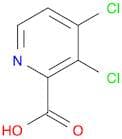
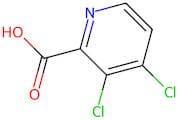
:3,4-Dichloro-2-pyridinecarboxylic acid
Description:
3,4-Dichloro-2-pyridinecarboxylic acid is a heterocyclic organic compound characterized by the presence of a pyridine ring substituted with two chlorine atoms and a carboxylic acid group. The molecular structure features a pyridine ring, which is a six-membered aromatic ring containing one nitrogen atom, contributing to its basicity and reactivity. The presence of the carboxylic acid group (-COOH) imparts acidic properties, allowing it to participate in various chemical reactions, such as esterification and amidation. The dichloro substitutions at the 3 and 4 positions of the pyridine ring enhance its reactivity and influence its solubility in polar solvents. This compound is of interest in pharmaceutical and agrochemical research due to its potential biological activity and applications in the synthesis of other chemical entities. Additionally, its unique structure may contribute to specific interactions with biological targets, making it a subject of study in medicinal chemistry. Safety and handling precautions should be observed, as with many chlorinated compounds, due to potential toxicity and environmental concerns.
Formula:C6H3Cl2NO2
InChI:InChI=1S/C6H3Cl2NO2/c7-3-1-2-9-5(4(3)8)6(10)11/h1-2H,(H,10,11)
SMILES:c1cnc(c(c1Cl)Cl)C(=O)O
Synonyms:- 3,4-Dichloropicolinic acid
Sort by
Purity (%)
0
100
|
0
|
50
|
90
|
95
|
100
Found 4 products.
3,4-dichloropicolinic acid
CAS:Formula:C6H3Cl2NO2Purity:97%Color and Shape:SolidMolecular weight:191.99953,4-Dichloropyridine-2-carboxylic acid
CAS:<p>3,4-Dichloropyridine-2-carboxylic acid</p>Purity:≥95%Molecular weight:192.00g/mol3,4-Dichloropicolinic acid
CAS:<p>3,4-Dichloropicolinic acid is an organic nitro compound that is used in the preparation of organic solvents. It is also used as a starting material for the synthesis of pyridine and picolinic acid. 3,4-Dichloropicolinic acid can be synthesized by the reaction of butyric acid with hydrochloric acid in the presence of a nitrite salt and dimethylamine. The resulting product may be purified by crystallization from water or ethanol. Symptoms associated with exposure to 3,4-dichloropicolinic acid may include headache, dizziness, blurred vision, nausea, vomiting and convulsions. Proton magnetic resonance spectroscopy has been used to detect 3,4-dichloropicolinic acid in urine samples from patients with hepatitis B.br><br>3,4-Dichloropicolinic acid was first isolated in 1887 by Suzuki coupling reaction between picolinic</p>Formula:C6H3Cl2NO2Purity:Min. 95%Molecular weight:192 g/mol