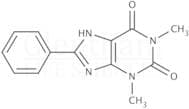
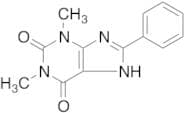
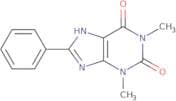
CAS 961-45-5
:8-Phenyltheophylline
- 1,2,3,6-Tetrahydro-1,3-Dimethyl-2,6-Dioxo-8-Phenylpurine
- 1,3-Dimethyl-8-phenyl-1H-purine-2,6(3H,7H)-dione
- 1,3-dimethyl-8-phenyl-3,7-dihydro-1H-purine-2,6-dione
- 1H-Purine-2,6-dione, 3,7-dihydro-1,3-dimethyl-8-phenyl-
- 1H-Purine-2,6-dione, 3,9-dihydro-1,3-dimethyl-8-phenyl-
- 3,7-Dihydro-1,3-dimethyl-8-phenyl-1H-purine-2,6-dione
- 3,9-Dihydro-1,3-dimethyl-8-phenyl-1H-purine-2,6-dione
- 8-Phenyl-1,3-dimethylxanthine
- 8-Phenyltheophylline
- NSC 14127
- Theophylline, 8-phenyl-
1,3-Dimethyl-8-phenylxanthine
CAS:Formula:C13H12N4O2Purity:≥ 95%Color and Shape:White to off-white or pale yellow crystalline powderMolecular weight:256.261,3-Dimethyl-8-phenylxanthine
CAS:Controlled ProductApplications 1,3-Dimethyl-8-phenylxanthine is a non-selective adenosine receptor antagonist prevents the anticonvulsant effect of curcumin.
References Akula, K. K., et al.: Phytoth. Res., 28, 714-721 (2014)Formula:C13H12N4O2Color and Shape:NeatMolecular weight:256.268-Phenyltheophylline
CAS:Controlled Product8-Phenyltheophylline (8PT) is an adenosine receptor agonist that is used as a bronchodilator for the treatment of asthma. It has been shown to increase the intracellular calcium concentration in hl-60 cells and in rat papillary muscles. 8PT also has locomotor activating effects, which are thought to be due to its ability to block potassium channels in the hippocampal formation. These effects may be related to ATP-sensitive potassium channels, which have been shown to be sensitive to ATP in untreated mice. 8PT also has anti-arrhythmic properties, which may be due to its ability to inhibit sodium channels and its effect on heart rate and contractility.
Formula:C13H12N4O2Purity:Min. 95%Color and Shape:PowderMolecular weight:256.26 g/mol