CAS 96129-73-6
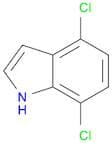
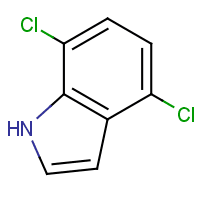
:4,7-dichloro-1H-indole
Description:
4,7-Dichloro-1H-indole is an organic compound characterized by its indole structure, which consists of a fused benzene and pyrrole ring. The presence of two chlorine atoms at the 4 and 7 positions of the indole ring significantly influences its chemical properties, including its reactivity and solubility. This compound typically appears as a solid at room temperature and is known for its potential applications in pharmaceuticals and agrochemicals due to its biological activity. It may exhibit properties such as antimicrobial or antifungal activity, making it of interest in medicinal chemistry. The molecular formula reflects its composition, and its molecular weight is determined by the sum of the atomic weights of its constituent atoms. As with many halogenated compounds, 4,7-dichloro-1H-indole may pose environmental and health concerns, necessitating careful handling and disposal. Its synthesis often involves specific chemical reactions that introduce the chlorine substituents onto the indole framework, showcasing the versatility of indole derivatives in organic synthesis.
Formula:C8H5Cl2N
InChI:InChI=1/C8H5Cl2N/c9-6-1-2-7(10)8-5(6)3-4-11-8/h1-4,11H
SMILES:c1cc(c2c(cc[nH]2)c1Cl)Cl
Synonyms:- 1H-indole, 4,7-dichloro-
- 4,7-Dichloro-1H-indole
Sort by
Purity (%)
0
100
|
0
|
50
|
90
|
95
|
100
Found 4 products.
4,7-Dichloro-1H-indole
CAS:4,7-Dichloro-1H-indole (4,7-DCI) is an indole that is obtained by the reaction of potassium with 3,4-dichloroaniline. The compound has been found to be a potent inhibitor of the growth of plants and algae. It has also been shown to inhibit the growth of bacteria by binding to their DNA and inhibiting transcription. This process prevents protein synthesis and leads to cell death. 4,7-DCI can be synthesized using zinc chloride as a catalyst. It reacts with potassium carbonate in an alkaline environment to form potassium chloride and 4,7-DCI.Formula:C8H5NCl2Purity:Min. 95%Molecular weight:186.03 g/mol