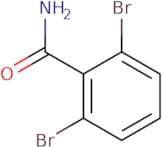
CAS 96237-91-1
:Benzamide, 2,6-dibromo-
Description:
Benzamide, 2,6-dibromo- is an organic compound characterized by the presence of a benzamide functional group with two bromine atoms substituted at the 2 and 6 positions of the benzene ring. This compound typically appears as a crystalline solid and is known for its relatively low solubility in water, while being more soluble in organic solvents. The presence of bromine atoms enhances its reactivity, making it useful in various chemical synthesis processes, including the development of pharmaceuticals and agrochemicals. The compound may exhibit biological activity, which can be attributed to the structural modifications introduced by the bromine substituents. Additionally, its melting and boiling points are influenced by the bromine atoms, which can affect intermolecular interactions. Safety data should be consulted, as halogenated compounds can pose environmental and health risks. Overall, 2,6-dibromobenzamide serves as an important building block in organic chemistry and materials science.
Formula:C7H5Br2NO
Sort by
Purity (%)
0
100
|
0
|
50
|
90
|
95
|
100
Found 1 products.
2,6-Dibromobenzamide
CAS:2,6-Dibromobenzamide is a reagent that has been used in the synthesis of benzoic amides and esters. It is used to convert primary alcohols or other functional groups into the corresponding benzoyl derivatives. This reagent is also used for halogenating aromatic compounds such as phenol and anisole. 2,6-Dibromobenzamide can be used to synthesize substances such as chloroformates, bromides, and iodides. This compound is also useful for transforming substances into different functional groups. For example, 2,6-dibromobenzamide can transform amides into esters or halogenate benzene rings with a variety of halogens. The mechanism is believed to involve the formation of a diazonium salt intermediate followed by loss of nitrogen gas and rearrangement to form the desired product.Formula:C7H5Br2NOPurity:Min. 95%Color and Shape:PowderMolecular weight:278.93 g/mol