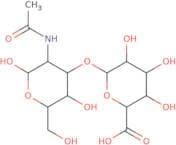
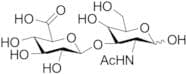
CAS 97747-46-1
:2-(Acetylamino)-2-deoxy-3-O-β-D-glucopyranuronosyl-β-D-glucopyranose
Description:
2-(Acetylamino)-2-deoxy-3-O-β-D-glucopyranuronosyl-β-D-glucopyranose, with the CAS number 97747-46-1, is a complex carbohydrate derivative characterized by its structural components, which include an acetylamino group and glucopyranose units. This compound features a glucopyranuronosyl linkage, indicating the presence of a uronic acid derivative, which contributes to its biological activity and solubility properties. The acetylamino group enhances its stability and may influence its interaction with biological systems, such as enzymes or receptors. Typically, such compounds are of interest in biochemical research and pharmaceutical applications due to their potential roles in cellular processes, including cell signaling and metabolism. The presence of multiple hydroxyl groups in the glucopyranose units suggests that the substance is likely to be hydrophilic, which can affect its solubility in aqueous environments. Overall, this compound exemplifies the complexity and functionality of glycosylated molecules in biological systems.
Formula:C14H23NO12
InChI:InChI=1S/C14H23NO12/c1-3(17)15-5-10(6(18)4(2-16)25-13(5)24)26-14-9(21)7(19)8(20)11(27-14)12(22)23/h4-11,13-14,16,18-21,24H,2H2,1H3,(H,15,17)(H,22,23)/t4-,5-,6-,7+,8+,9-,10-,11+,13-,14-/m1/s1
InChI key:InChIKey=LJORHONFMDUUHP-VOGNPWKQSA-N
SMILES:O([C@@H]1[C@@H](NC(C)=O)[C@H](O)O[C@H](CO)[C@H]1O)[C@@H]2O[C@H](C(O)=O)[C@@H](O)[C@H](O)[C@H]2O
Synonyms:- 2-(Acetylamino)-2-deoxy-3-O-β-D-glucopyranuronosyl-β-D-glucopyranose
- β-D-Glucopyranose, 2-(acetylamino)-2-deoxy-3-O-β-D-glucopyranuronosyl-
Sort by
Purity (%)
0
100
|
0
|
50
|
90
|
95
|
100
Found 2 products.
2-(Acetylamino)-2-deoxy-3-O-β-D-glucopyranuronosyl-β-D-glucopyranose
CAS:2-(Acetylamino)-2-deoxy-3-O-β-D-glucopyranuronosyl-β-D-glucopyranose is an analog of atropine that has shown potential as an anticancer agent. It acts as a kinase inhibitor, specifically targeting protein kinases involved in cancer cell growth and survival. This compound has been found in Chinese urine and has been shown to induce apoptosis in human tumor cells. As a potent inhibitor of kinases, it may have potential as a therapeutic agent for the treatment of various types of cancer.
Formula:C14H23NO12Purity:Min. 95%Molecular weight:397.33 g/molSodium (2S,3S,4S,5R,6R)-6-(((3R,4R,6R)-3-Acetamido-2,5-dihydroxy-6-(hydroxymethyl)tetrahydro-2H-pyran-4-yl)oxy)-3,4,5-trihydroxytetrahydro-2H-pyran-2-carboxylate
CAS:Controlled ProductFormula:C14H22NO12·NaColor and Shape:NeatMolecular weight:397.332