Potassium Channel
Potassium channels are a diverse group of membrane proteins that facilitate the flow of potassium ions (K+) across the cell membrane. These channels play a crucial role in maintaining the resting membrane potential, regulating cell volume, and controlling the excitability of neurons and muscle cells. Potassium channels are involved in various physiological processes, including cardiac rhythm regulation, insulin secretion, and neurotransmitter release. Dysregulation of potassium channels is linked to conditions such as arrhythmias, epilepsy, and hypertension. At CymitQuimica, we offer a wide range of potassium channel modulators to support your research in electrophysiology, cardiovascular health, and neurobiology.
Found 304 products of "Potassium Channel"
Sort by
Purity (%)
0
100
|
0
|
50
|
90
|
95
|
100
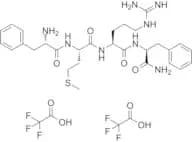
Phe-Met-Arg-Phe amide trifluoroacetate
CAS:Phe-met-arg-phe amide trifluoroacetate is an activator of K+ current with an ED50 of 23nm on the fundus nerve.Formula:C33H44F6N8O8SPurity:98%Color and Shape:SolidMolecular weight:826.81Dalazatide HCl
Dalazatide HCl is a peptide and specific Kv1.3 inhibitor that suppresses the activation and proliferation of memory effector T cells,Color and Shape:SolidMolecular weight:4317.53 (Free base)Jingzhaotoxin-XII TFA
Jingzhaotoxin-XII (JzTx-XII) TFA is a specific inhibitor of the Kv4.1 channel, exhibiting an IC50 of 0.363 μM. It interacts with the channel by altering gating behavior.Color and Shape:Odour SolidDendrotoxin K
CAS:Dendrotoxin K blocks Kv1.1 channels, modulating glutamate release in CA3 neurons by controlling presynaptic spike timing.Formula:C294H462N84O75S6Color and Shape:SolidMolecular weight:6559.666-FAM-AEEAC-SHK TFA
6-FAM-AEEAC-SHK TFA, a peptide neurotoxin derived from Stichodactyla helianthus and conjugated with a fluorescent marker, selectively blocks voltage-gated potassium channels (kv1.1 and kv1.2). By prolonging action potentials, it interferes with neural signal conduction, making it valuable in neuroscience research.Formula:C196H295N55O57S7·xCHF3O2Color and Shape:SolidMolecular weight:4558.23 (free acid)Pinacidil monohydrate
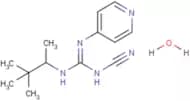
CAS:Pinacidil monohydrate is a potassium channel activator, antihypertensive drug.Formula:C13H21N5OPurity:99.94% - 99.98%Color and Shape:PowderMolecular weight:263.34BDS-I
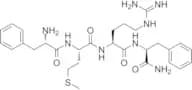
CAS:BDS-I, a marine toxin derived from Anemonia sulcata, functions as a selective inhibitor of the potassium channel, specifically targeting Kv3.4.Formula:C210H297N57O56S6Purity:98%Color and Shape:SolidMolecular weight:4708.34Phe-Met-Arg-Phe, amide
CAS:Phe-Met-Arg-Phe amide activates K+ current in neurons (ED50=23 nM), co-localizes with neuropeptide Y in brain regions.Formula:C29H42N8O4SPurity:98%Color and Shape:SolidMolecular weight:598.76Tertiapin-RQ
Tertiapin-RQ, an inward rectifier potassium (K+) channel-blocking peptide, exhibits antidepressant effects [1].Formula:C106H175N37O25S4Purity:98%Color and Shape:SolidMolecular weight:2496.02Iberiotoxin TFA
Iberiotoxin (TFA) is a selective inhibitor of high conductance Ca2+-activated K+ channels, exhibiting a dissociation constant (Kd) of approximately 1 nM, yet itFormula:C179H274N50O55S7·xC2HF3O2Purity:98%Color and Shape:SolidMolecular weight:4230.85 (free base)Jingzhaotoxin-X
Jingzhaotoxin-X (JZTX-X) selectively inhibits Kv4.2 and Kv4.3 potassium channels, resulting in prolonged mechanical hyperalgesia [1].Formula:C164H242N46O41S6Purity:98%Color and Shape:SolidMolecular weight:3706.35BeKm-1
CAS:Potent, selective hERG (KV11.1) blocker; doesn't affect 14 other K+ channels; extends QTc in rabbit heart dose-dependently.Formula:C174H261N51O52S6Purity:98%Color and Shape:SolidMolecular weight:4091.65Guangxitoxin 1E
CAS:Guangxitoxin 1E acts as a gating modifier since it shifts the voltage-dependence of Kv2.1 K+ currents towards depolarized potentials.Formula:C178H248N44O45S7Purity:98%Color and Shape:SolidMolecular weight:3948.61Lei-Dab7
CAS:Selective KCa2.2 channel blocker with Kd 3.8 nM, >200-fold specificity, enhances LTP, convulsive in vivo.Formula:C141H236N46O39S6Purity:98%Color and Shape:SolidMolecular weight:3392.06GsAF-II
GsAF-II is a peptide toxin that selectively blocks hERG1 subtype potassium channels through a voltage-dependent mechanism and impedes Nav1.x subtype sodiumFormula:C176H261N47O45S7Purity:98%Color and Shape:SolidMolecular weight:3979.7Aekatperone
Aekatperone, a reversible KATP channel inhibitor, exhibits an IC50 of 9 μM. It is utilized in research related to congenital hyperinsulinism (CHI).Formula:C20H25N5O2SColor and Shape:SolidMolecular weight:399.51Heteropodatoxin-1
Heteropodatoxin-1 (HpTx1), a spider peptide toxin, acts as an inhibitor of the Kv4.2 current, while concurrently inhibiting Nav1.7 and activating Nav1.9Formula:C168H238N46O51S6Purity:98%Color and Shape:SolidMolecular weight:3910.35Guanfu base A
CAS:Guanfu base A is a potent noncompetitive CYP2D6 inhibitor (Ki: 1.20 μM in HLMs; Ki: 0.37 μM for rCYP2D6). It also inhibits HERG channel current.Formula:C24H31NO6Purity:99.71% - 99.85%Color and Shape:SolidMolecular weight:429.5Tertiapin
CAS:Tertiapin (reduced) is a synthetic bee venom peptide characterized by disulfide bonds between Cys3-Cys14 and Cys5-Cys18. It acts as an inhibitor of inward-rectifying potassium channels (potassium Channel) and can also block the activity of calcium-activated large conductance potassium channels. Tertiapin (reduced) is utilized in research related to diseases such as rheumatoid arthritis and multiple sclerosis.Formula:C106H180N34O23S5Color and Shape:SolidMolecular weight:2459.1Foslevcromakalim
CAS:Foslevcromakalim (QLS-101) is an KATP opener, converted to its active form by alkaline phosphatase in vivo, reduces intraocular pressure in normotensive mice.Formula:C16H19N2O6PPurity:99.73%Color and Shape:SolidMolecular weight:366.31