Deuterated Compounds
Found 4238 products of "Deuterated Compounds"
Tolazamide-d7
CAS:Controlled ProductApplications Labelled Tolazamide, an antidiabetic.
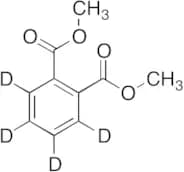
References Welling, et al.: J. Pharmac. Sci., 71, 1259 (1982);Formula:C14H14D7N3O3SColor and Shape:NeatMolecular weight:318.44Dimethyl phthalate-3,4,5,6-d4
CAS:Controlled ProductApplications Dimethyl phthalate-3,4,5,6-d4
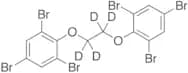
Formula:C102H4H6O4Color and Shape:YellowMolecular weight:198.211,2-Bis(2,4,6-tribromophenoxy)ethane-d4
CAS:Controlled ProductApplications Labelled 1,2-Bis(2,4,6-tribromophenoxy)ethane (B585425). One of the major "novel" brominated flame retardants (NBFRs) from varous polymer materials. An environmental pollutant.
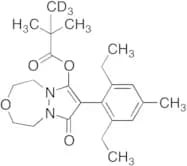
References Zhu, L., et al.: Environ. Sci. Technol., 40, 3711 (2006), Qui, X., et al.: Environ. Sci. Technol., 42, 31 (2008), Stone, R., et al.: Science, 325, 1055 (2009),Formula:C14H4D4Br6O2Color and Shape:NeatMolecular weight:691.66Pinoxaden-d3
CAS:Controlled ProductApplications Pinoxaden-d3 is a deuterized labeled form of Pinoxaden (P469505), which is derived from Diethylene Glycol Dimethanesulfonate (D444275), an intermediate in the production of alkylating agents.
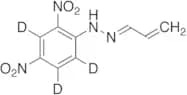
References Wong, I., et al.: J. Med. Chem., 52, 5311 (2009); Muehlebach, M., et al.: Bioorg. Med. Chem., 17, 4241 (2009)Formula:C23H29D3N2O4Color and Shape:Off-WhiteMolecular weight:403.53Acrolein 2,4-Dinitrophenylhydrazone-d3
CAS:Controlled ProductApplications Labelled analogue of Acrolein 2,4-Dinitrophenylhydrazone, a dinitrophenylhydrazone (DNPH) derivative of an aliphatic alldehyde found in mainstream cigarette smoke.
References Delgado, B. et al.: J. Liq. Chrom. Rel. Technol., 31, 361 (2008); Miller, J.H. et al.: J. Chrom. Sci., 48, 12 (2010);Formula:C9D3H5N4O4Color and Shape:OrangeMolecular weight:239.2Carbamezepine-D10
CAS:Controlled ProductApplications Carbamazepine-D10 is used to study occurrence of emerging trace organic chemicals in wastewater effluents in Saudi Arabia.
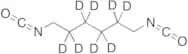
References Alidina, M., et al.: Sci. Total Environ., 478, 152 (2014);Formula:C152H10H2N2OColor and Shape:NeatMolecular weight:246.331,6-Diisocyanatohexane-d8
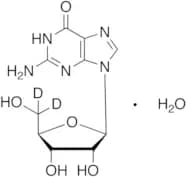
CAS:Controlled ProductFormula:C8D8H4N2O2Color and Shape:NeatMolecular weight:176.242Guanosine-5',5''-d2 Monohydrate
CAS:Controlled ProductStability Hygroscopic
Applications Isotope labelled analogue of Guanosine (G837900), a constituent of nucleic acids.
Not a dangerous good if item is equal to or less than 1g/ml and there is less than 100g/ml in the package
References Miles, et al.: Science, 142, 1458 (1963), Bugg, et al.: Biochem. Biophys. Res. Commun., 3, 436 (1968),Formula:C10H13D2N5O6Color and Shape:NeatMolecular weight:303.27Cyclopentanone-2,2,5,5-d4
CAS:Controlled ProductApplications Cyclopentanone-2,2,5,5-d4 (CAS# 3997-89-5) is a useful isotopically labeled research compound.
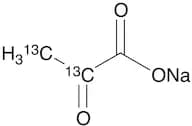
Formula:C5H4D4OColor and Shape:NeatMolecular weight:88.146 Pyruvic Acid Sodium Salt-13C2
CAS:Applications Pyruvic Acid-13C2 is an intermediate in synthesizing L-Lactic Acid-d3 Sodium Salt (L113503), a labelled sodium salt of L-Lactic Acid (L113500). L-Lactic Acid occurs in small quantities in the blood and muscle fluid of man and animals. The lactic acid concentration increases in muscle and blood after vigorous activity. L-(+)-Lactic acid is also present in liver, kidney, thymus gland, human amniotic fluid, and other organs and body fluids.
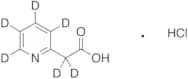
References Wenzel, A., et al.: J. Neurosci., 21, 53 (2001); Martinez., et al.: Development, 6, 851 (2002); Nakayama, K., et al.: J. Biochem., 146, 757 (2009); Tanaka, T., et al.: J. Pharmacol. Sci., 109, 24 (2009)Formula:C2CH3O3·NaColor and Shape:Off WhiteMolecular weight:112.032-Pyridylacetic Acid-d6 Hydrochloride (d5 Major)
CAS:Controlled ProductStability Unstable in Solution, Hygroscopic
Applications Used in nucleophilic substitution.
References Genicot, C., et al.: Bioorg. Med. Chem. Lett., 13, 437 (2003),Formula:C72H6HNO2·ClHColor and Shape:NeatMolecular weight:179.63Guaiacol-β-D-gentiobioside-d3
CAS:Controlled ProductStability Hygroscopic
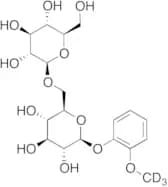
Applications Guaiacol-beta-D-gentiobioside-d3, is the labeled analogue of Guaiacol-beta-D-gentiobioside (G245570), a Guaiacol Conjugate, that has shown to present in fermentation of grapes that had been exposed to bushfire smoke and can potentially yield unpalatable, smoke-affected wine.
References Hayasaka, Y.m et al.: J. Arg. Food Chem., Vol. 58, Issue 4, P: 2076; 2081 (2010);Formula:C19H25D3O12Color and Shape:White To Off-WhiteMolecular weight:451.44N-Nitrosopiperidine-d4
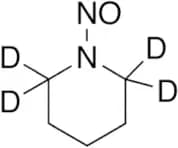
CAS:Controlled ProductApplications Labelled N-Nitrosopiperidine (N545370). A carcinogenic nitrosocompound.
Not a dangerous good if item is equal to or less than 1g/ml and there is less than 100g/ml in the package
References Bos, J., et al.: Cancer Res., 49, 4682 (1989), Wong, H., et al.: Carcinogenesis, 24, 291 (2003), Gonzalez-Mancebo, S., et al.: Mutat. Res., 558, 45 (2004), Gonzalez, M., et al.: Bioorg. Med. Chem., 13, 601 (2005),Formula:C52H4H6N2OColor and Shape:Light BrownMolecular weight:118.17Ethylbenzene-13C6
CAS:Controlled ProductApplications Ethylbenzene-13C6 is the labeled form of Ethylbenzene (E899745), which is used in the industrial production of stryrene trough various organic processes.
References Weiss, W. et al.: Prog. Surf. Sci., 70, 1 (2002); Cavani, F. et al.: App. Catal. A., 133, 219 (1995);Formula:C6C2H10Color and Shape:NeatMolecular weight:112.1212,3-Butanedione-d6
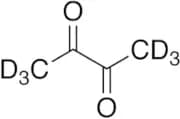
CAS:Controlled ProductApplications Labelled 2,3-Butanedione (B690030). 2,3-Butanedione (Diacetyl), the molecule implicated in the disease known as popcorn lung, has now been implicated in amyloid-β peptide toxicity associated with Alzheimer’s disease. Diacetyl accelerates amyloid-β aggregation-a hallmark of Alzheimer’s disease. These preliminary finding raise the possibility of long-term neurological toxicity mediated by DA.
Not a dangerous good if item is equal to or less than 1g/ml and there is less than 100g/ml in the package
References Wang, J., et al.: Exp. Neurol., 158, 328 (1999); Brown, M., et al.: Cell, 100, 391 (2000); Heinitz, K., et al.: J. Neurochem., 98, 1930 (2006); Brody, D., et al.: Science, 321, 1221 (2008); More, S., et al.: J. Med. Chem., 52, 4650 (2009);Formula:C42H6O2Color and Shape:YellowMolecular weight:92.13N-Hexadecanol-D31
CAS:Controlled ProductApplications N-Hexadecanol (2,2,3,3...16,16,16-D31, 98%) (cas# 203633-15-2) is a useful research chemical.
Formula:C16D31H3OColor and Shape:NeatMolecular weight:273.631,3-Dibromopropane-d6
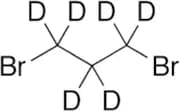
CAS:Controlled ProductApplications Isotope labelled 1,3-Dibromopropane is a substrate specificity of haloalkane dehalogenases.
Not a dangerous good if item is equal to or less than 1g/ml and there is less than 100g/ml in the package
References Koudelakova, T., et al.: Biochem. J., 435, 345 (2011),Formula:C3D6Br2Color and Shape:NeatMolecular weight:207.92Methomyl-d3
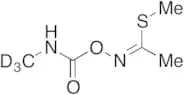
CAS:Controlled ProductApplications Labelled methomyl, a carbamate insecticide. Also used in Cannabis testing.
Not a dangerous good if item is equal to or less than 1g/ml and there is less than 100g/ml in the package
References Armes, N., et al.: Bull. Entomol. Res., 86, 499 (1996); Shono, T., et al.: Pest. Biochem. Physiol., 75, 1 (2003)Formula:C52H3H7N2O2SColor and Shape:ColourlessMolecular weight:165.23Bromoacetic-2-13C Acid
CAS:Controlled ProductApplications Bromoacetic-2-13C Acid is the isotope labelled analog of Bromoacetic Acid (B679075); a relatively strong alkylating agent as well as a versatile building block used very commonly in organic synthesis. Bromoacetic acid has been shown to reversibly inhibit human erythrocyte carbonic anhydrase B.
Not a dangerous good if item is equal to or less than 1g/ml and there is less than 100g/ml in the package
References Song, C. et al.: J. Org. Synth., 74, 8980 (2009); Kramer, S.P. et al.: J. Nat. Cancer Inst., 31, 297 (1963); Whitney, P.L. et al.: Eur. J. Biochem., 16, 126 (1970)Formula:C13CH3BrO2Color and Shape:NeatMolecular weight:139.94S-Methyl-d3-thioacetaminophen
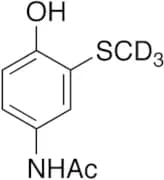
CAS:Controlled ProductApplications S-Methyl-d3-thioacetaminophen is deuterium labeled S-Methyl-3-thioacetaminophen (M330610), a metabolite of Acetaminophen (A161220). Acetaminophen is an analgesic and antipyretic agent used as a pain reliever to treat headache, muscle aches, and arthritis (1,2,3).
References (1) McGill, M. R. and Jaeschke, H. Pharm Res. 30, 2174 (2013)(2) Fairbrother, J.E., et al.: Anal. Profiles Drug Subs., 3, 1 (1974) (3) Hinson, J.A., et al.: Rev. Biochem. Toxicol., 2, 103 (1980)Formula:C92H3H8NO2SColor and Shape:NeatMolecular weight:200.27