Deuterated Compounds
Deuterated compounds are organic molecules in which one or more hydrogen atoms are replaced with deuterium, a stable isotope of hydrogen. These compounds are essential in various scientific fields, including NMR spectroscopy, mass spectrometry, and kinetic isotope studies. Deuterated compounds improve signal clarity and accuracy in analyses by reducing background noise and providing unique insights into reaction mechanisms and molecular structures. At CymitQuimica, you will find a wide range of deuterated compounds specifically designed to support your research in analytical chemistry and molecular studies.
Found 4232 products of "Deuterated Compounds"
Sort by
Purity (%)
0
100
|
0
|
50
|
90
|
95
|
100
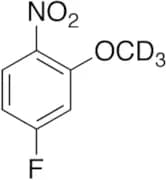
3-Fluoro-6-nitroanisole-d3
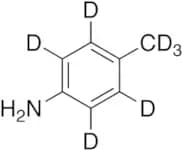
CAS:Controlled Product<p>Applications 3-Fluoro-6-nitroanisole-d3 is a compound useful in organic synthesis.<br></p>Formula:C7D3H3FNO3Color and Shape:NeatMolecular weight:174.1444-Toluidine-d7 (Major)
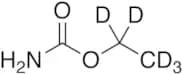
CAS:Controlled Product<p>Applications 4-Toluidine-d7 (Major) (cas# 68693-08-3) is a compound useful in organic synthesis.<br> Not a dangerous good if item is equal to or less than 1g/ml and there is less than 100g/ml in the package<br></p>Formula:C7D7H2NColor and Shape:NeatMolecular weight:114.2Urethane-d5
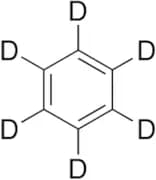
CAS:Controlled Product<p>Applications Isotope labelled Urethane (U82500), which is a naturally occurring contaminant in fermented foods, particularly wine, stone-fruit brandies, and bread. This substance is reasonably anticipated to be a human carcinogen (1) despite being an additive in some alcoholic beverages and foods (2). It binds covalently with DNA however due to its low unavoidable daily intake, it is considered of negligible concern (3).Drinking water contaminant candidate list 3 (CCL 3) compound as per United States Environmental Protection Agency (EPA). Environmental contaminants; Food contaminants.<br>References 1. Mirvish, S. et al.: Adv. Cancer Res. 1968;11:1-42.2. Battaglia R. et al.: Food Addit Contam. 1990 Jul-Aug;7(4):477-96.3. Zimmerli B. et al.: Mutat Res. 1991 Mar-Apr;259(3-4):325-50.<br></p>Formula:C32H5H2NO2Color and Shape:White To Light BrownMolecular weight:94.12Benzene-d6
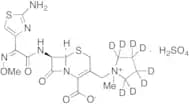
CAS:Controlled Product<p>Applications Isotope labelled benzene, an organic compound that is a natural constituent of crude oil and one of the most basic petrochemicals.<br> Not a dangerous good if item is equal to or less than 1g/ml and there is less than 100g/ml in the package<br>References Feng, Z.X.. et al.: J. Phys. Chem. Lett. 4, 285 (2013); Pilling. M., et al.: Chem. Eng. Prog., 108, 32 (2012);<br></p>Formula:C62H6Color and Shape:ColourlessMolecular weight:84.15Cefepime-D8 Sulfate
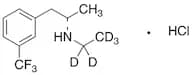
CAS:Controlled Product<p>Applications Cefepime-D8 sulfate is a labelled analogue of Cefepine sulfate, a cephalosporin that has antibacterial effects against Gram-positive and Gram-negative bacteria. Cefepime sulfate is used to treat mild to severe bacterial infections.<br>References Neu, H.: Am. J. Med., 100, 68S (1996); Sanders, C.: Clin. Infect. Dis., 17, 369 (1993); Sanders, W., et al.: Clin. Infect. Dis., 23, 454 (1996); Yahav, D., et al.: Lancet Infect. Dis., 7, 338 (2007)<br></p>Formula:C192H8H16N6O5S2·H2O4SColor and Shape:YellowMolecular weight:586.69rac Fenfluramine-d5 Hydrochloride
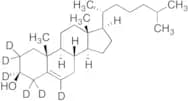
CAS:Controlled Product<p>Applications Labelled Fenfluramine. Anorexic.<br> Not a dangerous good if item is equal to or less than 1g/ml and there is less than 100g/ml in the package<br>References Pinder, et al.: Drugs, 10, 241 (1975), Caccia, S., et al.: Eur. J. Clin. Pharmacol., 29, 221 (1985), Finner, N., et al.: Curr. Ther. Res., 38, 847 (1985),<br></p>Formula:C12D5H11F3N·ClHColor and Shape:NeatMolecular weight:272.75Cholesterol-d6
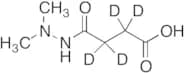
CAS:Controlled Product<p>Stability Hygroscopic<br>Applications Labelled Cholesterol (C432501). Cholesterol is the principal sterol of the higher animals. Cholesterol was found in all body tissues, especial in the brain, spinal cord, and in animal fats or oils. Cholesterol is the main constituent of gallstones.<br>References Rosin, Z., et al.: Physiol. Chem., 124, 282 (1923), Schoenheimer, et al.: J. Biol. Chem., 105, 355 (1934), Gemant, et al.: Life Sci., 1, 233 (1962), Johnson, K., et al.: 4, 457 (1964),<br></p>Formula:C272H6H40OColor and Shape:Off White SolidMolecular weight:392.69Daminozide-d4
CAS:Controlled Product<p>Applications Daminozide-d4 is labelled Daminozide which is a plant growth regulator. Used as a standard for Pesticide detection, and cannabis testing.<br>References Moriya, M., et al.: Mutation Res. Genetic Toxicol. Testing, 116, 185 (1983); Rose, N., et al.: J. Med. Chem., 55, 6639 (2012); Narayanan, V., et al.: Analusis, 21, 107 (1993)<br></p>Formula:C6D4H8N2O3Color and Shape:White To Off-WhiteMolecular weight:164.2N,N-Dimethyldodecylamine-d6
CAS:Controlled Product<p>Applications N,N-Dimethyldodecylamine-d6 is the isotope labelled analog of N,N-Dimethyldodecylamine. N,N-Dimethyldodecylamine is used as a reagent in the synthesis of epoxy quaternary ammonium salt surfactants which exhibit potential antibacterial activity.<br> Not a dangerous good if item is equal to or less than 1g/ml and there is less than 100g/ml in the package<br>References Liu, Y., et al.: J. Disper. Sci. Technol., 35, 1460 (2014)<br></p>Formula:C14D6H25NColor and Shape:Colourless To Off-WhiteMolecular weight:219.44Bis(2,3-dibromopropyl) Phosphate-d10
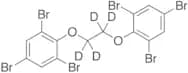
CAS:Controlled Product<p>Applications Bis(2,3-dibromopropyl) Phosphate-d10 is the isotope labelled analog of Bis(2,3-dibromopropyl) Phosphate. Bis(2,3-dibromopropyl) Phosphate is a derivative of Tris(2,3-dibromopropyl) Phosphate, a widely used flame retardant in plastic and textiles.<br>References Elliott, W.C., et al.: Life. Sci., 7, 1107 (1983);<br></p>Formula:C6HD10Br4O4PColor and Shape:NeatMolecular weight:507.81,2-Bis(2,4,6-tribromophenoxy)ethane-d4
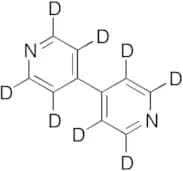
CAS:Controlled Product<p>Applications Labelled 1,2-Bis(2,4,6-tribromophenoxy)ethane (B585425). One of the major "novel" brominated flame retardants (NBFRs) from varous polymer materials. An environmental pollutant.<br>References Zhu, L., et al.: Environ. Sci. Technol., 40, 3711 (2006), Qui, X., et al.: Environ. Sci. Technol., 42, 31 (2008), Stone, R., et al.: Science, 325, 1055 (2009),<br></p>Formula:C14H4D4Br6O2Color and Shape:NeatMolecular weight:691.664,4'-Dipyridyl-d8
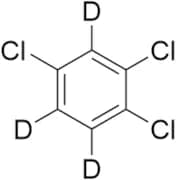
CAS:Controlled Product<p>Stability Hygroscopic<br>Applications 4,4'-Dipyridyl-d8 as a solid-solution approach to control the dynamics of molecular rotors in crystal solids.<br> Not a dangerous good if item is equal to or less than 1g/ml and there is less than 100g/ml in the package<br>References Inukai, M., et al.: J. Amer. Chem. Soc., 137, 12183-12186 (2015)<br></p>Formula:C102H8N2Color and Shape:NeatMolecular weight:164.231,2,4-Trichlorobenzene-d3
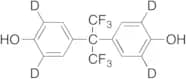
CAS:Controlled Product<p>Applications 1,2,4-Trichlorobenzene-d3 (CAS# 2199-72-6) is a useful isotopically labeled research compound.<br></p>Formula:C62H3Cl3Color and Shape:ColourlessMolecular weight:184.472,2-Bis-(4-hydroxyphenyl)hexafluoropropane-d4
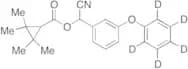
CAS:Controlled Product<p>Applications Bisphenol AF-d4 is the isotope labelled analog of Bisphenol AF (2,2-Bis-(4-hydroxyphenyl)hexafluoropropane). 2,2-Bis-(4-hydroxyphenyl)hexafluoropropane (B447290) acts as an endocrine-disrupting chemical (EDC), activating estrogen through the estrogen receptor ERα. It is a full agonist for the estrogen receptor.<br>References Matsushima, A. et al.: Environ. Health, Perspect. 118, 1267 (2010)<br></p>Formula:C15D4H6F6O2Color and Shape:NeatMolecular weight:340.25Fenpropathrin-d5
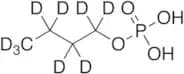
CAS:Controlled Product<p>Applications Fenpropathrin-d5 is labelled Fenpropathrin (F249300), a pesticide.<br> Not a dangerous good if item is equal to or less than 1g/ml and there is less than 100g/ml in the package<br>References Lehotay, S., et al.: J. AOAC International, 88, 595 (2005); Andersen, H., et al.: Toxicol. Appl. Pharmacol., 179, 1 (2002)<br></p>Formula:C22H18D5NO3Color and Shape:NeatMolecular weight:354.45Monobutyl Phosphate-d9
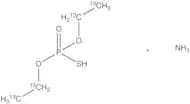
CAS:Controlled Product<p>Applications Labelled Monobutyl Phosphate (M525050). Mono and dibasic phosphate esters are anionic surfactants which have the main feature of the stability in alkaline conditions over other surfactants. They have a wide range of properties including outstanding wetting, emulsification, lubrication, coupling activity and detergency.<br> Not a dangerous good if item is equal to or less than 1g/ml and there is less than 100g/ml in the package<br>References Ramirez, F., et al.: Tetrahedron, 35, 1581 (1979);<br></p>Formula:C4H2D9O4PColor and Shape:NeatMolecular weight:163.16O,O-Diethyl Thiophosphate-13C4 Ammonium Salt
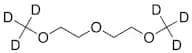
CAS:Controlled Product<p>Stability Hygroscopic<br>Applications Labelled O,O-Diethyl Thiophosphate (D445120). Used in the synthesis of novel phosphorothioates and phosphorodithioates as cholinesterase inhibitor.<br>References Sussman, J., et al.: Science, 253, 872 (1991), Mallender, W., et al.: J. Biol. Chem 1999, 274, 8491,<br></p>Formula:C4H14NO3PSColor and Shape:White To Off-WhiteMolecular weight:191.17Diglyme-d6
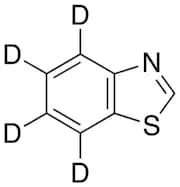
CAS:Controlled Product<p>Applications Labelled Diglyme. Solvent; it is used as reaction medium for Grignard and similar synthesis.<br> Not a dangerous good if item is equal to or less than 1g/ml and there is less than 100g/ml in the package<br></p>Formula:C6H8D6O3Color and Shape:NeatMolecular weight:140.21Benzothiazole-d4
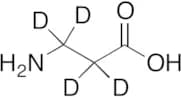
CAS:Controlled Product<p>Applications Labelled Benzothiazole. Various benzothiazole-benzamides synthesized were evaluated for their analgesic and antidepressant activities.<br> Not a dangerous good if item is equal to or less than 1g/ml and there is less than 100g/ml in the package<br>References Porsolt, R., et al.: Nature, 266, 730 (1977), Foster, J., et al.: Bioorg. Med. Chem., 7, 2415 (1999), Caliendo, G., et al.: Eur. J. Med. Chem., 36, 517 (2001), Rana, A., et al.: Eur. J. Med. Chem., 43, 1114 (2008),<br></p>Formula:C7HD4NSColor and Shape:NeatMolecular weight:139.21β-Alanine-2,2,3,3-D4
CAS:Controlled Product<p>Applications Isotope labelled β-Alanine is a naturally occurring beta amino acid. β-Alanine is formed in vivo by the degradation of dihydrouracil (D449990) and carnosine. β-Alanine is also the rate-limiting precursor of carnosine, as a result supplementation with β-alanine increases the concentration of carnosine in muscles.<br></p>Formula:C3D4H3NO2Color and Shape:NeatMolecular weight:93.12