Organic Halides
Subcategories of "Organic Halides"
Found 20442 products of "Organic Halides"
(D-Ala2,N-Me-Phe4,methionin(O)-ol5)-Enkephalin trifluoroacetate salt
CAS:D-Ala2,N-Me-Phe4,methionin(O)-ol5)-Enkephalin trifluoroacetate salt H-Tyr-D-Ala-Gly-N-Me-Phe-methionin(O)-ol trifluoroacetate salt is an analog of the endocannabinoid neurotransmitter, anandamide. It has been shown to be effective in the treatment of autoimmune diseases such as multiple sclerosis and inflammatory bowel disease. D-(3R)-3-[(1S,2R,3R,5R) -3-[2-(2,6 dichlorophenyl)ethenyl] -1H -indole]-1 -butanamine trifluoroacetate salt has been shown to inhibit the replication of a number of viruses including human immunodeficiency virus type 1 (HIV). This drug also inhibits the growth of organisms that are resistant
Formula:C29H41N5O7SPurity:Min. 95%Molecular weight:603.73 g/mol(Cys(Et)2·7)-a-CGRP (human) trifluoroacetate salt
CAS:Please enquire for more information about (Cys(Et)2·7)-a-CGRP (human) trifluoroacetate salt including the price, delivery time and more detailed product information at the technical inquiry form on this page
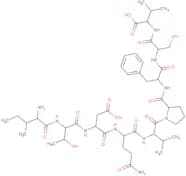
Formula:C167H277N51O49S2Purity:Min. 95%Molecular weight:3,847.43 g/molMelanocyte Protein PMEL 17 (185-193) (human, bovine, mouse) trifluoroacetate salt
CAS:Please enquire for more information about Melanocyte Protein PMEL 17 (185-193) (human, bovine, mouse) trifluoroacetate salt including the price, delivery time and more detailed product information at the technical inquiry form on this pageFormula:C46H72N10O15Purity:Min. 95%Molecular weight:1,005.12 g/molBiotinyl-Obestatin (rat) trifluoroacetate salt
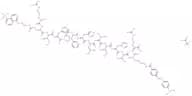
CAS:Please enquire for more information about Biotinyl-Obestatin (rat) trifluoroacetate salt including the price, delivery time and more detailed product information at the technical inquiry form on this pageFormula:C124H188N36O33SPurity:Min. 95%Molecular weight:2,743.11 g/mol5-Chloro-1H-indazole
CAS:5-Chloro-1H-indazole is a molecule that is structurally related to benzodiazepinones and has been shown to have serotoninergic activity. It was one of the first compounds in the benzodiazepinone class to be synthesized, and it was found to have potent cerebral effects in rats with frequencies between 2 and 6 GHz. 5-Chloro-1H-indazole has been synthesized by reacting 2,6-dichlorobenzoic acid with aniline in tetrahydrofuran (THF) solution, followed by reaction with chlorine gas. The synthesis was analysed using proton NMR spectroscopy and anions.Formula:C7H5ClN2Purity:Min. 95%Molecular weight:152.58 g/mol6,8-Dichlorochromone-2-carboxylic acid
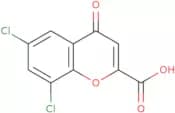
CAS:6,8-Dichlorochromone-2-carboxylic acid is a fine chemical that is used as a building block in the synthesis of complex compounds. It is also a versatile building block that can be used in many reactions, such as nucleophilic substitution, electrophilic addition, and condensation reactions. This compound has CAS number 16722-38-6 and is a reagent for research purposes.Formula:C10H4Cl2O4Purity:Min. 95%Color and Shape:PowderMolecular weight:259.04 g/molBAM-22P (8-22) trifluoroacetate salt
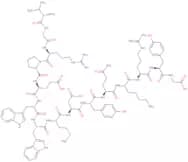
CAS:BAM-22P (8-22) trifluoroacetate salt is a compound that has been shown to be an effective drug for the treatment of pain. It has been shown to have an effect on bone cancer, which can be activated by serotonin. This compound may be beneficial in treating nerve injury and fibrosarcoma cells. BAM-22P (8-22) trifluoroacetate salt is an allosteric modulator of the serotonin receptor and may be used as a treatment for pain in wild-type mice. The molecule is also a serotonin reuptake inhibitor, which prevents the reuptake of serotonin into the presynaptic neuron. This leads to increased levels of serotonin in the synapse and increased pain relief.Formula:C91H127N25O23SPurity:Min. 95%Molecular weight:1,971.2 g/molRenin Substrate 1 trifluoroacetate salt
CAS:Please enquire for more information about Renin Substrate 1 trifluoroacetate salt including the price, delivery time and more detailed product information at the technical inquiry form on this pageFormula:C109H157N31O22S2Purity:Min. 95%Molecular weight:2,317.74 g/molNeuropeptide S (1-10) (human) trifluoroacetate salt
CAS:Please enquire for more information about Neuropeptide S (1-10) (human) trifluoroacetate salt including the price, delivery time and more detailed product information at the technical inquiry form on this pageFormula:C42H68N14O14SPurity:Min. 95%Molecular weight:1,025.14 g/mol3-Bromo-5-chlorobenzaldehyde
CAS:3-Bromo-5-chlorobenzaldehyde is a fine chemical that is used as a building block in the synthesis of other chemicals. It is also a reagent and speciality chemical with high quality and versatility. 3-Bromo-5-chlorobenzaldehyde has been shown to be useful in the preparation of complex compounds, such as heterocyclic aromatic compounds, which are versatile scaffolds for drug discovery. 3-Bromo-5-chlorobenzaldehyde has a CAS No. 188813-05-0.Formula:C7H4BrClOPurity:Min. 95%Color and Shape:PowderMolecular weight:219.46 g/mol(Chlorodifluoromethyl)trimethylsilane
CAS:(Chlorodifluoromethyl)trimethylsilane is a chlorinating agent that is used for the transfer of chlorine to organic compounds. The activated chlorides are converted to aldehydes, which are then reacted with terminal alkynes in the presence of sodium carbonate to produce (chlorodifluoromethyl)trimethylsilanes. This reaction produces an organosilicon compound that has been shown to inhibit certain enzymes, such as lipases and proteases. Chlorodifluoromethyl)trimethylsilane also has bioisosteres, or structural analogs, with other halogens. It can be prepared by irradiation of chlorodichloromethane at room temperature in the presence of a catalyst.Formula:C4H9ClF2SiPurity:Min. 95%Color and Shape:Colorless PowderMolecular weight:158.65 g/molFurin Inhibitor II trifluoroacetate salt
CAS:Furin inhibitor II is a small molecule that inhibits the activity of furin, which is an enzyme used in the processing of growth factor-β1. Furin inhibitor II binds to human receptors and blocks their binding to the surface glycoprotein on cancer cells. Furin inhibitor II also has physiological activities, such as reducing inflammation, inhibiting viral replication, and inhibiting the growth of bacteria. Furin inhibitor II may be useful for treating cancer or infectious diseases.Formula:C36H75N25O6Purity:Min. 95%Molecular weight:954.15 g/molpTH (1-37) (human) trifluoroacetate salt
CAS:Please enquire for more information about pTH (1-37) (human) trifluoroacetate salt including the price, delivery time and more detailed product information at the technical inquiry form on this pageFormula:C195H316N58O54S2Purity:Min. 95%Molecular weight:4,401.09 g/molAc-Ala-Ala-Ser(PO3H2)-Pro-Arg-pNA trifluoroacetate salt
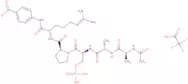
CAS:Please enquire for more information about Ac-Ala-Ala-Ser(PO3H2)-Pro-Arg-pNA trifluoroacetate salt including the price, delivery time and more detailed product information at the technical inquiry form on this pageFormula:C28H43N10O12PPurity:Min. 95%Molecular weight:742.67 g/molBoc-D-Homoarg (Et)2-OH (symmetrical) hydrochloride salt
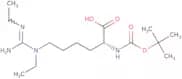
CAS:Please enquire for more information about Boc-D-Homoarg (Et)2-OH (symmetrical) hydrochloride salt including the price, delivery time and more detailed product information at the technical inquiry form on this pageFormula:C16H32N4O4Purity:Min. 95%Molecular weight:344.45 g/mol1,1,2,2-Tetrahydroperfluoro dodecanol
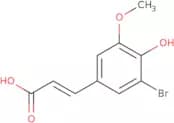
CAS:1,1,2,2-Tetrahydroperfluoro dodecanol (1HFPD) is a chemical substance used in analytical chemistry as an internal standard for gas chromatography. It is also used to prepare samples for analysis by particle-induced X-ray emission. 1HFPD has been shown to have a high uptake in preschool children and can be detected in human serum at levels of 0.5 micrograms per milliliter. The use of 1HFPD has been linked to adverse health effects such as kidney and liver damage.Formula:C12H5F21OPurity:Min. 95%Molecular weight:564.13 g/mol3-(3-Bromo-4-hydroxy-5-methoxyphenyl)acrylic acid
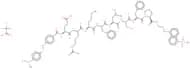
CAS:3-(3-Bromo-4-hydroxy-5-methoxyphenyl)acrylic acid is a polyphenol that can be found in plants and food. It has been shown to have antimicrobial properties against certain bacteria and fungi, such as Staphylococcus aureus, Clostridium perfringens, and Candida albicans. 3-(3-Bromo-4-hydroxy-5-methoxyphenyl)acrylic acid is synthesized by means of the condensation of p-coumaric acid with acrylic acid in the presence of a base catalyst. This compound undergoes biotransformations such as hydroxylation and oxidation to form 3-(3,4′-dihydroxyphenyl)acrylic acid (DHPAA). The compound is also able to react with other phenolic compounds such as cinnamic acid under certain conditions.Formula:C10H9BrO4Purity:Min. 95%Color and Shape:PowderMolecular weight:273.08 g/molDABCYL-Glu-Arg-Nle-Phe-Leu-Ser-Phe-Pro-EDANS trifluoroacetate salt
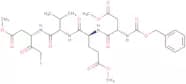
CAS:Please enquire for more information about DABCYL-Glu-Arg-Nle-Phe-Leu-Ser-Phe-Pro-EDANS trifluoroacetate salt including the price, delivery time and more detailed product information at the technical inquiry form on this pageFormula:C76H98N16O15SPurity:Min. 95%Molecular weight:1,507.76 g/molZ-Asp(OMe)-Glu(OMe)-Val-DL-Asp(OMe)-fluoromethylketone
CAS:Z-Asp(OMe)-Glu(OMe)-Val-DL-Asp(OMe)-fluoromethylketone is a small molecule that has been shown to induce apoptosis in cultured cells. It is a caspase-3 inhibitor, which prevents the activation of the caspase cascade and protects cells from oxidative injury. Low doses of Z-Asp(OMe)-Glu(OMe)-Val-DL-Asp(OMe)-fluoromethylketone have been shown to induce apoptosis in cultured cells, with no significant cytotoxicity at high doses. The mechanism of action for this agent is not yet known, but it may promote mitochondrial membrane potential loss and neuronal death by binding to DNA, or induce cell death through a caspase-independent pathway.Formula:C30H41FN4O12Purity:Min. 95%Molecular weight:668.66 g/mol2-Bromo-1-indanol
CAS:2-Bromo-1-indanol is an industrial solvent used in the production of dyes, pigments, perfumes, pharmaceuticals, and other organic compounds. It is a chiral compound with two stereoisomers (R and S) that have different properties. The R isomer has a hydroxyl group on the 2 position of the indane ring, while the S isomer does not. The industrial process involves recycling of 2-bromo-1-indanol from the reaction mixture. This process can be monitored using mass spectrometric detection for bromine and hydrogen ions released during hydrolysis. 2-Bromo-1-indanol can be used to synthesize methoxybenzaldehyde with high regioselectivity, which can then be used to make some drugs such as amphetamine and methamphetamine.Formula:C9H9BrOPurity:Min. 95%Color and Shape:PowderMolecular weight:213.07 g/mol