Biochemicals and Reagents
Subcategories of "Biochemicals and Reagents"
- Biomolecules(98,576 products)
- By Biological Target(100,660 products)
- By Pharmacological Effects(6,934 products)
- Cryopreservatives(21 products)
- Desinfectants and Related Compounds(28 products)
- Hormones(362 products)
- Plant Biology(6,908 products)
- Secondary Metabolites(14,364 products)
Found 130473 products of "Biochemicals and Reagents"
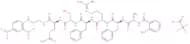
Abz-Ala-Phe-Arg-Phe-Ser-Gln-EDDnp trifluoroacetate salt
CAS:Please enquire for more information about Abz-Ala-Phe-Arg-Phe-Ser-Gln-EDDnp trifluoroacetate salt including the price, delivery time and more detailed product information at the technical inquiry form on this pageFormula:C50H63N15O13Purity:Min. 95%Molecular weight:1,082.13 g/molRef: 3D-FA110993
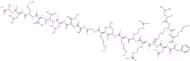
Discontinued product[Cys(Acm)20,31]-EGF (20-31)
Catalogue peptide; min. 95% purity
Formula:C63H98N16O23S3Molecular weight:1,543.77 g/mol[Thr46]-Osteocalcin (45-49) (human)
Catalogue peptide; min. 95% purity
Formula:C25H37N5O7Molecular weight:519.6 g/molCalmodulin-Dependent Protein Kinase II (290-309)
CAS:Calmodulin-dependent protein kinase II (CAMKII) is a calcium/calmodulin-dependent enzyme that plays an important role in the regulation of cardiac contractility. CAMKII is activated by the binding of beta-adrenergic and other hormones to their receptors on the plasma membrane, leading to a change in the membrane potential. CAMKII then phosphorylates myofibrils, which leads to an increase in cardiac contractility. In liver cells, CAMKII activation leads to an increase in contractility and perfusion through increased ethylene production.
Formula:C103H185N31O24SPurity:Min. 95%Molecular weight:2,273.83 g/molRef: 3D-FC110422
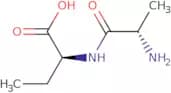
Discontinued productH-Ala-Abu-OH
CAS:Please enquire for more information about H-Ala-Abu-OH including the price, delivery time and more detailed product information at the technical inquiry form on this page
Formula:C7H14N2O3Purity:Min. 90%Color and Shape:PowderMolecular weight:174.2 g/molRef: 3D-FA107958
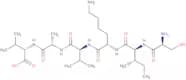
Discontinued productH-Ser-Ile-Lys-Val-Ala-Val-OH
CAS:H-Ser-Ile-Lys-Val-Ala-Val-OH is a peptide that is synthesized from the amino acid sequence of the human skin cells. It has been shown to be effective in inhibiting bacterial growth and inducing death in bacteria. This peptide binds to the bacterial cell wall and inhibits its growth. The polymer film can be used for the delivery of H-Ser-Ile-Lys-Val-Ala-Val-OH in the form of lamellar, galacturonic acid, collagen, or lipid nanoparticles. The lamellar phase can be prepared by using water as solvent and lipids as surfactant. The lipid nanoparticle formulation consists of a core material (e.g., cholesterol) surrounded by a lipid bilayer composed of phospholipids or glycolipids with H Ser Ile Lys Val Ala Val OH incorporated into it. This peptide has also been shown to have skin care properties when
Formula:C28H53N7O8Purity:Min. 95%Molecular weight:615.76 g/molRef: 3D-FS108741
Discontinued productAngiotensinogen (1-13)
Catalogue peptide; min. 95% purity
Formula:C79H116N22O17Molecular weight:1,645.9 g/molNeurotrophic Factor for Retinal Cholinergic Neurons
Catalogue peptide; min. 95% purity
Formula:C53H84N12O16Molecular weight:1,145.33 g/molNES Topoisomerase II alpha (1017-1028)
Catalogue peptide; min. 95% purity
Formula:C73H117N19O19Molecular weight:1,564.86 g/molH-9 hydrochloride
CAS:H-9 hydrochloride is a selective protein kinase inhibitor, which is synthetically derived. It primarily inhibits cyclic nucleotide-dependent protein kinases, including protein kinase A (PKA) and protein kinase G (PKG), along with myosin light chain kinase (MLCK). The mode of action involves competitive inhibition at the ATP binding site of these kinases, thereby impacting phosphorylation pathways crucial for multiple physiological functions. The selective inhibition by H-9 hydrochloride allows for detailed exploration of kinase-mediated signaling pathways in cellular biology. Moreover, it is extensively utilized in studies involving cell motility, smooth muscle contraction, and signal transduction. The relevance of H-9 hydrochloride in academic research lies in its ability to provide insights into kinase activity modulation and its ensuing effects on cellular dynamics. This compound serves as an invaluable tool for scientists aiming to elucidate the complex role of protein kinases in health and disease, enabling the development of innovative therapeutic strategies.
Formula:C11H14ClN3O2SPurity:Min. 95%Color and Shape:White To Off-White SolidMolecular weight:287.77 g/mol[Asn76] PTH (64-84), human
Catalogue peptide; min. 95% purity
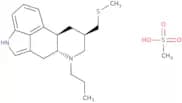
Formula:C94H163N27O35Molecular weight:2,231.51 g/molPergolide mesylate
CAS:Controlled ProductD1 and D2 dopamine agonist
Formula:C20H30N2O3S2Purity:Min. 95%Color and Shape:White To Off-White SolidMolecular weight:410.6 g/molCalcitonin N-Terminal Flanking Peptide, human
Catalogue peptide; min. 95% purity
Formula:C264H426N74O97SMolecular weight:6,220.84 g/molAc-a-CGRP (19-37) (human)
Catalogue peptide; min. 95% purity
Formula:C88H139N25O26Molecular weight:1,963.24 g/molL-α-Phosphatidylserine sodium, porcine brain
CAS:L-alpha-Phosphatidylserine sodium salt, derived from porcine brain, is a research chemical that has shown promising potential in various fields. It has been studied for its role in HIV-1 infection, where it has been found to inhibit the fusion of the virus with host cells. Additionally, L-alpha-Phosphatidylserine sodium salt has shown positive effects on spermatozoa motility and fertility. In cancer research, L-alpha-Phosphatidylserine sodium salt has been investigated for its ability to enhance the efficacy of certain anti-cancer drugs. It is believed to work by increasing the uptake of these drugs into cancer cells, thereby improving their effectiveness. This compound also plays a role in neurological health. It is involved in the synthesis of steroidal hormones and neurotransmitters such as dopamine. Studies have suggested that L-alpha-Phosphatidylserine sodium salt may support cognitive function and memory. Furthermore, L-alpha-Ph
Purity:Min. 95%C-Reactive Protein (CRP) (77-82)
Catalogue peptide; min. 95% purity
Formula:C23H40N6O10Molecular weight:560.61 g/molgp100 (178-187)
Catalogue peptide; min. 95% purity
Formula:C42H71N11O14S2Molecular weight:1,018.23 g/molGrowth Hormone Releasing Factor, GRF (1-40), amide, human
Catalogue peptide; min. 95% purity
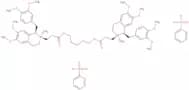
Formula:C194H318N62O62SMolecular weight:4,543.14 g/molCisatracurium besylate
CAS:nAChRs nicotinic receptor antagonist; neuromuscular-blocking agent
Formula:C65H82N2O18S2Purity:Min. 95%Color and Shape:White PowderMolecular weight:1,243.48 g/molRef: 3D-FC20458
Discontinued product

![[Cys(Acm)20,31]-EGF (20-31)](/_next/image/?url=https%3A%2Fstatic.cymitquimica.com%2Fproducts%2F3D%2Fthumb-webp%2FVAC-00265.webp&w=3840&q=75)
![[Thr46]-Osteocalcin (45-49) (human)](/_next/image/?url=https%3A%2Fstatic.cymitquimica.com%2Fproducts%2F3D%2Fthumb-webp%2FVAC-00401.webp&w=3840&q=75)



![[Asn76] PTH (64-84), human](/_next/image/?url=https%3A%2Fstatic.cymitquimica.com%2Fproducts%2F3D%2Fthumb-webp%2FVAC-00372.webp&w=3840&q=75)