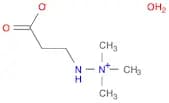
Hydrazines
Found 1359 products of "Hydrazines"
1-Boc-1-methylhydrazine
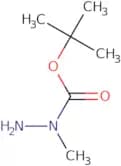
CAS:1-Boc-1-methylhydrazine is a molecule that is used as a chemical intermediate for pharmaceuticals. It has been shown to inhibit the proteasome pathway by targeting the ubiquitin-proteasome system, which is involved in protein degradation and cell growth regulation. 1-Boc-1-methylhydrazine has synergistic effects when combined with other inhibitors of the ubiquitin proteasome system, such as anamorelin. It was found to be effective at inhibiting the growth of k562 cells but not normal cells, suggesting that it may have therapeutic applications for inflammatory bowel disease.Formula:C6H14N2O2Purity:Min. 95%Molecular weight:146.19 g/mol4-Isopropylphenylhydrazine hydrochloride
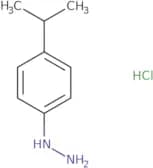
CAS:4-Isopropylphenylhydrazine, hydrochloride (IPH) is a chemical compound that has been shown to induce rearrangements in the indolenines. IPH can also be used as a nucleophile. IPH is regioselective and stereoselective for the indole ring system. It has shown to react with nucleophiles such as alcohols, amines, and thiols.Formula:C9H14N2•HClPurity:Min. 95%Color and Shape:PowderMolecular weight:186.68 g/mol3-Trifluoromethyl phenylhydrazine hydrochloride
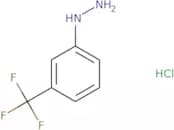
CAS:3-Trifluoromethyl phenylhydrazine HCl is a fine chemical that can be used as a versatile building block in the synthesis of complex compounds. It has been shown to be a useful intermediate for the preparation of research chemicals, reaction components and speciality chemicals. 3-Trifluoromethyl phenylhydrazine HCl belongs to CAS No. 3107-33-3 and can be used as a reagent in organic synthesis. The compound is high quality with a purity of over 99%.Formula:C7H8ClF3N2Purity:Min. 95%Color and Shape:PowderMolecular weight:212.6 g/mol3-Fluorophenylhydrazine hydrochloride
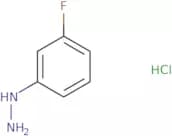
CAS:3-Fluorophenylhydrazine HCl is a high quality, versatile building block that is useful for the synthesis of complex compounds. It can be used as a reactant or reagent in research and development projects. 3-Fluorophenylhydrazine HCl is also an important intermediate for the synthesis of fine chemicals and speciality chemicals, such as pharmaceuticals and pesticides. This chemical can be used as a building block to create various products, including pharmaceuticals, pesticides, and dyes. 3-Fluorophenylhydrazine HCl has been shown to react with anilines to produce tertiary amines.Formula:C6H8ClFN2Purity:Min. 95%Color and Shape:PowderMolecular weight:162.59 g/molHydrazine acetate
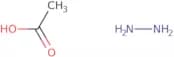
CAS:Controlled ProductHydrazine acetate is an organic solution that has a glycoconjugate. It is also found in uridine, hydrogen bond and serine protease. Hydrazine acetate has been shown to have a benzyl group and carbonyl group. Hydrazine acetate interacts with trifluoroacetic acid and particle. This drug can be used for the treatment of autoimmune diseases, such as rheumatoid arthritis, and infectious diseases such as HIV/AIDS. Hydrazine acetate has shown high values for growth factor activity, which may be due to its ability to inhibit the enzyme ns3 protease in the synthesis of proinflammatory cytokines.Formula:C2H4O2·H4N2Purity:Min. 95%Color and Shape:White PowderMolecular weight:92.1 g/mol2-Hydrazinobenzoic acid hydrochloride - technical grade
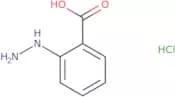
CAS:2-Hydrazinobenzoic acid hydrochloride is a synthetic compound that can be used as a ligand or substrate for the polymerase. It has been shown to interact with the NS5B polymerase, which is involved in viral replication and drug resistance. 2-Hydrazinobenzoic acid hydrochloride also produces reduction products and luminescence when combined with chloride. The luminescence is thought to be due to an interaction with the nucleophilic carbonyl group of 2-hydrazinobenzoic acid hydrochloride and a nucleophilic attack on the carbonyl oxygen atom by chloride ions. This reaction produces blue light at around 470 nm.Formula:C7H8N2O2·xHClPurity:(%) Min. 60%Color and Shape:PowderMolecular weight:188.61 g/mol5-Fluoro-2-hydrazinopyridine
CAS:Please enquire for more information about 5-Fluoro-2-hydrazinopyridine including the price, delivery time and more detailed product information at the technical inquiry form on this pageFormula:C5H6FN3Purity:Min. 95%Molecular weight:127.12 g/mol1,2-Diacetylhydrazine
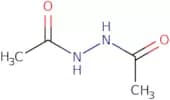
CAS:1,2-Diacetylhydrazine (DAH) is a chemical used as an herbicide. It inhibits the enzyme hydrazine acetyltransferase in plants, which is required for the biosynthesis of nicotinic acid and nicotinamide adenine dinucleotide. DAH also inhibits the liver enzyme fatty acid synthase, which is responsible for synthesizing fatty acids from acetyl-CoA and malonyl-CoA. This inhibition leads to an accumulation of hydrogen bond, protocatechuic acid, and hydrochloric acid in plasma samples. The structural analysis of DAH has been done by NMR spectroscopy and X-ray crystallography. It has been found that DAH contains a hydroxyl group at position C1’ and three nitrogen atoms at positions C3’, C4’, and C5’. DAH can also produce drug interactions with isoniazid by inhibiting its metabolismFormula:C4H8N2O2Molecular weight:116.12 g/molBenzenesulfonamide,3-hydrazino-
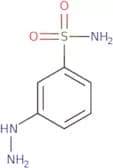
CAS:Please enquire for more information about Benzenesulfonamide,3-hydrazino- including the price, delivery time and more detailed product information at the technical inquiry form on this page
Formula:C6H9N3O2SPurity:Min. 95%Molecular weight:187.22 g/mol2-Fluoroacetaldehyde 2,4-Dinitrophenylhydrazone
CAS:Formula:C8H7FN4O4Color and Shape:Off-White SolidMolecular weight:242.17Ref: 4Z-P-10303
Discontinued productRef: 4Z-H-055001
Discontinued productRef: 4Z-H-055015
Discontinued productRef: 4Z-P-10312
Discontinued productRef: 4Z-H-055002
Discontinued productRef: 4Z-P-10309
Discontinued productRef: 4Z-H-055011
Discontinued productRef: 4Z-P-10304
Discontinued productRef: 4Z-H-055010
Discontinued productHydrazine monohydrate
CAS:Controlled ProductHydrazine monohydrate is a hydrazine compound that is used in the oxidation of aromatic compounds. Hydrazine monohydrate is composed of a hydrazine skeleton and one hydroxyl group. It can be prepared by reacting hydrochloric acid with ammonium hydroxide, followed by crystallization of the product. Hydrazine monohydrate has been shown to inhibit brain infarction in an animal model, as well as infectious diseases such as tuberculosis and leprosy, due to its ability to inhibit bacterial growth. This compound also has an analytical method, which involves x-ray diffraction data for nitrogen atoms and flow system for x-ray crystal structures.
Formula:H4N2·H2OPurity:Min. 95%Color and Shape:PowderMolecular weight:50.06 g/mol