Synthetic Organic Chemistry
Synthetic organic chemistry is a branch of chemistry focused on the design and construction of organic molecules through controlled chemical reactions. This field plays a crucial role in the development of pharmaceuticals, agrochemicals, polymers, and advanced materials. At CymitQuimica, we offer a comprehensive range of high-purity reagents, catalysts, and building blocks essential for synthetic organic chemistry. Our catalog includes a variety of functionalized compounds, protecting groups, chiral auxiliaries, and coupling reagents, all meticulously tested for quality and consistency. By providing top-quality materials, we support researchers and industry professionals in achieving precise and efficient synthetic transformations, facilitating the discovery and development of innovative chemical entities and complex organic structures. Our products enable advancements in medicinal chemistry, material science, and chemical biology, driving progress in both research and industrial applications.
Subcategories of "Synthetic Organic Chemistry"
- Acids and Synthetic Reagents(14,988 products)
- Building Blocks(248,191 products)
- C-C Bond Forming Reactions(885 products)
- Protecting Groups(2,696 products)
- Reagents for Functional Group Introduction/Modification(1,021 products)
Found 207 products of "Synthetic Organic Chemistry"
Sort by
Purity (%)
0
100
|
0
|
50
|
90
|
95
|
100
Potassium dicyanoaurate(I); 99.95% (metals basis)
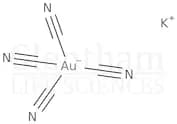
CAS:Formula:KAu(CN)2Purity:≥ 99.95% (trace metals basis)Color and Shape:White crystalline powder or crystalsMolecular weight:288.10Potassium tetracyanoaurate(III); 99.95% (metals basis)
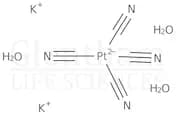
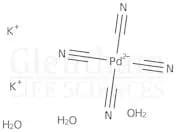
CAS:Formula:KAu(CN)4Color and Shape:White crystalline powderMolecular weight:340.14Potassium tetracyanopalladate(II) hydrate, 99.95% (metals basis)
CAS:Formula:K2Pd(CN)4·xH2OMolecular weight:288.72Potassium dicyanoaurate(I)
CAS:Formula:C2AuKN2Purity:≥ 99.9%Color and Shape:White crystalline powder or crystalsMolecular weight:288.1Trihexyl(tetradecyl)phosphonium chloride, min. 95% CYPHOS IL 101
CAS:<p>Trihexyl(tetradecyl)phosphonium chloride, min. 93% CYPHOS® IL 101</p>Formula:(C6H13)3(C14H29)PClPurity:min. 95%Color and Shape:colorless liq.Molecular weight:519.31Bis(2-cyanoethyl)-N,N-diisopropyl Phosphoramidite
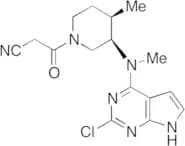
CAS:Controlled Product<p>Applications A useful phosphorylating reagent.<br> Not a dangerous good if item is equal to or less than 1g/ml and there is less than 100g/ml in the package<br></p>Formula:C12H22N3O2PColor and Shape:NeatMolecular weight:271.30N-Methyl-N-(3R,4R)-1-cyanoacetyl-4-methylpiperidin-3-yl-2-chloro-7-deazapurine-6-amine
CAS:Controlled Product<p>Applications N-Methyl-N-(3R,4R)-1-cyanoacetyl-4-methylpiperidin-3-yl-2-chloro-7-deazapurine-6-amine is a Tasocitinib (Tofacitinib [T528000]) impurity.<br></p>Formula:C16H19ClN6OColor and Shape:NeatMolecular weight:346.8152-Amino-4-cyano-5-imidazolecarboxamide
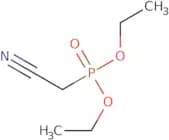
CAS:<p>Applications 2-Amino-4-cyano-5-imidazolecarboxamide (cas# 125815-68-1) is a compound useful in organic synthesis.<br></p>Formula:C5H5N5OColor and Shape:NeatMolecular weight:151.13Diethylcyanomethylphosphonate
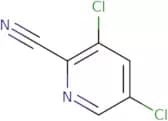
CAS:<p>Diethylcyanomethylphosphonate is a hydrochloric acid salt of diethylcyanomethylphosphonic acid. It is used in the asymmetric synthesis of many organic molecules, including pharmaceuticals, and has been shown to have antiviral properties. Diethylcyanomethylphosphonate binds to the receptor on the surface of cells and inhibits their growth. This may be due to its ability to block the binding of sodium ions to cell receptors. The drug also prevents hydroxyl group metabolism and has been shown to be active against infectious diseases such as HIV and malaria.</p>Formula:C6H12NO3PPurity:Min. 95%Color and Shape:Colorless Clear LiquidMolecular weight:177.14 g/mol3,5-Dichloro-2-cyanopyridine
CAS:<p>3,5-Dichloro-2-cyanopyridine is an organic compound that can be synthesized in a scalable manner. It is used to make pharmaceuticals and agrochemicals and it also has potential applications in pollution control. 3,5-Dichloro-2-cyanopyridine can be made by the reaction of cuprous cyanide with chlorocarbonyl compounds in organic solvents. This synthesis yields a product with high purity which can then be purified using chromatography. The synthesis is scalable and does not produce any side products or waste because the reactants are inexpensive, commercially available, and the product is stable under most conditions.</p>Formula:C6H2N2Cl2Purity:Min. 95%Color and Shape:White PowderMolecular weight:173 g/mol5-Amino-3-cyano-4-iodo-1-[2,6-dichloro-4-(trifluoromethyl)phenyl]pyrazole
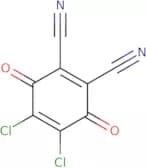
CAS:<p>Please enquire for more information about 5-Amino-3-cyano-4-iodo-1-[2,6-dichloro-4-(trifluoromethyl)phenyl]pyrazole including the price, delivery time and more detailed product information at the technical inquiry form on this page</p>Formula:C11H4Cl2F3IN4Purity:Min. 95%Molecular weight:446.98 g/mol2,3-Dichloro-5,6-dicyanobenzoquinone
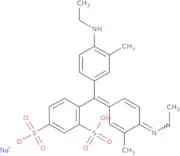
CAS:<p>2,3-Dichloro-5,6-dicyanobenzoquinone is a chemical compound with the molecular formula C12H4Cl2O2. It is used as a chemical intermediate in the production of dyes and pesticides. 2,3-Dichloro-5,6-dicyanobenzoquinone has been shown to have cytotoxic properties against lung fibroblasts in a model system that mimics the human body's reaction to this compound. The mechanism of action is thought to involve the formation of reactive oxygen species that leads to DNA damage. 2,3-Dichloro-5,6-dicyanobenzoquinone also has antiestrogenic activity and has been shown to be active against MDA-MB-231 breast cancer cells. The activation energies for these reactions are 7.8 kcal/mol for carbonyl group elimination and 8.1 kcal/mol for hyd</p>Formula:C8Cl2N2O2Color and Shape:Yellow PowderMolecular weight:227 g/molXylene cyanol FF
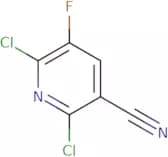
CAS:<p>Xylene cyanol FF is a monoclonal antibody that specifically binds to the human and simian virus 40 (SV40) large T-antigen, which is a protein encoded by the SV40 genome. It is used in the diagnosis of HIV infection. The interaction between Xylene cyanol FF and SV40 large T-antigen activates caspase-3, leading to apoptosis. This binding also leads to cell lysis and DNA intercalation.</p>Formula:C25H27N2NaO6S2Purity:Min. 95%Color and Shape:PowderMolecular weight:538.61 g/mol2,6-Dichloro-3-cyano-5-fluoropyridine
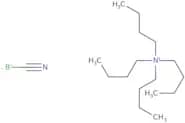
CAS:<p>2,6-Dichloro-3-cyano-5-fluoropyridine is an inorganic compound that is a salt. It has the chemical formula CHClFNO and a molecular weight of 215.4 g/mol. The compound is soluble in water and ethanol, but insoluble in ether. It has a melting point of about -60 degrees Celsius. The compound can react with amines to form 2,6-dichloro-3-(2H)-pyridinone, which can be converted into other compounds via chlorinating or hydrolyzing the imidazole ring. This compound reacts with ethyl bromoacetate to form a monosodium salt at temperatures between 0 and 60 degrees Celsius. 2,6-Dichloro-3-cyano-5-fluoropyridine also reacts with chlorine to produce dichlorofluoropyridine, which can be oxidized by nitric</p>Formula:C6HCl2FN2Purity:Min. 98 Area-%Color and Shape:PowderMolecular weight:190.99 g/molTetrabutylammoniumcyanoborohydride
CAS:<p>Tetrabutylammoniumcyanoborohydride (TBAB) is a reducing agent that is used in the synthesis of halides and oligosaccharides. It can be used to reduce carboxylic acids, such as sodium formate, to aldehydes or ketones. TBAB reacts with an alkoxy radical to produce trifluoroacetic acid, which can be converted back into TBAB by adding sodium formate. Tetrabutylammoniumcyanoborohydride has been shown to have chemoselective effects on cancer cells and control experiments have shown that it does not affect healthy cells.</p>Formula:C17H39BN2Purity:Min. 95%Color and Shape:PowderMolecular weight:282.32 g/mol9-(2-Carboxy-2-cyanovinyl)julolidine
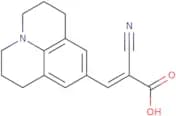
CAS:<p>9-(2-Carboxy-2-cyanovinyl)julolidine is a monoclonal antibody that recognizes the human protein CD38, which plays an important role in the activation of T cells and natural killer cells. This antibody can be used as a marker for these cells. 9-(2-Carboxy-2-cyanovinyl)julolidine has been shown to bind to human serum albumin (HSA) in a manner similar to other antibodies that are specific for HSA. It is also able to bind to mouse monoclonal antibodies, but with lower affinity than the mouse monoclonal antibody itself. 9-(2-Carboxy-2-cyanovinyl)julolidine has been used as a model system for hydrogen bonds and membrane interactions with coumarin derivatives in solid dispersions. The activation energies of emissions from these molecules have been determined using this system.</p>Formula:C16H16N2O2Purity:Min. 95%Color and Shape:PowderMolecular weight:268.31 g/mol






![5-Amino-3-cyano-4-iodo-1-[2,6-dichloro-4-(trifluoromethyl)phenyl]pyrazole](/_next/image/?url=https%3A%2Fstatic.cymitquimica.com%2Fproducts%2F3D%2Fthumb-webp%2FFA99521.webp&w=3840&q=75)