Building Blocks
This section contains fundamental products for the synthesis of organic and biological compounds. Building blocks are the essential starting materials used to construct complex molecules through various chemical reactions. They play a critical role in drug discovery, material science, and chemical research. At CymitQuimica, we offer a diverse range of high-quality building blocks to support your innovative research and industrial projects, ensuring you have the essential components for successful synthesis.
Subcategories of "Building Blocks"
- Boronic Acids & Boronic Acid Derivatives(5,778 products)
- Chiral Building Blocks(1,242 products)
- Hydrocarbon Building Blocks(6,098 products)
- Organic Building Blocks(61,059 products)
Found 199580 products of "Building Blocks"
Sort by
Purity (%)
0
100
|
0
|
50
|
90
|
95
|
100
tert-Butyl N-{8-azabicyclo[3.2.1]octan-3-yl}-N-methylcarbamate hydrochloride
CAS:<p>Versatile small molecule scaffold</p>Formula:C13H25ClN2O2Purity:Min. 95%Molecular weight:276.8 g/molRef: 3D-ZLD00175
Discontinued product8-[(tert-Butoxy)carbonyl]-2-oxa-8-azaspiro[4.5]decane-6-carboxylic acid
CAS:<p>Versatile small molecule scaffold</p>Formula:C14H23NO5Purity:Min. 95%Molecular weight:285.3 g/molRef: 3D-ZLD00165
Discontinued producttert-Butyl 4-[(1,3-thiazol-2-yl)amino]piperidine-1-carboxylate
CAS:<p>Versatile small molecule scaffold</p>Formula:C13H21N3O2SPurity:Min. 95%Molecular weight:283.39 g/molRef: 3D-ZIB54665
Discontinued productImidazo[1,2-c]pyrimidin-5(1H)-one
CAS:<p>Imidazo[1,2-c]pyrimidin-5(1H)-one is a compound that exhibits various characteristics and functions. It acts as a glycosylase, which is an enzyme involved in DNA repair processes. Additionally, it interacts with melatonin receptors and racemase enzymes. Imidazo[1,2-c]pyrimidin-5(1H)-one has been found to have reactive properties towards diclofenac and amino groups. It can also form complexes with zeolite and glycosylases.</p>Formula:C6H5N3OPurity:Min. 95%Molecular weight:135.1 g/molRef: 3D-ZIB03592
Discontinued product1-Boc-6-amino-1-azaspiro[3.3]heptane
CAS:<p>Versatile small molecule scaffold</p>Formula:C11H20N2O2Purity:Min. 95%Molecular weight:212.29 g/molRef: 3D-ZEC65919
Discontinued product2-[({12-Oxo-7-thia-9,11-diazatricyclo[6.4.0.0,2,6]dodeca-1(8),2(6),9-trien-10-yl}methyl)sulfanyl]acetic acid
CAS:<p>Versatile small molecule scaffold</p>Formula:C12H12N2O3S2Purity:Min. 95%Molecular weight:296.4 g/molRef: 3D-ZEB92070
Discontinued product2-[2-(2-Methylphenyl)-2-oxoethylidene]-1,3-thiazolidin-4-one
CAS:<p>Versatile small molecule scaffold</p>Formula:C12H11NO2SPurity:Min. 95%Molecular weight:233.29 g/molN-tert-Butyl 4-nitrophenylsulfonamide
CAS:<p>N-tert-Butyl 4-nitrophenylsulfonamide is a versatile compound with various applications. It can be used as a research chemical in scientific studies or as an ingredient in the synthesis of other compounds. This compound has been found to exhibit antinociceptive properties, making it potentially useful in pain management. Additionally, N-tert-Butyl 4-nitrophenylsulfonamide can act as an electrode material and has been studied for its electrochemical properties. It reacts with certain chemicals such as dioscin, 5-hydroxymethylfurfural (5-HMF), and nicl2, forming new compounds with unique characteristics. Its carbonyl group allows for the formation of N-substituted carbamic acid derivatives, which have shown potential in various fields such as medicinal chemistry and materials science. With its wide range of applications and diverse reactivity, N-tert-Butyl 4-nit</p>Formula:C10H14N2O4SPurity:Min. 95%Molecular weight:258.3 g/molRef: 3D-ZBA69009
Discontinued product4-(4-Acetylphenoxy)benzoic acid
CAS:<p>Versatile small molecule scaffold</p>Formula:C15H12O4Purity:Min. 95%Molecular weight:256.25 g/molRef: 3D-ZAC13582
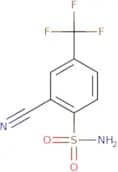
Discontinued product2-Cyano-4-(trifluoromethyl)benzene-1-sulfonamide
CAS:<p>Versatile small molecule scaffold</p>Formula:C8H5F3N2O2SPurity:Min. 95%Molecular weight:250.2 g/molRef: 3D-YZB02454
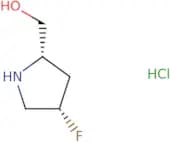
Discontinued product2S,4S)-4-Fluoropyrrolidin-2-Yl)Methanol Hydrochloride
CAS:<p>Versatile small molecule scaffold</p>Formula:C5H11ClFNOPurity:Min. 95%Molecular weight:155.6 g/molRef: 3D-YZA58308
Discontinued product5,6-Dihydro-4H-pyrrolo[1,2-b]pyrazole-2-carbaldehyde
CAS:<p>Versatile small molecule scaffold</p>Formula:C7H8N2OPurity:Min. 95%Molecular weight:136.15 g/molRef: 3D-YZA56446
Discontinued product2-[3-(4-Methylphenyl)propanamido]acetic acid
CAS:<p>Versatile small molecule scaffold</p>Formula:C12H15NO3Purity:Min. 95%Molecular weight:221.25 g/mol1-[(5-Methyl-1,3,4-thiadiazol-2-yl)methyl]piperazine dihydrochloride
CAS:<p>Versatile small molecule scaffold</p>Formula:C8H16Cl2N4SPurity:Min. 95%Molecular weight:271.2 g/molRef: 3D-APD14702
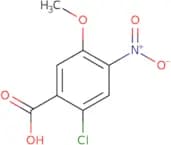
Discontinued product2-Chloro-5-methoxy-4-nitrobenzoic acid
CAS:<p>Versatile small molecule scaffold</p>Formula:C8H6ClNO5Purity:Min. 95%Molecular weight:231.59 g/mol1-tert-Butyl 2,5-dimethyl 1H-pyrrole-1,2,5-tricarboxylate
CAS:<p>Versatile small molecule scaffold</p>Formula:C13H17NO6Purity:Min. 95%Molecular weight:283.3 g/mol(4R)-6,8-Dimethyl-3,4-dihydro-2H-1-benzopyran-4-amine hydrochloride
CAS:<p>Versatile small molecule scaffold</p>Formula:C11H16ClNOPurity:Min. 95%Molecular weight:213.7 g/molRef: 3D-YLD63770
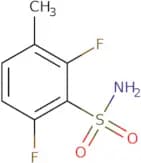
Discontinued product2,6-Difluoro-3-methylbenzene-1-sulfonamide
CAS:<p>Versatile small molecule scaffold</p>Formula:C7H7F2NO2SPurity:Min. 95%Molecular weight:207.2 g/molRef: 3D-YLC89794
Discontinued product1-Methyl-2,6-dioxa-9-azaspiro[4.5]decane
CAS:<p>Versatile small molecule scaffold</p>Formula:C8H15NO2Purity:Min. 95%Molecular weight:157.21 g/molRef: 3D-YLC23915
Discontinued productMethyl 3-[(3-bromophenyl)methoxy]propanoate
CAS:<p>Versatile small molecule scaffold</p>Formula:C11H13BrO3Purity:Min. 95%Molecular weight:273.12 g/molRef: 3D-YLC23139
Discontinued product5-(Furan-2-amido)-3-methylthiophene-2-carboxylic acid
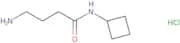
CAS:<p>Versatile small molecule scaffold</p>Formula:C11H9NO4SPurity:Min. 95%Molecular weight:251.26 g/mol4-Amino-N-cyclobutylbutanamide hydrochloride
CAS:<p>Versatile small molecule scaffold</p>Formula:C8H17ClN2OPurity:Min. 95%Molecular weight:192.7 g/molRef: 3D-APD14684
Discontinued product2-Chloro-1-[4-(3-chloro-4-fluorobenzenesulfonyl)piperazin-1-yl]ethan-1-one
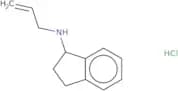
CAS:<p>Versatile small molecule scaffold</p>Formula:C12H13Cl2FN2O3SPurity:Min. 95%Molecular weight:355.2 g/molN-(Prop-2-en-1-yl)-2,3-dihydro-1H-inden-1-amine hydrochloride
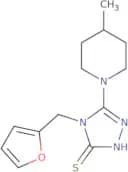
CAS:<p>Versatile small molecule scaffold</p>Formula:C12H16ClNPurity:Min. 95%Molecular weight:209.7 g/mol4-(Furan-2-ylmethyl)-5-(4-methylpiperidin-1-yl)-4H-1,2,4-triazole-3-thiol
CAS:<p>Versatile small molecule scaffold</p>Formula:C13H18N4OSPurity:Min. 95%Molecular weight:278.38 g/molRef: 3D-YLB74898
Discontinued product2-(1-Chloroethyl)-5,6-dimethylthieno[2,3-d]pyrimidin-4-amine
CAS:<p>Versatile small molecule scaffold</p>Formula:C10H12ClN3SPurity:Min. 95%Molecular weight:241.74 g/mol3-(2-Chloroacetamido)-N-cyclopropylbenzamide
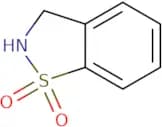
CAS:<p>Versatile small molecule scaffold</p>Formula:C12H13ClN2O2Purity:Min. 95%Molecular weight:252.69 g/mol2,3-dihydro-1lambda6,2-benzothiazole-1,1-dione
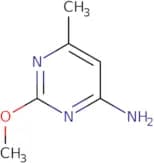
CAS:<p>2,3-Dihydro-1lambda6,2-benzothiazole-1,1-dione is a plant growth regulator that is used in horticultural applications. It is an anion that can be used as an additive to prevent corrosion and rusting of metals. 2,3-Dihydro-1lambda6,2-benzothiazole-1,1-dione reacts with chloride ions to form the corresponding chromatographic product. This compound also forms reaction products with other compounds such as pyrrole, amide and carbonyl group.</p>Formula:C7H7NO2SPurity:Min. 95%Molecular weight:169.2 g/mol2-Methoxy-6-methylpyrimidine-4-yl-amine
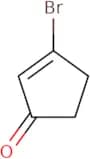
CAS:<p>Versatile small molecule scaffold</p>Formula:C6H9N3OPurity:Min. 95%Molecular weight:139.15 g/mol3-Bromocyclopent-2-en-1-one
CAS:<p>3-Bromocyclopent-2-en-1-one is an organic compound that belongs to the group of cycloalkenones. It is a methyl ester with a cyclopentane backbone and a ketone group at the end of the molecule. 3-Bromocyclopent-2-en-1-one is synthesized by a cross-coupling reaction between zinc chloride and 3,4,5,6,7,8,9,10,11 bromodecane. The product can be isolated in crystalline form as well as in yields up to 90%. The product has been shown to act as an analog for prostaglandin E2.</p>Formula:C5H5BrOPurity:Min. 95%Molecular weight:161 g/mol4-{3-[({[(9H-Fluoren-9-yl)methoxy]carbonyl}amino)methyl]phenyl}benzoic acid
CAS:<p>Versatile small molecule scaffold</p>Formula:C29H23NO4Purity:Min. 95%Molecular weight:449.5 g/molRef: 3D-YGA91123
Discontinued product4-Chloro-3-methyl-[1,2]oxazolo[5,4-d]pyrimidine
CAS:<p>Versatile small molecule scaffold</p>Formula:C6H4ClN3OPurity:Min. 95%Molecular weight:169.57 g/molRef: 3D-BCA85060
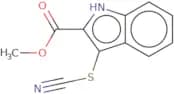
Discontinued productMethyl 3-(cyanosulfanyl)-1H-indole-2-carboxylate
CAS:<p>Versatile small molecule scaffold</p>Formula:C11H8N2O2SPurity:Min. 95%Molecular weight:232.3 g/molRef: 3D-APD14637
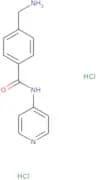
Discontinued product4-(Aminomethyl)-N-(pyridin-4-yl)benzamide dihydrochloride
CAS:<p>Versatile small molecule scaffold</p>Formula:C13H15Cl2N3OPurity:Min. 95%Molecular weight:300.18 g/mol4-(2-Hydroxyethoxy)oxane-4-carbonitrile
CAS:<p>Versatile small molecule scaffold</p>Formula:C8H13NO3Purity:Min. 95%Molecular weight:171.19 g/molRef: 3D-BTC84537
Discontinued product6-({[(9H-fluoren-9-yl)methoxy]carbonyl}(methyl)amino)hexanoic acid
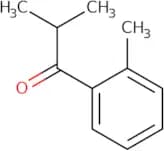
CAS:<p>Versatile small molecule scaffold</p>Formula:C22H25NO4Purity:Min. 95%Molecular weight:367.4 g/mol2-Methyl-1-(2-methylphenyl)propan-1-one
CAS:<p>Versatile small molecule scaffold</p>Formula:C11H14OPurity:Min. 95%Molecular weight:162.23 g/mol1-(tert-Butoxy)-4-nitrobenzene
CAS:<p>Versatile small molecule scaffold</p>Formula:C10H13NO3Purity:Min. 95%Molecular weight:195.22 g/mol4-Isothiocyanatophenol
CAS:<p>4-Isothiocyanatophenol (4ITCP) is an anticancer agent that has been shown to inhibit the growth of cancer cells in vivo. It is a metabolite of etoposide, which is used to treat certain types of cancer. 4ITCP inhibits the growth of cancer cells by enhancing mitochondrial membrane potential and inhibiting cell proliferation. This compound also inhibits cell growth by binding to phenyl groups on proteins, including enzymes and structural proteins. 4ITCP has been shown to act as a prodrug in vivo, where it is converted into 4-nitrophenol before being activated. 4ITCP also has optical properties that can be detected using spectroscopy and fluorescence.</p>Formula:C7H5NOSPurity:Min. 95%Molecular weight:151.19 g/mol2-[Ethyl(propan-2-yl)amino]ethan-1-ol
CAS:Controlled Product<p>Versatile small molecule scaffold</p>Formula:C7H17NOPurity:Min. 95%Molecular weight:131.22 g/mol7-Bromo-5-phenyl-2,3-dihydro-1H-1,4-benzodiazepin-2-one
CAS:Controlled Product<p>Versatile small molecule scaffold</p>Formula:C15H11BrN2OPurity:Min. 95%Molecular weight:315.16 g/molRef: 3D-CAA89461
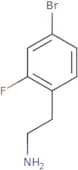
Discontinued product2-(4-Bromo-2-fluorophenyl)ethan-1-amine
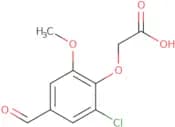
CAS:Controlled Product<p>Versatile small molecule scaffold</p>Formula:C8H9BrFNPurity:Min. 95%Molecular weight:218.07 g/mol2-(2-chloro-4-formyl-6-methoxyphenoxy)acetic acid
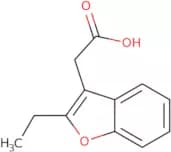
CAS:<p>Versatile small molecule scaffold</p>Formula:C10H9ClO5Purity:Min. 95%Molecular weight:244.6 g/mol2-(2-Ethyl-1-benzofuran-3-yl)acetic acid
CAS:<p>Versatile small molecule scaffold</p>Formula:C12H12O3Purity:Min. 95%Molecular weight:204.22 g/molRef: 3D-CCA40748
Discontinued product2-Bromo-5-nitrobenzenesulphonyl chloride
CAS:Versatile small molecule scaffoldFormula:C6H3BrClNO4SPurity:Min. 95%Molecular weight:300.51 g/molRef: 3D-YDA13055
Discontinued productEthyl 3-amino-4,6-dimethylthieno[2,3-b]pyridine-2-carboxylate
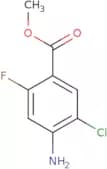
CAS:<p>Ethyl 3-amino-4,6-dimethylthieno[2,3-b]pyridine-2-carboxylate is a heterocyclic compound that is used as a reagent in organic synthesis. It is a polyfunctionalized heterocycle that contains an ethyl ester and an acid ethyl ester moiety. The compound can be prepared by the reaction of thiophene with nitromethane and ethyl iodide followed by hydrolysis.</p>Formula:C12H14N2O2SPurity:Min. 95%Molecular weight:250.32 g/molMethyl 4-amino-5-chloro-2-fluorobenzoate
CAS:<p>Versatile small molecule scaffold</p>Formula:C8H7ClFNO2Purity:Min. 95%Molecular weight:203.6 g/molRef: 3D-CHC37240
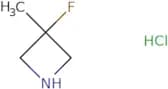
Discontinued product3-Fluoro-3-methylazetidine hydrochloride
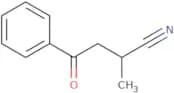
CAS:<p>Versatile small molecule scaffold</p>Formula:C4H9ClFNPurity:Min. 95%Molecular weight:125.57 g/mol2-Methyl-4-oxo-4-phenylbutanenitrile
CAS:<p>2-Methyl-4-oxo-4-phenylbutanenitrile is a chemical compound that is used in the synthesis of pharmaceuticals. It can be obtained by reacting an organic base with an organic acid. This reaction takes place in a reaction vessel and requires an inorganic base and inorganic reagents. The process also requires ethyl cyanoacetate as the starting material and produces 2-methyl-4-oxo-4-phenylbutanenitrile as the product. The use of this chemical has been linked to environmental pollution, so it should never be released into the environment or come into contact with water.</p>Formula:C11H11NOPurity:Min. 95%Molecular weight:173.21 g/molRef: 3D-BCA76578
Discontinued product2-Chloro-N-[3-(difluoromethoxy)phenyl]acetamide
CAS:<p>Versatile small molecule scaffold</p>Formula:C9H8ClF2NO2Purity:Min. 95%Molecular weight:235.61 g/mol1-(7-Hydroxy-2-methylpyrazolo[1,5-a]pyrimidin-6-yl)-ethanone
CAS:<p>Versatile small molecule scaffold</p>Formula:C9H9N3O2Purity:Min. 95%Molecular weight:191.19 g/molRef: 3D-CMB17733
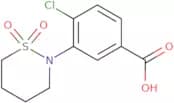
Discontinued product4-Chloro-3-(1,1-dioxido-1,2-thiazinan-2-yl)benzoic acid
CAS:<p>Versatile small molecule scaffold</p>Formula:C11H12ClNO4SPurity:Min. 95%Molecular weight:289.74 g/mol6-{2-Hydroxy-3-[(2-methoxyethyl)amino]propoxy}-1,2,3,4-tetrahydroquinolin-2-one
CAS:<p>Versatile small molecule scaffold</p>Formula:C15H22N2O4Purity:Min. 95%Molecular weight:294.35 g/molRef: 3D-CMC16581
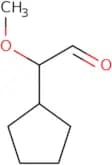
Discontinued product2-Cyclopentyl-2-methoxyacetaldehyde
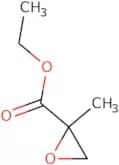
CAS:<p>Versatile small molecule scaffold</p>Formula:C8H14O2Purity:Min. 95%Molecular weight:142.2 g/molEthyl 2-methyloxirane-2-carboxylate
CAS:<p>Versatile small molecule scaffold</p>Formula:C6H10O3Purity:Min. 95%Molecular weight:130.14 g/molRef: 3D-WDA68520
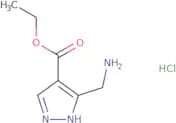
Discontinued productEthyl 3-(aminomethyl)-1H-pyrazole-4-carboxylate hydrochloride
CAS:<p>Versatile small molecule scaffold</p>Formula:C7H12ClN3O2Purity:Min. 95%Molecular weight:205.64 g/molRef: 3D-CMD25749
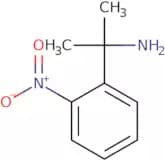
Discontinued product2-(2-Nitrophenyl)propan-2-amine
CAS:<p>Versatile small molecule scaffold</p>Formula:C9H12N2O2Purity:Min. 95%Molecular weight:180.2 g/molRef: 3D-CRA75708
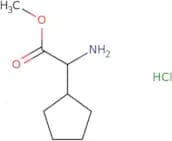
Discontinued productMethyl 2-amino-2-cyclopentylacetate hydrochloride
CAS:<p>Versatile small molecule scaffold</p>Formula:C8H16ClNO2Purity:Min. 95%Molecular weight:193.67 g/molRef: 3D-CUA58483
Discontinued product1,2-Dihydro-1-oxo-2-[(pyridin-3-yl)methyl]isoquinoline-4-carboxylic acid
CAS:<p>Versatile small molecule scaffold</p>Formula:C16H12N2O3Purity:Min. 95%Molecular weight:280.29 g/mol1-(3-Methylbenzoyl)piperidine-2-carboxylic acid
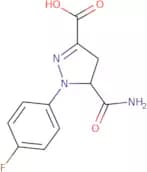
CAS:<p>Versatile small molecule scaffold</p>Formula:C14H17NO3Purity:Min. 95%Molecular weight:247.29 g/mol5-Carbamoyl-1-(4-fluorophenyl)-4,5-dihydro-1H-pyrazole-3-carboxylic acid
CAS:<p>Versatile small molecule scaffold</p>Formula:C11H10FN3O3Purity:Min. 95%Molecular weight:251.21 g/molRef: 3D-CWB88087
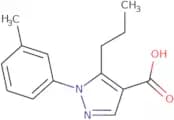
Discontinued product1-(3-Methylphenyl)-5-propyl-1H-pyrazole-4-carboxylic acid
CAS:Versatile small molecule scaffoldFormula:C14H16N2O2Purity:Min. 95%Molecular weight:244.29 g/molRef: 3D-CWB88210
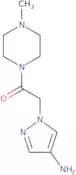
Discontinued product2-(4-Amino-1H-pyrazol-1-yl)-1-(4-methylpiperazin-1-yl)ethan-1-one
CAS:<p>Versatile small molecule scaffold</p>Formula:C10H17N5OPurity:Min. 95%Molecular weight:223.28 g/molRef: 3D-CWB91424
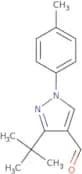
Discontinued product3-tert-Butyl-1-(4-methylphenyl)-1H-pyrazole-4-carbaldehyde
CAS:<p>Versatile small molecule scaffold</p>Formula:C15H18N2OPurity:Min. 95%Molecular weight:242.32 g/mol4-(1-Phenyl-1H-pyrazol-4-yl)-1H-pyrrole-3-carboxylic acid
CAS:<p>Versatile small molecule scaffold</p>Formula:C14H11N3O2Purity:Min. 95%Molecular weight:253.26 g/molRef: 3D-CWB96426
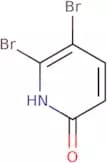
Discontinued product5,6-Dibromopyridin-2-ol
CAS:<p>Versatile small molecule scaffold</p>Formula:C5H3Br2NOPurity:Min. 95%Molecular weight:252.89 g/mol2-Bromo-3,3,3-trifluoro-1-propene
CAS:Controlled Product<p>2-Bromo-3,3,3-trifluoro-1-propene is a chemical compound that has been synthesized in an asymmetric reaction. The reactant is bromopropane and the product is 2,2,2-trifluoropropene. The methylene group on the propene molecule is activated by the nucleophilic attack of a fluoride ion from hydrogen fluoride to form a cavity with a highly strained bond. The kinetic study of this reaction revealed that the activation energy for the reaction is 42 kJ/mol. Palladium-catalyzed coupling reactions are catalyzed by palladium and require nonpolar solvents such as toluene or dichloromethane. This type of reaction has been shown to be exothermic with an isolated yield of 1%.</p>Formula:C3H2BrF3Purity:Min. 95%Color and Shape:Colorless PowderMolecular weight:174.95 g/mol3-(Methoxycarbonyl)pyridine-4-carboxylic acid
CAS:<p>Versatile small molecule scaffold</p>Formula:C8H7NO4Purity:Min. 95%Molecular weight:181.15 g/mol3-[5-(Aminomethyl)-1-oxo-2,3-dihydro-1H-isoindol-2-yl]piperidine-2,6-dione hydrochloride
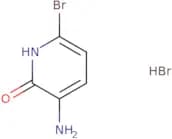
CAS:<p>Versatile small molecule scaffold</p>Formula:C14H16ClN3O3Purity:Min. 95%Molecular weight:309.75 g/mol3-amino-6-bromopyridin-2-ol hydrobromide
CAS:<p>Versatile small molecule scaffold</p>Formula:C5H6Br2N2OPurity:Min. 95%Molecular weight:269.9 g/mol3-Methylbenzo[b]thiophene-2-carboxylic acid
CAS:<p>3-Methylbenzo[b]thiophene-2-carboxylic acid (MBTCA) is a heterocyclic compound that is an intermediate in the synthesis of 3-methylthiophene-2-carboxylic acid, a precursor to other drugs. MBTCA is an aerobic, nonpolar compound that has shown antimicrobial activity against some bacteria and fungi. It also has been shown to have practicality as a biomolecular probe for methyl groups in organic solvents. MBTCA can be synthesized by nitration of benzene in the presence of sulfur and sulfoxides. This reaction produces nitrobenzene, which can then be oxidized by potassium permanganate or hydrogen peroxide to produce MBTCA. The most common isomer of MBTCA is 2-(3,5-dimethoxybenzylidene)tetrahydrofuran, with three methyl groups on the</p>Formula:C10H8O2SPurity:Min. 95%Molecular weight:192.23 g/mol(2S,3R)-2-((((9H-Fluoren-9-yl)methoxy)carbonyl)amino)-3-methoxybutanoic acid
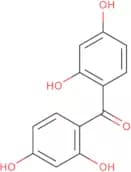
CAS:<p>Versatile small molecule scaffold</p>Formula:C20H21NO5Purity:Min. 95%Molecular weight:355.4 g/mol2,2',4,4'-tetrahydroxybenzophenone
CAS:<p>2,2',4,4'-tetrahydroxybenzophenone is a hydroxylated benzophenone that has immunomodulatory effects. It binds to the receptor in the immune system and can cause an increase in cytokine production. 2,2',4,4'-tetrahydroxybenzophenone is cytotoxic and has significant toxicity in vitro. The molecule has been shown to disrupt mitochondrial membrane potential. This may be due to its ability to form hydrogen bonds with molecules on the mitochondrial membrane. 2,2',4,4'-tetrahydroxybenzophenone also modulates transcriptional regulation of genes involved in cell proliferation and apoptosis. The drug is detectable at low levels by mass spectrometry and is not known to have any toxicological effects.END>></p>Formula:C13H10O5Purity:Min. 95%Color and Shape:Green PowderMolecular weight:246.22 g/molRef: 3D-FT55663
Discontinued producttert-Butyl 5-bromo-3,4-dihydro-2,7-naphthyridine-2(1H)-carboxylate
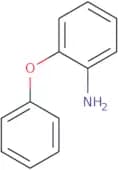
CAS:<p>Versatile small molecule scaffold</p>Formula:C13H17BrN2O2Purity:Min. 95%Molecular weight:313.19 g/mol2-Phenoxyaniline
CAS:<p>2-Phenoxyaniline is a nitro compound that can be converted to the corresponding palladium complexes. It is an inhibitor of the acylation reaction, which is a type of chemical reaction in which an organic molecule reacts with an acid. The inhibition of this reaction has been shown to have an effect on heart disease, specifically by lowering cholesterol levels and reducing atherosclerosis. 2-Phenoxyaniline has also been shown to inhibit the activation energy for electron transfer reactions, making it useful as a catalyst in analytical methods. 2-Phenoxyaniline also undergoes vibrational spectroscopy when exposed to liquid chromatography and other analytical methods.</p>Formula:C12H11NOPurity:Min. 95%Color and Shape:Brown PowderMolecular weight:185.22 g/mol4-(Methylamino)benzene-1-sulfonamide
CAS:<p>Versatile small molecule scaffold</p>Formula:C7H10N2O2SPurity:Min. 95%Molecular weight:186.23 g/mol1-[3-(Dimethylamino)propyl]-1-(4-fluorophenyl)-1,3-dihydro-3-oxo-5-isobenzofurancarbonitrile
CAS:<p>Please enquire for more information about 1-[3-(Dimethylamino)propyl]-1-(4-fluorophenyl)-1,3-dihydro-3-oxo-5-isobenzofurancarbonitrile including the price, delivery time and more detailed product information at the technical inquiry form on this page</p>Formula:C20H19FN2O2Purity:Min. 95%Molecular weight:338.38 g/molRef: 3D-FD184085
Discontinued product2-Acetylbenzoic acid
CAS:<p>2-Acetylbenzoic acid is a functional molecule that contains an acetyl group. It can form hydrogen bonds with other molecules and has been shown to induce apoptosis in cells. The reaction products of 2-acetylbenzoic acid are malonic acid, acetylsalicylic acid, and 2-benzoylbenzoic acid. These three compounds are made by the addition of hydrogen or hydroxide to the molecule 2-acetylbenzoic acid. The molecule has two functional groups: a carbonyl group and an acetyl group. The chemical structure of this molecule can be seen in the figure below.<br>2-Acetylbenzoic Acid</p>Formula:C9H8O3Purity:Min. 95%Color and Shape:PowderMolecular weight:164.16 g/molRef: 3D-FA05086
Discontinued productH-Ser-Ala-Glu-Glu-Tyr-Glu-Tyr-Pro-Ser OH trifluoroacetate
CAS:<p>Please enquire for more information about H-Ser-Ala-Glu-Glu-Tyr-Glu-Tyr-Pro-Ser OH trifluoroacetate including the price, delivery time and more detailed product information at the technical inquiry form on this page</p>Formula:C47H63N9O20•(C2HF3O2)xPurity:Min. 95%Ref: 3D-FS183525
Discontinued productGivinostat hydrochloride
CAS:<p>Givinostat hydrochloride is a research chemical that has shown potential in various fields. It is a molybdenum-based compound that has been studied for its effects on dopamine release and hydrogen evolution. Givinostat hydrochloride has also been investigated as an osteoclast inhibitor, which may be beneficial in the treatment of bone-related disorders such as osteoporosis. Additionally, it has shown promise as a retinoid and calpain inhibitor, suggesting its potential use in dermatological conditions and neurodegenerative diseases. The compound contains fluorine atoms, making it suitable for imaging studies using fluorine MRI techniques. Givinostat hydrochloride has been tested on MDA-MB-231 cells and has shown inhibitory effects on their growth, indicating its potential as an anticancer agent.</p>Formula:C24H27N3O4·HClPurity:Min. 95%Molecular weight:457.95 g/mol
![tert-Butyl N-{8-azabicyclo[3.2.1]octan-3-yl}-N-methylcarbamate hydrochloride](/_next/image/?url=https%3A%2Fstatic.cymitquimica.com%2Fproducts%2F3D%2Fthumb-webp%2FZLD00175.webp&w=3840&q=75)

![8-[(tert-Butoxy)carbonyl]-2-oxa-8-azaspiro[4.5]decane-6-carboxylic acid](/_next/image/?url=https%3A%2Fstatic.cymitquimica.com%2Fproducts%2F3D%2Fthumb-webp%2FZLD00165.webp&w=3840&q=75)
![tert-Butyl 4-[(1,3-thiazol-2-yl)amino]piperidine-1-carboxylate](/_next/image/?url=https%3A%2Fstatic.cymitquimica.com%2Fproducts%2F3D%2Fthumb-webp%2FZIB54665.webp&w=3840&q=75)
![Imidazo[1,2-c]pyrimidin-5(1H)-one](/_next/image/?url=https%3A%2Fstatic.cymitquimica.com%2Fproducts%2F3D%2Fthumb-webp%2FZIB03592.webp&w=3840&q=75)
![1-Boc-6-amino-1-azaspiro[3.3]heptane](/_next/image/?url=https%3A%2Fstatic.cymitquimica.com%2Fproducts%2F3D%2Fthumb-webp%2FZEC65919.webp&w=3840&q=75)
![2-[({12-Oxo-7-thia-9,11-diazatricyclo[6.4.0.0,2,6]dodeca-1(8),2(6),9-trien-10-yl}methyl)sulfanyl]a…](/_next/image/?url=https%3A%2Fstatic.cymitquimica.com%2Fproducts%2F3D%2Fthumb-webp%2FZEB92070.webp&w=3840&q=75)
![2-[2-(2-Methylphenyl)-2-oxoethylidene]-1,3-thiazolidin-4-one](/_next/image/?url=https%3A%2Fstatic.cymitquimica.com%2Fproducts%2F3D%2Fthumb-webp%2FZEB92039.webp&w=3840&q=75)

![5,6-Dihydro-4H-pyrrolo[1,2-b]pyrazole-2-carbaldehyde](/_next/image/?url=https%3A%2Fstatic.cymitquimica.com%2Fproducts%2F3D%2Fthumb-webp%2FYZA56446.webp&w=3840&q=75)
![2-[3-(4-Methylphenyl)propanamido]acetic acid](/_next/image/?url=https%3A%2Fstatic.cymitquimica.com%2Fproducts%2F3D%2Fthumb-webp%2FYTB36746.webp&w=3840&q=75)
![1-[(5-Methyl-1,3,4-thiadiazol-2-yl)methyl]piperazine dihydrochloride](/_next/image/?url=https%3A%2Fstatic.cymitquimica.com%2Fproducts%2F3D%2Fthumb-webp%2FAPD14702.webp&w=3840&q=75)

![1-Methyl-2,6-dioxa-9-azaspiro[4.5]decane](/_next/image/?url=https%3A%2Fstatic.cymitquimica.com%2Fproducts%2F3D%2Fthumb-webp%2FYLC23915.webp&w=3840&q=75)
![Methyl 3-[(3-bromophenyl)methoxy]propanoate](/_next/image/?url=https%3A%2Fstatic.cymitquimica.com%2Fproducts%2F3D%2Fthumb-webp%2FYLC23139.webp&w=3840&q=75)
![2-Chloro-1-[4-(3-chloro-4-fluorobenzenesulfonyl)piperazin-1-yl]ethan-1-one](/_next/image/?url=https%3A%2Fstatic.cymitquimica.com%2Fproducts%2F3D%2Fthumb-webp%2FYLB78046.webp&w=3840&q=75)
![2-(1-Chloroethyl)-5,6-dimethylthieno[2,3-d]pyrimidin-4-amine](/_next/image/?url=https%3A%2Fstatic.cymitquimica.com%2Fproducts%2F3D%2Fthumb-webp%2FYLB72147.webp&w=3840&q=75)
![4-{3-[({[(9H-Fluoren-9-yl)methoxy]carbonyl}amino)methyl]phenyl}benzoic acid](/_next/image/?url=https%3A%2Fstatic.cymitquimica.com%2Fproducts%2F3D%2Fthumb-webp%2FYGA91123.webp&w=3840&q=75)
![4-Chloro-3-methyl-[1,2]oxazolo[5,4-d]pyrimidine](/_next/image/?url=https%3A%2Fstatic.cymitquimica.com%2Fproducts%2F3D%2Fthumb-webp%2FBCA85060.webp&w=3840&q=75)

![6-({[(9H-fluoren-9-yl)methoxy]carbonyl}(methyl)amino)hexanoic acid](/_next/image/?url=https%3A%2Fstatic.cymitquimica.com%2Fproducts%2F3D%2Fthumb-webp%2FYGA69047.webp&w=3840&q=75)


![2-[Ethyl(propan-2-yl)amino]ethan-1-ol](/_next/image/?url=https%3A%2Fstatic.cymitquimica.com%2Fproducts%2F3D%2Fthumb-webp%2FCAA89361.webp&w=3840&q=75)

![Ethyl 3-amino-4,6-dimethylthieno[2,3-b]pyridine-2-carboxylate](/_next/image/?url=https%3A%2Fstatic.cymitquimica.com%2Fproducts%2F3D%2Fthumb-webp%2FCCA50556.webp&w=3840&q=75)
![2-Chloro-N-[3-(difluoromethoxy)phenyl]acetamide](/_next/image/?url=https%3A%2Fstatic.cymitquimica.com%2Fproducts%2F3D%2Fthumb-webp%2FCMA93608.webp&w=3840&q=75)
![1-(7-Hydroxy-2-methylpyrazolo[1,5-a]pyrimidin-6-yl)-ethanone](/_next/image/?url=https%3A%2Fstatic.cymitquimica.com%2Fproducts%2F3D%2Fthumb-webp%2FCMB17733.webp&w=3840&q=75)
![6-{2-Hydroxy-3-[(2-methoxyethyl)amino]propoxy}-1,2,3,4-tetrahydroquinolin-2-one](/_next/image/?url=https%3A%2Fstatic.cymitquimica.com%2Fproducts%2F3D%2Fthumb-webp%2FCMC16581.webp&w=3840&q=75)
![1,2-Dihydro-1-oxo-2-[(pyridin-3-yl)methyl]isoquinoline-4-carboxylic acid](/_next/image/?url=https%3A%2Fstatic.cymitquimica.com%2Fproducts%2F3D%2Fthumb-webp%2FCUA85107.webp&w=3840&q=75)




![3-[5-(Aminomethyl)-1-oxo-2,3-dihydro-1H-isoindol-2-yl]piperidine-2,6-dione hydrochloride](/_next/image/?url=https%3A%2Fstatic.cymitquimica.com%2Fproducts%2F3D%2Fthumb-webp%2FIWB26469.webp&w=3840&q=75)
![3-Methylbenzo[b]thiophene-2-carboxylic acid](/_next/image/?url=https%3A%2Fstatic.cymitquimica.com%2Fproducts%2F3D%2Fthumb-webp%2FDAA13378.webp&w=3840&q=75)



![1-[3-(Dimethylamino)propyl]-1-(4-fluorophenyl)-1,3-dihydro-3-oxo-5-isobenzofurancarbonitrile](/_next/image/?url=https%3A%2Fstatic.cymitquimica.com%2Fproducts%2F3D%2Fthumb-webp%2FFD184085.webp&w=3840&q=75)