


Building Blocks
Subcategories of "Building Blocks"
- Acidi boronici e derivati dell'acido boronico(5,784 products)
- Building Blocks Chirali(1,242 products)
- Building Blocks Idrocarburici(6,105 products)
- Building Blocks organici(61,061 products)
Found 205399 products of "Building Blocks"
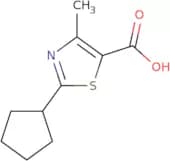
2-Cyclopentyl-4-methyl-1,3-thiazole-5-carboxylic acid
CAS:Versatile small molecule scaffold
Formula:C10H13NO2SPurity:Min. 95%Molecular weight:211.28 g/molRef: 3D-XTA80545
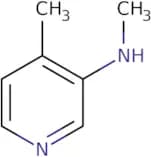
Discontinued productN,4-dimethylpyridin-3-amine
CAS:Versatile small molecule scaffold
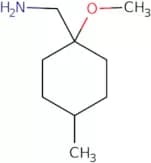
Formula:C7H10N2Purity:Min. 95%Molecular weight:122.16 g/mol(1-Methoxy-4-methylcyclohexyl)methanamine
CAS:Versatile small molecule scaffoldFormula:C9H19NOPurity:Min. 95%Molecular weight:157.25 g/molRef: 3D-BNA48799
Discontinued product3-[(4-Hydroxypiperidin-1-yl)sulfonyl]thiophene-2-carboxylic acid
CAS:Versatile small molecule scaffoldFormula:C10H13NO5S2Purity:Min. 95%Molecular weight:291.3 g/molRef: 3D-XTB00167
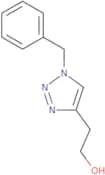
Discontinued product2-(1-Benzyl-1H-1,2,3-triazol-4-yl)ethan-1-ol
CAS:Versatile small molecule scaffold
Formula:C11H13N3OPurity:Min. 95%Molecular weight:203.24 g/molRef: 3D-IHB73697
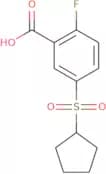
Discontinued product5-(Cyclopentanesulfonyl)-2-fluorobenzoic acid
CAS:Versatile small molecule scaffold
Formula:C12H13FO4SPurity:Min. 95%Molecular weight:272.29 g/molRef: 3D-XTB00741
Discontinued product2,2-Difluoroethenyl 4-methylbenzene-1-sulfonate
CAS:2,2-Difluoroethenyl 4-methylbenzene-1-sulfonate is a coupling reagent that is used to form terminal alkynes. It reacts with fluorescing compounds to yield 2,2-difluoroethenyl esters or thioesters and can be used as a source of terminal alkynes. This reagent has been shown to react with various aromatic compounds in the presence of base. The reaction results in the formation of a difluorinated aromatic compound and a sulfonic acid salt.
Formula:C9H8F2O3SPurity:Min. 95%Molecular weight:234.22 g/mol2-[3-(Trifluoromethyl)-1H-pyrazol-4-yl]ethan-1-ol
CAS:Versatile small molecule scaffold
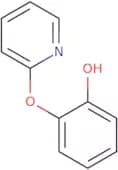
Formula:C6H7F3N2OPurity:Min. 95%Molecular weight:180.13 g/molo-(2-Pyridyloxy)phenol
CAS:o-(2-Pyridyloxy)phenol is a nitro compound that contains a nitrogen atom and an oxygen atom. It has two isomers, which are designated as 1-nitro-2-pyridyloxybenzene and 2-nitro-1-pyridyloxybenzene. The 1-isomer is more stable than the 2-isomer, but both forms can be synthesized. The 1 form can be obtained by reacting pyridine with nitric acid and anhydrous potassium carbonate at temperatures of 120 degrees Celsius. The 2 isomer can be obtained by reacting pyridine with nitric acid, anhydrous potassium carbonate, and fluorine at temperatures of 190 degrees Celsius. Nitrogen atoms in the molecule can bind to metal ions such as copper or zinc to form complexes. These metal complexes have been shown to exhibit antiinflammatory activity in vitro against Pai-1 cells (a human monocytic cell
Formula:C11H9NO2Purity:Min. 95%Molecular weight:187.19 g/molRef: 3D-KBA97437
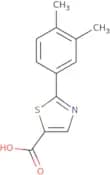
Discontinued product2-(3,4-Dimethylphenyl)-1,3-thiazole-5-carboxylic acid
CAS:Versatile small molecule scaffold
Formula:C12H11NO2SPurity:Min. 95%Molecular weight:233.29 g/mol5,6-Dimethylthieno[2,3-d]pyrimidine-2,4(1H,3H)-dione
CAS:Versatile small molecule scaffoldFormula:C8H8N2O2SPurity:Min. 95%Molecular weight:196.23 g/mol(3-Cyclopropoxyphenyl)boronic acid
CAS:Versatile small molecule scaffold
Formula:C9H11BO3Purity:Min. 95%Molecular weight:177.99 g/molBicyclo[6.1.0]nonane-9-carboxylic acid
CAS:Versatile small molecule scaffold
Formula:C10H16O2Purity:Min. 95%Molecular weight:168.23 g/molRef: 3D-CDA84163
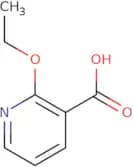
Discontinued product2-Ethoxy-nicotinic acid
CAS:2-Ethoxy-nicotinic acid is an inorganic compound that contains oxygen and hydrogen. It has been shown to interact with amines, carboxylates, and other inorganic compounds. 2-Ethoxy-nicotinic acid is a supramolecular complex consisting of naphthyridine and ethoxy groups. The hydrogen bonding interactions between the ethoxy groups and the amine groups are what make this molecule magnetic. The isomers of this compound have been synthesized and diffraction experiments have shown that it has a cyclic structure. Compounds similar to 2-Ethoxy-nicotinic acid include malonate, which has two carboxylate groups. This molecule also reacts with hydrogen gas at high temperatures to produce hydrogen gas and carbon dioxide.
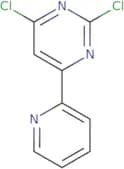
Formula:C8H9NO3Purity:Min. 95%Molecular weight:167.16 g/mol2,4-Dichloro-6-(pyridin-2-yl)pyrimidine
CAS:Versatile small molecule scaffold
Formula:C9H5Cl2N3Purity:Min. 95%Molecular weight:226.06 g/molRef: 3D-ENB23256
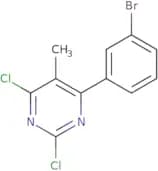
Discontinued product4-(3-Bromophenyl)-2,6-dichloro-5-methylpyrimidine
CAS:Versatile small molecule scaffoldFormula:C11H7BrCl2N2Purity:Min. 95%Molecular weight:317.99 g/molRef: 3D-ENB23130
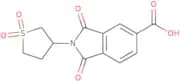
Discontinued product2-(1,1-Dioxo-1-thiolan-3-yl)-1,3-dioxo-2,3-dihydro-1H-isoindole-5-carboxylic acid
CAS:Versatile small molecule scaffold
Formula:C13H11NO6SPurity:Min. 95%Molecular weight:309.3 g/molRef: 3D-XTB04653
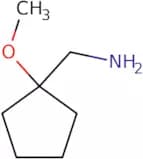
Discontinued product(1-Methoxycyclopentyl)methanamine
CAS:Versatile small molecule scaffold
Formula:C7H15NOPurity:Min. 95%Molecular weight:129.2 g/mol2-(Propan-2-yl)-5H,6H,7H,8H-pyrido[4,3-d]pyrimidine
CAS:Versatile small molecule scaffold
Formula:C10H15N3Purity:Min. 95%Molecular weight:177.25 g/mol1-[3-(Propan-2-yl)phenyl]-5-propyl-1H-1,2,3-triazole-4-carboxylic acid
CAS:Versatile small molecule scaffold
Formula:C15H19N3O2Purity:Min. 95%Molecular weight:273.33 g/molRef: 3D-XTB05094
Discontinued product

![3-[(4-Hydroxypiperidin-1-yl)sulfonyl]thiophene-2-carboxylic acid](/_next/image/?url=https%3A%2Fstatic.cymitquimica.com%2Fproducts%2F3D%2Fthumb-webp%2FXTB00167.webp&w=3840&q=75)

![2-[3-(Trifluoromethyl)-1H-pyrazol-4-yl]ethan-1-ol](/_next/image/?url=https%3A%2Fstatic.cymitquimica.com%2Fproducts%2F3D%2Fthumb-webp%2FKHA85385.webp&w=3840&q=75)
![5,6-Dimethylthieno[2,3-d]pyrimidine-2,4(1H,3H)-dione](/_next/image/?url=https%3A%2Fstatic.cymitquimica.com%2Fproducts%2F3D%2Fthumb-webp%2FKBA97082.webp&w=3840&q=75)
![Bicyclo[6.1.0]nonane-9-carboxylic acid](/_next/image/?url=https%3A%2Fstatic.cymitquimica.com%2Fproducts%2F3D%2Fthumb-webp%2FCDA84163.webp&w=3840&q=75)
![2-(Propan-2-yl)-5H,6H,7H,8H-pyrido[4,3-d]pyrimidine](/_next/image/?url=https%3A%2Fstatic.cymitquimica.com%2Fproducts%2F3D%2Fthumb-webp%2FENB23061.webp&w=3840&q=75)
![1-[3-(Propan-2-yl)phenyl]-5-propyl-1H-1,2,3-triazole-4-carboxylic acid](/_next/image/?url=https%3A%2Fstatic.cymitquimica.com%2Fproducts%2F3D%2Fthumb-webp%2FXTB05094.webp&w=3840&q=75)