Building Blocks
This section contains fundamental products for the synthesis of organic and biological compounds. Building blocks are the essential starting materials used to construct complex molecules through various chemical reactions. They play a critical role in drug discovery, material science, and chemical research. At CymitQuimica, we offer a diverse range of high-quality building blocks to support your innovative research and industrial projects, ensuring you have the essential components for successful synthesis.
Subcategories of "Building Blocks"
- Boronic Acids & Boronic Acid Derivatives(5,778 products)
- Chiral Building Blocks(1,242 products)
- Hydrocarbon Building Blocks(6,098 products)
- Organic Building Blocks(61,034 products)
Found 199601 products of "Building Blocks"
Sort by
Purity (%)
0
100
|
0
|
50
|
90
|
95
|
100
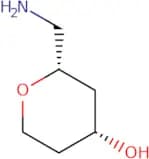
rac-(2R,4S)-2-(Aminomethyl)oxan-4-ol
CAS:<p>rac-2R,4S)-2-(Aminomethyl)oxan-4-ol is a chemical building block that can be used as a reaction component in organic synthesis. It can also be used as a reagent to synthesize other compounds and as a starting material for the synthesis of pharmaceuticals. This chemical is an intermediate in the syntheses of many biologically active substances, such as the anti-epileptic drug carbamazepine and the analgesic drug pentazocine. Racemic 2-(aminomethyl)oxan-4-ol has been shown to exhibit antitumor activity against human colon adenocarcinoma cells. Racemic 2-(aminomethyl)oxan-4-ol is an excellent versatile building block for complex compounds with various applications in the chemical industry.</p>Formula:C6H13NO2Purity:Min. 95%Color and Shape:PowderMolecular weight:131.2 g/mol4-(Difluoromethyl)benzyl alcohol
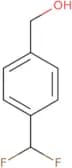
CAS:<p>4-(Difluoromethyl)benzyl alcohol is a chemical intermediate with CAS No. 444915-77-9. It is a versatile building block that can be used to synthesize a wide variety of compounds, including useful scaffolds and speciality chemicals. 4-(Difluoromethyl)benzyl alcohol has been shown to be an effective reactant in the synthesis of complex compounds. It is also used as a reagent in high quality research and development laboratories.</p>Formula:C8H8F2OPurity:Min. 95%Molecular weight:158.15 g/mol2-(2,4-Difluorophenyl)pyrrolidine hydrochloride
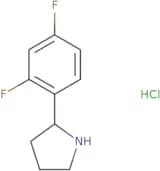
CAS:Versatile small molecule scaffoldFormula:C10H11NF2•HClPurity:Min. 95%Color and Shape:PowderMolecular weight:219.65 g/mol1-[3-(Trifluoromethyl)phenyl]cyclobutan-1-amine
CAS:Versatile small molecule scaffoldFormula:C11H12F3NPurity:Min. 95%Color and Shape:Clear LiquidMolecular weight:215.21 g/molBis(trifluoromethane)sulfonimide lithium salt
CAS:<p>Please enquire for more information about Bis(trifluoromethane)sulfonimide lithium salt including the price, delivery time and more detailed product information at the technical inquiry form on this page</p>Formula:C2F6LiNO4S2Molecular weight:287.09 g/molRef: 3D-Q-101273
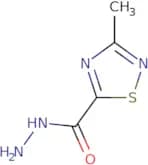
1kgTo inquire5kgTo inquire250gTo inquire500gTo inquire2500gTo inquire-Unit-kgkgTo inquire3-Methyl-1,2,4-thiadiazole-5-carbohydrazide
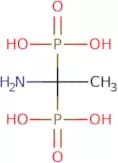
CAS:3-Methyl-1,2,4-thiadiazole-5-carbohydrazide is an intermediate in the synthesis of fezolinetant. It can be used as a pharmaceutical intermediate.Formula:C4H6N4OSPurity:Min. 95%Molecular weight:158.18 g/mol(1-Aminoethane-1,1-diyl)diphosphonic acid
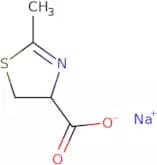
CAS:<p>(1-Aminoethane-1,1-diyl)diphosphonic acid (HEDPA) is a synthetic phosphonate that is soluble in water and organic solvents. HEDPA has been used in gravimetric analysis because it is stable to boiling point and can be easily dried on the surface of a glass plate. It also has been used as a reagent for the synthesis of hydroxy methyl phosphonates and other phosphonate compounds. In crystal x-ray diffraction, HEDPA shows strong hydrogen bonding interactions with counterions such as PO43-, SO42-, or NH4+. The coordination chemistry of HEDPA involves metal ions such as Fe3+, Cu2+, Co2+, Ni2+, Cr3+, Mn2+, Zn2+, Cd2+ and Al3+. Functional theory predicts that the architecture of HEDPA's supramolecular units are either tetrahedral or octahedral. Inf</p>Formula:C2H9NO6P2Purity:Min. 95%Color and Shape:PowderMolecular weight:205.04 g/molSodium 2-methyl-4,5-dihydro-1,3-thiazole-4-carboxylate
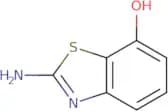
CAS:<p>Versatile small molecule scaffold</p>Formula:C5H6NNaO2SPurity:Min. 95%Color and Shape:PowderMolecular weight:167.16 g/mol2-amino-1,3-benzothiazol-7-ol
CAS:<p>2-Amino-1,3-benzothiazol-7-ol is a versatile building block that can be used in the synthesis of complex compounds. It has been used as a research chemical and as a reagent for the production of speciality chemicals. 2-Amino-1,3-benzothiazol-7-ol is also useful as an intermediate in organic reactions or as a scaffold to construct novel molecular frameworks. This compound is known to have a high quality and purity.</p>Formula:C7H6N2OSPurity:Min. 95%Color and Shape:PowderMolecular weight:166.2 g/molEthyl homovanillate
CAS:<p>Inhibitor of monoamine oxidase A</p>Formula:C11H14O4Purity:Min. 95%Color and Shape:Colorless PowderMolecular weight:210.23 g/molEthyl 2,4-dihydroxy-6-methylbenzoate
CAS:<p>Ethyl 2,4-dihydroxy-6-methylbenzoate is a phenolic acid that is found in lichens. It has been shown to have anti-cancer and anti-inflammatory properties. The hydrogen bonds of ethyl 2,4-dihydroxy-6-methylbenzoate are the result of an intramolecular hydrogen bonding between the benzoic acid group and the hydroxymethyl group. This compound can also be found in matrix effect health care products as well as wastewater treatment plants. Ethyl 2,4-dihydroxy-6-methylbenzoate has also been shown to inhibit enzymes such as uv absorption and phenolic acids.</p>Formula:C10H12O4Purity:Min. 95%Molecular weight:196.2 g/mol5-Ethylthio-1H-tetrazole - Conductivity >30 uS/cm
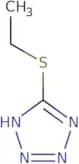
CAS:<p>5-Ethylthio-1H-tetrazole is a chloroformate that is used as an inhibitor of the cell membrane permeability. It can be prepared by the reaction of thiourea and ethyl bromoacetate in chloroform. This compound has been shown to inhibit the acidification of cells, which is caused by hydrogen ions leaking through the cell membrane. 5-Ethylthio-1H-tetrazole is also an inhibitor of RNA synthesis, which may be due to its ability to bind with nucleoside triphosphates and competitively inhibit ATPase activity. This product also has a luminescent property, which may be due to its ability to produce light upon oxidation in air or water.</p>Formula:C3H6N4SColor and Shape:PowderMolecular weight:130.17 g/mol4-(Ethenylsulfonyl)benzoic acid 2,5-dioxo-1-pyrrolidinyl ester
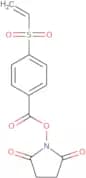
CAS:<p>4-(Ethenylsulfonyl)benzoic acid 2,5-dioxo-1-pyrrolidinyl ester is a fine chemical that is a useful scaffold for the synthesis of complex compounds. It can be used as a versatile building block in the production of research chemicals and pharmaceuticals, as well as a reaction component in speciality chemicals. The CAS Number for 4-(Ethenylsulfonyl)benzoic acid 2,5-dioxo-1-pyrrolidinyl ester is 343934-41-8.</p>Formula:C13H11NO6SPurity:Min. 95%Color and Shape:White PowderMolecular weight:309.3 g/molEthopabate - Technical
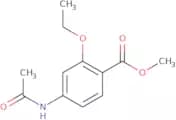
CAS:<p>Ethopabate is a salt of ethopropazine and sodium carbonate. It is used in pharmaceutical preparations as an antiparasitic agent. The chemical composition of the salt is CHNO, with one hydrogen bond between the ethopropazine and sodium carbonate. Ethopabate has been shown to be active against amprolium-resistant coccidia in human serum, as well as being an analytical reagent for detecting monoclonal antibodies. This chemical can be used to prepare a polymeric matrix for use in fluorescence detection or for antimicrobial agents. Hydrochloric acid and UV light are used to synthesize this compound.</p>Formula:C12H15NO4Purity:Min. 95%Color and Shape:White PowderMolecular weight:237.25 g/mol4-aminobutan-2-one hydrochloride
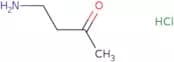
CAS:4-Aminobutan-2-one hydrochloride is a β-unsaturated compound that can be synthesized by the condensation of methyl ketone and sulfide. This reaction converts the carbonyl group to an aminoketone group. The isomers of 4-aminobutan-2-one hydrochloride include 3,4-dimethylketone and 2,3,5,6-tetramethylketone. 4-Aminobutan-2-one hydrochloride can be used as a precursor for nitriles and sulfur compounds. It also selectively reacts with sodium sulfide in water to produce cyanoacetate or with sodium hydroxide to produce hydrogen cyanide and sulfides.Formula:C4H10ClNOPurity:Min. 95%Color and Shape:PowderMolecular weight:123.58 g/mol1-(4-Ethoxycarbonylphenyl)piperazine
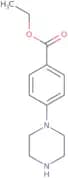
CAS:<p>1-(4-Ethoxycarbonylphenyl)piperazine is an enantiopure phosphatase inhibitor. It is used in the treatment of cancer and other life-threatening diseases. 1-(4-Ethoxycarbonylphenyl)piperazine inhibits phosphatases, which are enzymes that catalyze hydrolysis of phosphate groups from substrates. This inhibition leads to a decrease in the production of fatty acids and cholesterol, resulting in a reduction in body mass index. The drug has been shown to be effective against animal models for cancer, with an effective dose of 100 mg/kg intraperitoneally. In addition, 1-(4-ethoxycarbonylphenyl)piperazine has been shown to inhibit cardiac phosphatases and increase cardiac uptake by inhibiting acylation reactions.</p>Formula:C13H18N2O2Purity:Min. 98%Color and Shape:White PowderMolecular weight:234.29 g/molN1-(4,5-Dihydro-1H-imidazol-2-yl)benzene-1,4-diamine dihydrochloride
CAS:<p>Versatile small molecule scaffold</p>Formula:C9H14Cl2N4Purity:Min. 95%Color and Shape:PowderMolecular weight:249.14 g/molEthyl 4-iodobenzoate
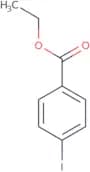
CAS:<p>Ethyl 4-iodobenzoate is an amide that reacts with a variety of substances, including retinoic acid and pemetrexed. It is a reactive substance that can be used in the synthesis of other substances such as iron oxides and transfer mechanism. Ethyl 4-iodobenzoate is also used for the preparation of picolinic acid and crystalline structure. Radical coupling reactions are most common and involve halides, phenyl groups, and aryl halides. The reaction temperature ranges from room temperature to 100 ˚C, while the reaction mechanism varies depending on the type of coupling reaction.</p>Formula:C9H9IO2Purity:Min. 95%Color and Shape:PowderMolecular weight:276.07 g/mol5-Ethylindole-2-carboxylic acid
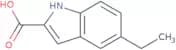
CAS:<p>5-Ethylindole-2-carboxylic acid is an organic compound that is a decarboxylation product of indole. It can be obtained by catalytic dehydrogenation of ethyl ester or 5-ethylindole-2-carboxylic acid. It has been shown to inhibit the growth of bacteria and fungi, as well as to have anti-inflammatory properties.</p>Formula:C11H11NO2Purity:Min. 95%Molecular weight:189.21 g/mol2-Ethyl-3,5-dimethylpyrazine
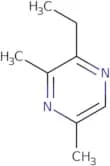
CAS:<p>2-Ethyl-3,5-dimethylpyrazine (2E-DMP) is a fatty acid that is produced by the reaction of unsaturated ketones and fatty acids. 2E-DMP has been shown to have an inhibitory effect on the activity of kidney bean lipoxygenase. It also inhibits the growth of mammalian cells in culture. 2E-DMP has a molecular weight of 152.24, a melting point of -50 degrees Celsius, and a boiling point at 230 degrees Celsius. The compound has not been tested for carcinogenic or mutagenic effects in mammals or humans.</p>Formula:C8H12N2Purity:Min. 95%Color and Shape:Clear LiquidMolecular weight:136.19 g/mol

![1-[3-(Trifluoromethyl)phenyl]cyclobutan-1-amine](/_next/image/?url=https%3A%2Fstatic.cymitquimica.com%2Fproducts%2F3D%2Fthumb-webp%2FUTB21835.webp&w=3840&q=75)