Building Blocks
Subcategories of "Building Blocks"
- Boronic Acids & Boronic Acid Derivatives(5,783 products)
- Chiral Building Blocks(1,242 products)
- Hydrocarbon Building Blocks(6,105 products)
- Organic Building Blocks(61,055 products)
Found 205383 products of "Building Blocks"
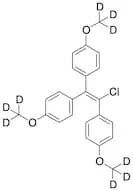
Chlorotrianisene-d9 (trimethoxy-d9)
CAS:Controlled ProductApplications Chlorotrianisene-d9 (trimethoxy-d9) (CAS# 1276197-26-2) is a useful isotopically labeled research compound.
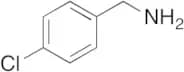
Formula:C23H12D9ClO3Color and Shape:NeatMolecular weight:389.924-Chlorobenzylamine
CAS:Controlled ProductApplications 4-Chlorobenzylamine is a reactant in the environmentally friendly synthesis of pyrroles.
Not a dangerous good if item is equal to or less than 1g/ml and there is less than 100g/ml in the package
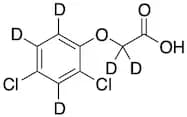
References Xu, P., et. al.: J. Org. Chem., 80, 4729 (2015)Formula:C7H8ClNColor and Shape:NeatMolecular weight:141.6(2,4-Dichlorophenoxy-d3)acetic-d2 Acid
CAS:Controlled ProductApplications (2,4-Dichlorophenoxy-d3)acetic-d2 Acid (CAS# 352438-69-8) is a useful isotopically labeled research compound.
Formula:C8HD5Cl2O3Color and Shape:NeatMolecular weight:226.06N-(5-Oxo-L-prolyl)-L-glutamic Acid
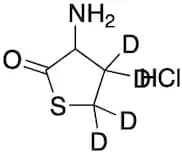
CAS:Controlled ProductFormula:C10H14N2O6Color and Shape:NeatMolecular weight:258.23DL-Homocysteine Thiolactone-3,3,4,4-d4 HCl
CAS:Controlled ProductApplications DL-Homocysteine Thiolactone-3,3,4,4-d4 HCl (CAS# 1219805-31-8) is a useful isotopically labeled research compound.
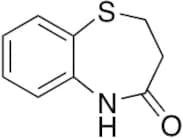
Formula:C4H4D4ClNOSColor and Shape:NeatMolecular weight:157.653,5-dihydro-2H-1,5-benzothiazepin-4-one
CAS:Controlled ProductApplications 3,5-dihydro-2H-1,5-benzothiazepin-4-one (cas# 53454-43-6) is a useful research chemical.
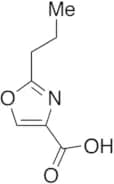
Formula:C9H9NOSColor and Shape:NeatMolecular weight:179.242-Propyl-4-oxazolecarboxylic Acid
CAS:Controlled ProductFormula:C7H9NO3Color and Shape:NeatMolecular weight:155.15Ethyl 2-Isopropylacetoacetate
CAS:Controlled ProductApplications Ethyl 2-Isopropylacetoacetate is a reactant in the preparation of nonracemic arylhydroxymethylpyrrolidinylmethylphenyl thiazoleacetamides and cyclopentathiazolecarboxamides as conformationally restricted β3-adrenoceptor agonists as a potential treatment for overactive bladder.
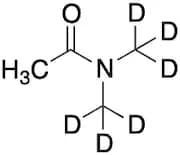
References Moyes, C.R., et. al.: J. Med. Chem., 57, 1437 (2014)Formula:C9H16O3Color and Shape:NeatMolecular weight:172.22N,N-Dimethyl-d6-acetamide
CAS:Controlled ProductApplications N,N-Dimethyl-d6-acetamide (CAS# 31591-08-9) is a useful isotopically labeled research compound.
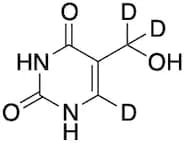
Formula:C4H3D6NOColor and Shape:NeatMolecular weight:93.165-(Hydroxymethyl-d2)uracil-6-d1
CAS:Controlled ProductApplications 5-(Hydroxymethyl-d2)uracil-6-d1 (CAS# 352438-73-4) is a useful isotopically labeled research compound.
Formula:C5H3D3N2O3Color and Shape:NeatMolecular weight:145.13Ethyl 4-Piperidinecarboxylate-2,2,3,3,4,5,5,6,6-d9
CAS:Controlled ProductApplications Ethyl 4-Piperidinecarboxylate-2,2,3,3,4,5,5,6,6-d9 (CAS# 1219803-75-4) is a useful isotopically labeled research compound.
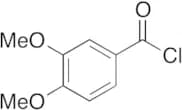
Formula:C8H6D9NO2Color and Shape:NeatMolecular weight:166.273,4-Dimethoxybenzoyl Chloride
CAS:Controlled ProductStability Moisture Sensitive
Applications 3,4-Dimethoxybenzoyl Chloride is a benzoyl chloride derivative used in the preparation of a variety of biologically active compounds such as bronchodilators
Not a dangerous good if item is equal to or less than 1g/ml and there is less than 100g/ml in the package
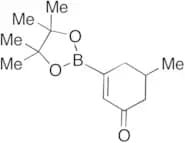
References Sharma, R.L. et al.: ARKIVOC, 10, 233 (2009);Formula:C9H9ClO3Color and Shape:NeatMolecular weight:200.625-Methyl-3-(4,4,5,5-tetramethyl-1,3,2-dioxaborolan-2-yl)cyclohex-2-en-1-one
CAS:Controlled ProductFormula:C13H21BO3Color and Shape:NeatMolecular weight:236.124-Chloro-1-butanol (Technical Grade)
CAS:Applications 4-Chloro-1-butanol is a reagent used in the preparation of pharmaceutical compounds such as canthine analogues for their activity against HeLa cervical cells. Also used in the preparation of novel and highly potent Bryostatin, another anti-cancer agent.
Not a dangerous good if item is equal to or less than 1g/ml and there is less than 100g/ml in the package
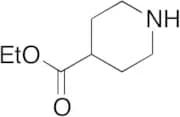
References Naik, P. et al.: Tetrahedron, 69, 6545 (2013); Wender, P. et al.: J. Am. Chem. Soc., 124,13648 (2002);Formula:C4H9ClOColor and Shape:NeatMolecular weight:108.5667Ethyl Isonipecotate
CAS:Controlled ProductFormula:C8H15NO2Color and Shape:NeatMolecular weight:157.211-Phenylcyclopropanesulfonyl Chloride
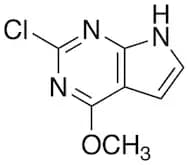
CAS:Controlled ProductFormula:C9H9ClO2SColor and Shape:NeatMolecular weight:216.6852-Chloro-6-methoxy-7-deazapurine
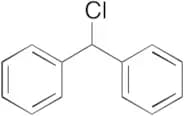
CAS:Controlled ProductFormula:C7H6ClN3OColor and Shape:NeatMolecular weight:183.6Chlorodiphenylmethane
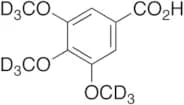
CAS:Controlled ProductFormula:C13H11ClColor and Shape:NeatMolecular weight:202.683,4,5-Trimethoxybenzoic Acid-d9
CAS:Controlled ProductApplications A labelled metabolite of Trimebutine (T795605).
References Dieks, H., et al.: J. Labelled Comp. Radiopharm., 28, 1093 (1990),Formula:C10H3D9O5Color and Shape:NeatMolecular weight:221.25Glyceryl-d5 Tripentadecanoate
CAS:Controlled ProductApplications Glyceryl-d5 Tripentadecanoate (CAS# 1219804-57-5) is a useful isotopically labeled research compound.
Formula:C48H87D5O6Color and Shape:NeatMolecular weight:770.29