Building Blocks
This section contains fundamental products for the synthesis of organic and biological compounds. Building blocks are the essential starting materials used to construct complex molecules through various chemical reactions. They play a critical role in drug discovery, material science, and chemical research. At CymitQuimica, we offer a diverse range of high-quality building blocks to support your innovative research and industrial projects, ensuring you have the essential components for successful synthesis.
Subcategories of "Building Blocks"
- Boronic Acids & Boronic Acid Derivatives(5,778 products)
- Chiral Building Blocks(1,242 products)
- Hydrocarbon Building Blocks(6,098 products)
- Organic Building Blocks(61,059 products)
Found 199580 products of "Building Blocks"
Sort by
Purity (%)
0
100
|
0
|
50
|
90
|
95
|
100
(2E)-4-(Dimethylamino)-N-(prop-2-yn-1-yl)but-2-enamide
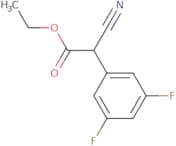
CAS:Versatile small molecule scaffoldFormula:C9H14N2OPurity:Min. 95%Molecular weight:166.2 g/molEthyl 2-cyano-2-(3,5-difluorophenyl)acetate
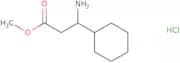
CAS:Versatile small molecule scaffoldFormula:C11H9F2NO2Purity:Min. 95%Molecular weight:225.19 g/molMethyl 3-amino-3-cyclohexylpropanoate hydrochloride
CAS:Versatile small molecule scaffoldFormula:C10H20ClNO2Purity:Min. 95%Molecular weight:221.72 g/mol1-Benzyl-1H-[1,2,3]triazole-4-carbonitrile
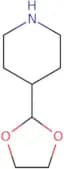
CAS:Versatile small molecule scaffoldFormula:C10H8N4Purity:Min. 95%Molecular weight:184.2 g/mol4-(1,3-Dioxolan-2-yl)piperidine
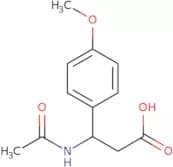
CAS:<p>Versatile small molecule scaffold</p>Formula:C8H15NO2Purity:Min. 95%Molecular weight:157.21 g/mol3-Acetamido-3-(4-methoxyphenyl)propanoic acid
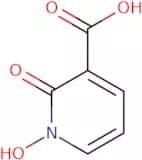
CAS:<p>Versatile small molecule scaffold</p>Formula:C12H15NO4Purity:Min. 95%Molecular weight:237.25 g/mol1-Hydroxy-2-oxo-1,2-dihydropyridine-3-carboxylic acid
CAS:Versatile small molecule scaffoldFormula:C6H5NO4Purity:Min. 95%Molecular weight:155.11 g/mol2-Hydroxy-1-(2-hydroxyethyl)-4-methyl-6-oxo-1,6-dihydropyridine-3-carbonitrile
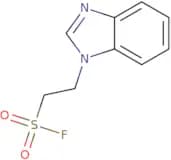
CAS:Versatile small molecule scaffoldFormula:C9H10N2O3Purity:Min. 95%Molecular weight:194.2 g/mol2-(1H-1,3-Benzodiazol-1-yl)ethane-1-sulfonyl fluoride
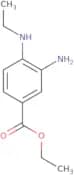
CAS:Versatile small molecule scaffoldFormula:C9H9FN2O2SPurity:Min. 95%Molecular weight:228.25 g/molEthyl 3-amino-4-(ethylamino)benzoate
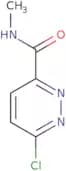
CAS:<p>Versatile small molecule scaffold</p>Formula:C11H16N2O2Purity:Min. 95%Molecular weight:208.26 g/mol6-Chloro-N-methylpyridazine-3-carboxamide
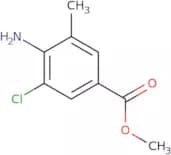
CAS:Versatile small molecule scaffoldFormula:C6H6ClN3OPurity:Min. 95%Molecular weight:171.58 g/molmethyl 4-amino-3-chloro-5-methylbenzoate
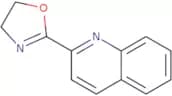
CAS:Versatile small molecule scaffoldFormula:C9H10ClNO2Purity:Min. 95%Molecular weight:199.6 g/mol2-(4,5-Dihydro-2-oxazolyl)quinoline
CAS:<p>2-(4,5-Dihydro-2-oxazolyl)quinoline is a nitrogen heterocycle with two allyl groups. It is an organic compound that has been shown to be cytotoxic and to inhibit the growth of cancer cells in vitro. 2-(4,5-Dihydro-2-oxazolyl)quinoline has also been shown to have biological properties against infectious diseases. The mechanism of action is unknown but may involve hydrogen bonding interactions with picolinic acid or trifluoroacetic acid. 2-(4,5-Dihydro-2-oxazolyl)quinoline is toxic and should not be handled without gloves as it reacts with light and oxygen to form unstable complexes that can cause burns.</p>Formula:C12H10N2OPurity:Min. 95%Molecular weight:198.22 g/mol4-[(Carboxymethyl)sulfanyl]-3-nitrobenzoic acid
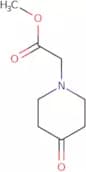
CAS:<p>Versatile small molecule scaffold</p>Formula:C9H7NO6SPurity:Min. 95%Molecular weight:257.22 g/molMethyl 2-(4-oxopiperidin-1-yl)acetate
CAS:Versatile small molecule scaffoldFormula:C8H13NO3Purity:Min. 95%Molecular weight:171.19 g/molMethyl 2,4-dimethyl-5-nitrobenzoate
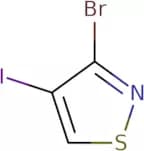
CAS:Versatile small molecule scaffoldFormula:C10H11NO4Purity:Min. 95%Molecular weight:209.2 g/mol3-Bromo-4-iodo-1,2-thiazole
CAS:<p>3-Bromo-4-iodo-1,2-thiazole is a palladium catalyst that can be used in cross-coupling reactions. It is a generalised catalyst that can be used to catalyse the oxidative coupling of terminal olefins. The reaction occurs with the formation of an isothiazole as the major product, which contains two adjacent carbon atoms and one nitrogen atom. The reaction mechanism involves oxidative addition of a palladium complex to an olefin followed by reductive elimination. 3-Bromo-4-iodo-1,2-thiazole can also be used to synthesise various isothiazoles and related compounds.</p>Formula:C3HBrINSPurity:Min. 95%Molecular weight:289.92 g/mol2-[(Pyridin-3-yl)methoxy]aniline dihydrochloride
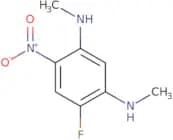
CAS:Versatile small molecule scaffoldFormula:C12H14Cl2N2OPurity:Min. 95%Molecular weight:273.15 g/mol4-Fluoro-1-N,3-N-dimethyl-6-nitrobenzene-1,3-diamine
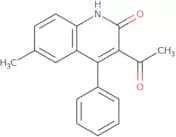
CAS:Versatile small molecule scaffoldFormula:C8H10FN3O2Purity:Min. 95%Molecular weight:199.18 g/mol3-Acetyl-6-methyl-4-phenyl-1,2-dihydroquinolin-2-one
CAS:Versatile small molecule scaffoldFormula:C18H15NO2Purity:Min. 95%Molecular weight:277.3 g/mol

![1-Benzyl-1H-[1,2,3]triazole-4-carbonitrile](/_next/image/?url=https%3A%2Fstatic.cymitquimica.com%2Fproducts%2F3D%2Fthumb-webp%2FCIA00307.webp&w=3840&q=75)
![4-[(Carboxymethyl)sulfanyl]-3-nitrobenzoic acid](/_next/image/?url=https%3A%2Fstatic.cymitquimica.com%2Fproducts%2F3D%2Fthumb-webp%2FCIA19124.webp&w=3840&q=75)

![2-[(Pyridin-3-yl)methoxy]aniline dihydrochloride](/_next/image/?url=https%3A%2Fstatic.cymitquimica.com%2Fproducts%2F3D%2Fthumb-webp%2FCIA28873.webp&w=3840&q=75)