


Building Blocks
This section contains fundamental products for the synthesis of organic and biological compounds. Building blocks are the essential starting materials used to construct complex molecules through various chemical reactions. They play a critical role in drug discovery, material science, and chemical research. At CymitQuimica, we offer a diverse range of high-quality building blocks to support your innovative research and industrial projects, ensuring you have the essential components for successful synthesis.
Subcategories of "Building Blocks"
- Boronic Acids & Boronic Acid Derivatives(5,756 products)
- Chiral Building Blocks(1,242 products)
- Hydrocarbon Building Blocks(6,095 products)
- Organic Building Blocks(61,055 products)
Found 199650 products of "Building Blocks"
Sort by
Purity (%)
0
100
|
0
|
50
|
90
|
95
|
100
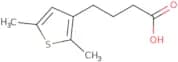
4-(2,5-Dimethylthiophen-3-yl)butanoic acid
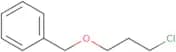
CAS:<p>Versatile small molecule scaffold</p>Formula:C10H14O2SPurity:Min. 95%Molecular weight:198.28 g/mol((3-Chloropropoxy)methyl)benzene
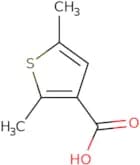
CAS:<p>Versatile small molecule scaffold</p>Formula:C10H13ClOPurity:Min. 95%Color and Shape:Clear LiquidMolecular weight:184.66 g/mol2,5-Dimethyl-thiophene-3-carboxylic acid
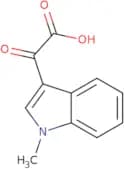
CAS:<p>Versatile small molecule scaffold</p>Formula:C7H8O2SPurity:Min. 95%Molecular weight:156.2 g/molN-Methyl-3-indoleglyoxylic acid 97
CAS:Controlled Product<p>N-Methyl-3-indoleglyoxylic acid 97 is a potent and selective inhibitor of protein kinases, including the mitogen activated protein kinase (MAPK) family. It has been shown to inhibit proliferation of cells in vitro. In addition, N-Methyl-3-indoleglyoxylic acid 97 inhibits the activation of MAPK in response to stress or cytokine stimulation. This agent has been shown to be selective for different isotypes of protein kinases and displays good selectivity for inhibition of the enzyme activity.</p>Formula:C11H9NO3Purity:Min. 95%Molecular weight:203.19 g/mol2,5-Dichloro-3,4-dinitrothiophene
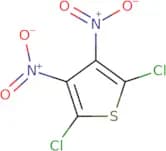
CAS:<p>2,5-Dichloro-3,4-dinitrothiophene is a crystalline solid with a tetragonal crystal system. It has been shown to form with yields of up to 45%, depending on the solvent. The crystal structure has been determined by X-ray crystallography and it was found to be monoclinic with nitro groups interacting in a manner analogous to nitro groups. Nitration of 2,5-dichloro-3,4-dinitrothiophene has been shown to produce 2,5-dichloro-3,4-dinitrobenzene and 2,5-dichloro-3,4-dinitrophenylhydrazine.</p>Formula:C4Cl2N2O4SPurity:Min. 95%Molecular weight:243.02 g/mol4-Methyl-5-propyl-4H-1,2,4-triazole-3-thiol
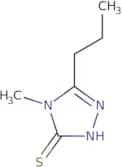
CAS:<p>Versatile small molecule scaffold</p>Formula:C6H11N3SPurity:Min. 95%Molecular weight:157.24 g/mol1-(2H-chromen-3-yl)ethanone
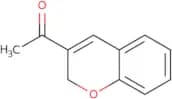
CAS:<p>Versatile small molecule scaffold</p>Formula:C11H10O2Purity:Min. 95%Molecular weight:174.19 g/mol1-(4-Fluorophenyl)prop-2-en-1-one
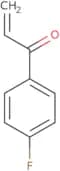
CAS:<p>1-(4-Fluorophenyl)prop-2-en-1-one is a chalcone that has been shown to have anticancer activity. It has been shown to stabilize the response elements of the transcriptional regulatory protein NF-κB and induce apoptosis in colorectal adenocarcinoma cells. This compound is also able to inhibit cancer growth by inhibiting tumor angiogenesis and metastasis. 1-(4-Fluorophenyl)prop-2-en-1-one binds to DNA, preventing transcription and replication, which leads to cell death. 1-(4-Fluorophenyl)prop-2-en-1-one has also been found to bind withaferin A, a molecule that has been shown to have anticancer activity.</p>Formula:C9H7FOPurity:Min. 95%Molecular weight:150.15 g/mol3-Chloro-N-[(furan-2-yl)methyl]aniline
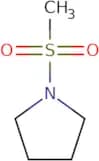
CAS:<p>Versatile small molecule scaffold</p>Formula:C11H10ClNOPurity:Min. 95%Molecular weight:207.65 g/mol1-Methanesulfonylpyrrolidine
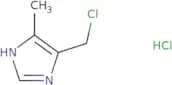
CAS:<p>Versatile small molecule scaffold</p>Formula:C5H11NO2SPurity:Min. 95%Molecular weight:149.21 g/mol5-(Chloromethyl)-4-methyl-1H-imidazole hydrochloride
CAS:<p>Isothiourea is an imidazole derivative that acts as a competitive antagonist of histamine H2 receptors. It has been used in the synthesis of cimetidine and other histamine H2 receptor antagonists. Isothiourea inhibits the action of histamine on the H2 receptor by binding to it, thereby preventing its activation. This drug is a synthetic compound that can be made from chloroform and thionyl chloride. It may be synthesized in a two-step process starting with chloromethyl methyl (methylchloro)imidazole, which is reacted with hydrochloric acid to produce 5-(chloromethyl)-4-methyl-1H-imidazole hydrochloride.</p>Formula:C5H8Cl2N2Purity:Min. 95%Molecular weight:167.04 g/mol2-Bromo-4-isopropylaniline
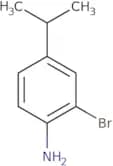
CAS:<p>2-Bromo-4-isopropylaniline is a spiroindoline that was synthesized by modification of the natural product, bryostatin. The compound has shown experimental activity against encephalomyelitis in mice. However, the mechanism of action is not known. 2-Bromo-4-isopropylaniline has been found to be an activator for ethylene and can catalyze reactions involving diphosphines and ligands. It binds to phenyl substituents on the molecule and forms x-ray crystallographic structures with high resolution. Optimization of the structure may lead to more potent analogs.</p>Formula:C9H12BrNPurity:Min. 95%Molecular weight:214.11 g/molChloro[(chlorocarbonyl)disulfanyl]methanone
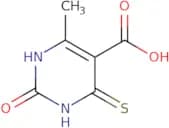
CAS:Chloro[(chlorocarbonyl)disulfanyl]methanone is a chemical compound that is used in the synthesis of new organic compounds. It is a substrate for cross-coupling reactions with organometallic reagents. Chloro[(chlorocarbonyl)disulfanyl]methanone reacts to form a chloroalkyl sulfide and an alkene, which can be converted into an amide or amine. The reaction mechanism involves nucleophilic attack at the sulfur atom by the metal halide, followed by elimination of chloride ion from the intermediate sulfonium salt to form the desired product. Chloro[(chlorocarbonyl)disulfanyl]methanone has been used in the synthesis of enantiopure compounds that are difficult to obtain through other methods.Formula:C2Cl2O2S2Purity:Min. 95%Molecular weight:191.1 g/mol6-Methyl-2-oxo-4-sulfanylidene-1,2,3,4-tetrahydropyrimidine-5-carboxylic acid
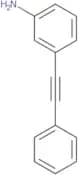
CAS:<p>Versatile small molecule scaffold</p>Formula:C6H6N2O3SPurity:Min. 95%Molecular weight:186.19 g/mol3-(phenylethynyl)aniline
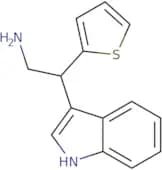
CAS:<p>3-(Phenylethynyl)aniline is a chemical compound that is insoluble in water and has a reactive crosslink. It is reactive with long-term exposure and has a gel permeation chromatography isolated yield. 3-(Phenylethynyl)aniline can be thermally decomposed to phenylethanethiol, which is an exothermic reaction. The technique of nmr spectroscopy can be used to study the reactivity of this compound. 3-(Phenylethynyl)aniline exhibits specific spectral features that can be used to identify it by nmr spectroscopy.</p>Formula:C14H11NPurity:Min. 95%Molecular weight:193.24 g/mol2-(1H-Indol-3-yl)-2-(thiophen-2-yl)ethan-1-amine
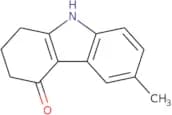
CAS:<p>Versatile small molecule scaffold</p>Formula:C14H14N2SPurity:Min. 95%Molecular weight:242.34 g/mol6-Methyl-2,3,4,9-tetrahydro-1H-carbazol-4-one
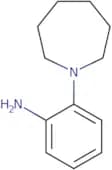
CAS:<p>Versatile small molecule scaffold</p>Formula:C13H13NOPurity:Min. 95%Molecular weight:199.25 g/mol2-Azepan-1-yl-phenylamine
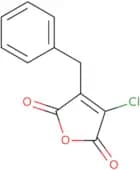
CAS:<p>Versatile small molecule scaffold</p>Formula:C12H18N2Purity:Min. 95%Molecular weight:190.28 g/mol3-Benzyl-4-chloro-2,5-dihydrofuran-2,5-dione
CAS:Versatile small molecule scaffoldFormula:C11H7ClO3Purity:Min. 95%Molecular weight:222.62 g/mol1-Azabicyclo[2.2.2]octane-3-carbonitrile
CAS:<p>1-Azabicyclo[2.2.2]octane-3-carbonitrile (1ABOC) is a hydrolyzing antihistamine that is used to treat allergies in the eye. This drug binds to histamine H1 receptors and blocks the release of histamine from mast cells, thereby preventing allergic symptoms. 1ABOC also has anti-inflammatory properties and may be useful for treating inflammatory disorders.</p>Formula:C8H12N2Purity:Min. 95%Molecular weight:136.19 g/mol

![3-Chloro-N-[(furan-2-yl)methyl]aniline](/_next/image/?url=https%3A%2Fstatic.cymitquimica.com%2Fproducts%2F3D%2Fthumb-webp%2FBCA59776.webp&w=3840&q=75)
![Chloro[(chlorocarbonyl)disulfanyl]methanone](/_next/image/?url=https%3A%2Fstatic.cymitquimica.com%2Fproducts%2F3D%2Fthumb-webp%2FBCA61588.webp&w=3840&q=75)
![1-Azabicyclo[2.2.2]octane-3-carbonitrile](/_next/image/?url=https%3A%2Fstatic.cymitquimica.com%2Fproducts%2F3D%2Fthumb-webp%2FBCA62776.webp&w=3840&q=75)