Building Blocks
This section contains fundamental products for the synthesis of organic and biological compounds. Building blocks are the essential starting materials used to construct complex molecules through various chemical reactions. They play a critical role in drug discovery, material science, and chemical research. At CymitQuimica, we offer a diverse range of high-quality building blocks to support your innovative research and industrial projects, ensuring you have the essential components for successful synthesis.
Subcategories of "Building Blocks"
- Boronic Acids & Boronic Acid Derivatives(5,756 products)
- Chiral Building Blocks(1,242 products)
- Hydrocarbon Building Blocks(6,095 products)
- Organic Building Blocks(61,055 products)
Found 199650 products of "Building Blocks"
Sort by
Purity (%)
0
100
|
0
|
50
|
90
|
95
|
100
N'-(5-Chlorobenzofuran-2-carbonyl)-2-(trifluoromethyl)benzenesulfonohydrazide
CAS:<p>Versatile small molecule scaffold</p>Formula:C16H10ClF3N2O4SPurity:Min. 95%Molecular weight:418.8 g/molIsoquinoline-1-carboxylic acid hydrazide
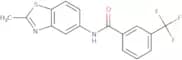
CAS:<p>Isoquinoline-1-carboxylic acid hydrazide (IQCAH) is a fluorescent probe that can be used to detect anions in aqueous solution. IQCAH has been used as a fluorescence probe for the detection of Fe(III) and Cu(II) in the presence of anions. The probe interacts with anionic species, such as salicylaldehyde, to produce a signal that can be detected by using fluorescence spectrometry. The high sensitivity and selectivity of IQCAH makes it useful for detecting low concentrations of anions in complex matrices, such as biological fluids.</p>Formula:C10H9N3OPurity:Min. 95%Molecular weight:187.2 g/molN-(2-Methyl-1,3-benzothiazol-5-yl)-3-(trifluoromethyl)benzamide
CAS:<p>Versatile small molecule scaffold</p>Formula:C16H11F3N2OSPurity:Min. 95%Molecular weight:336.3 g/mol8-Bromo-2,4-dichloroquinoline
CAS:<p>Versatile small molecule scaffold</p>Formula:C9H4BrCl2NPurity:Min. 95%Molecular weight:276.94 g/mol1-[3-(Benzyloxy)pyridin-2-yl]ethan-1-one
CAS:<p>Versatile small molecule scaffold</p>Formula:C14H13NO2Purity:Min. 95%Molecular weight:227.26 g/moltert-Butyl 3-formyl-3-methylpiperidine-1-carboxylate
CAS:<p>Versatile small molecule scaffold</p>Formula:C12H21NO3Purity:Min. 95%Molecular weight:227.3 g/mol4-Chloro-3-trifluoromethylbenzenesulfonamide
CAS:<p>Versatile small molecule scaffold</p>Formula:C7H5ClF3NO2SPurity:Min. 95%Molecular weight:259.64 g/mol4-(3,3-Dimethylpyrrolidin-1-yl)benzoic acid
CAS:<p>Versatile small molecule scaffold</p>Formula:C13H17NO2Purity:Min. 95%Molecular weight:219.28 g/mol5-(4-Iodophenoxymethyl)furan-2-carboxylic acid
CAS:<p>Versatile small molecule scaffold</p>Formula:C12H9IO4Purity:Min. 95%Molecular weight:344.1 g/mol5-(4-Chloro-3-methylphenoxymethyl)furan-2-carboxylic acid
CAS:<p>5-(4-Chloro-3-methylphenoxymethyl)furan-2-carboxylic acid is a lipase inhibitor that has been shown to have an inhibitory effect on hepatic lipase. It also inhibits amide hydrolysis, which may be due to its ability to bind to the active site of the enzyme. 5-(4-Chloro-3-methylphenoxymethyl)furan-2-carboxylic acid is used in the treatment of inflammatory diseases and autoimmune diseases. This drug has an inhibitory effect on the production of syncytial virus and prevents hyperglycemia caused by cancer cells. 5-(4-Chloro-3-methylphenoxymethyl)furan-2-carboxylic acid is found in oilseed crops such as soybeans, peanuts, and cottonseed.</p>Formula:C13H11ClO4Purity:Min. 95%Molecular weight:266.67 g/mol5-{[4-(Propan-2-yl)phenoxy]methyl}furan-2-carboxylic acid
CAS:<p>Versatile small molecule scaffold</p>Formula:C15H16O4Purity:Min. 95%Molecular weight:260.28 g/molMethyl 4-[(4-bromophenoxy)methyl]benzoate
CAS:<p>Versatile small molecule scaffold</p>Formula:C15H13BrO3Purity:Min. 95%Molecular weight:321.16 g/mol5-(4-Iodo-phenoxymethyl)-furan-2-carboxylic acid methyl ester
CAS:<p>Versatile small molecule scaffold</p>Formula:C13H11IO4Purity:Min. 95%Molecular weight:358.13 g/molMethyl 5-[(4-chlorophenoxy)methyl]-2-furoate
CAS:<p>Versatile small molecule scaffold</p>Formula:C13H11ClO4Purity:Min. 95%Molecular weight:266.67 g/mol4-(3-Nitro-[1,2,4]triazol-1-ylmethyl)-benzoic acid methyl ester
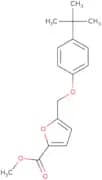
CAS:<p>Versatile small molecule scaffold</p>Formula:C11H10N4O4Purity:Min. 95%Molecular weight:262.22 g/mol5-(4-tert-Butyl-phenoxymethyl)-furan-2-carboxylic acid methyl ester
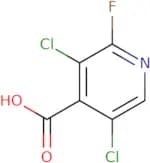
CAS:<p>Versatile small molecule scaffold</p>Formula:C17H20O4Purity:Min. 95%Molecular weight:288.34 g/mol3,5-Dichloro-2-fluoropyridine-4-carboxylic acid
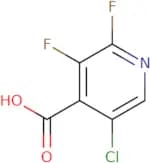
CAS:<p>Versatile small molecule scaffold</p>Formula:C6H2Cl2FNO2Purity:Min. 95%Molecular weight:209.99 g/mol5-Chloro-2,3-difluoropyridine-4-carboxylic acid
CAS:<p>Versatile small molecule scaffold</p>Formula:C6H2ClF2NO2Purity:Min. 95%Molecular weight:193.53 g/molMethyl 4-cyano-2-methoxybenzoate
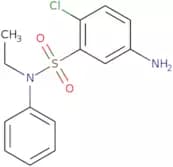
CAS:<p>Versatile small molecule scaffold</p>Formula:C10H9NO3Purity:Min. 95%Molecular weight:191.18 g/mol5-Amino-2-chloro-N-ethyl-N-phenyl-benzenesulfonamide
CAS:<p>5-Amino-2-chloro-N-ethyl-N-phenylbenzenesulfonamide is a novel antibiotic that belongs to the group of synthetic antibiotics. This drug has been shown to be effective against bacteria, fungi, and viruses, as well as parasites like malaria. 5-Amino-2-chloro-N-ethylbenzenesulfonamide is structurally similar to sulfanilamide and may act in a similar manner. It inhibits bacterial growth by competing with paraaminobenzoic acid (PABA) for binding sites on the enzyme dihydropteroate synthase. This leads to reduced synthesis of folic acid and other bacterial enzymes, which are required for DNA synthesis and cell division.</p>Formula:C14H15ClN2O2SPurity:Min. 95%Molecular weight:310.8 g/mol



![1-[3-(Benzyloxy)pyridin-2-yl]ethan-1-one](/_next/image/?url=https%3A%2Fstatic.cymitquimica.com%2Fproducts%2F3D%2Fthumb-webp%2FGRA21235.webp&w=3840&q=75)


![5-{[4-(Propan-2-yl)phenoxy]methyl}furan-2-carboxylic acid](/_next/image/?url=https%3A%2Fstatic.cymitquimica.com%2Fproducts%2F3D%2Fthumb-webp%2FGRA47058.webp&w=3840&q=75)
![Methyl 4-[(4-bromophenoxy)methyl]benzoate](/_next/image/?url=https%3A%2Fstatic.cymitquimica.com%2Fproducts%2F3D%2Fthumb-webp%2FGRA47062.webp&w=3840&q=75)

![Methyl 5-[(4-chlorophenoxy)methyl]-2-furoate](/_next/image/?url=https%3A%2Fstatic.cymitquimica.com%2Fproducts%2F3D%2Fthumb-webp%2FGRA47068.webp&w=3840&q=75)
![4-(3-Nitro-[1,2,4]triazol-1-ylmethyl)-benzoic acid methyl ester](/_next/image/?url=https%3A%2Fstatic.cymitquimica.com%2Fproducts%2F3D%2Fthumb-webp%2FGRA47074.webp&w=3840&q=75)