Building Blocks
This section contains fundamental products for the synthesis of organic and biological compounds. Building blocks are the essential starting materials used to construct complex molecules through various chemical reactions. They play a critical role in drug discovery, material science, and chemical research. At CymitQuimica, we offer a diverse range of high-quality building blocks to support your innovative research and industrial projects, ensuring you have the essential components for successful synthesis.
Subcategories of "Building Blocks"
- Boronic Acids & Boronic Acid Derivatives(5,805 products)
- Chiral Building Blocks(1,248 products)
- Hydrocarbon Building Blocks(6,122 products)
- Organic Building Blocks(61,463 products)
Found 208442 products of "Building Blocks"
Sort by
Purity (%)
0
100
|
0
|
50
|
90
|
95
|
100
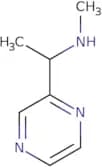
Methyl-(1-pyrazin-2-yl-ethyl)-amine
CAS:Versatile small molecule scaffold
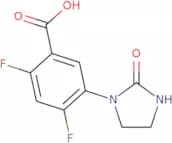
Formula:C7H11N3Purity:Min. 95%Molecular weight:137.18 g/mol2,4-Difluoro-5-(2-oxoimidazolidin-1-yl)benzoic acid
CAS:Versatile small molecule scaffoldFormula:C10H8F2N2O3Purity:Min. 95%Molecular weight:242.18 g/mol3-Amino-4-(4-chlorophenoxy)benzoic acid
CAS:3-Amino-4-(4-chlorophenoxy)benzoic acid is a peptide activator that binds to the receptor for nerve growth factor (NGF). It has been shown to be a research tool for studying protein interactions and antibody recognition. This product is also an inhibitor of ion channels, including calcium ion channels. 3-Amino-4-(4-chlorophenoxy)benzoic acid is used in pharmacology and life science research as it can be used as a ligand or receptor, depending on the desired study.Formula:C13H10ClNO3Purity:Min. 95%Molecular weight:263.67 g/mol7-Hydrazinyl-5-(trifluoromethyl)-[1,2,4]triazolo[1,5-a]pyrimidine
CAS:Versatile small molecule scaffoldFormula:C6H5F3N6Purity:Min. 95%Molecular weight:218.14 g/mol4-Bromo-1-[(4-methoxyphenyl)methyl]-1H-pyrazole
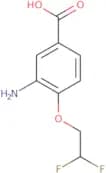
CAS:Versatile small molecule scaffoldFormula:C11H11BrN2OPurity:Min. 95%Molecular weight:267.12 g/mol3-Amino-4-(2,2-difluoroethoxy)benzoic acid
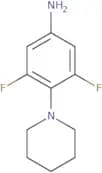
CAS:Versatile small molecule scaffoldFormula:C9H9F2NO3Purity:Min. 95%Molecular weight:217.17 g/mol3,5-Difluoro-4-(piperidin-1-yl)aniline
CAS:Versatile small molecule scaffoldFormula:C11H14F2N2Purity:Min. 95%Molecular weight:212.24 g/mol1-[2-(4-Chlorophenyl)phenyl]ethan-1-amine
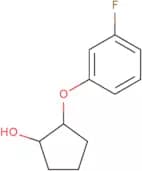
CAS:Versatile small molecule scaffoldFormula:C14H14ClNPurity:Min. 95%Molecular weight:231.72 g/mol2-(3-Fluorophenoxy)cyclopentan-1-ol
CAS:Versatile small molecule scaffold
Formula:C11H13FO2Purity:Min. 95%Molecular weight:196.22 g/mol2-[4-(2,2-Difluoroethanesulfonyl)phenyl]acetic acid
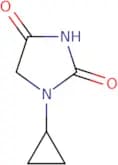
CAS:Versatile small molecule scaffoldFormula:C10H10F2O4SPurity:Min. 95%Molecular weight:264.25 g/mol1-Cyclopropylimidazolidine-2,4-dione
CAS:Cyclopropylimidazolidine-2,4-dione is a heterocyclic compound with a 1,3-dioxane framework. It is an organic compound that is commonly used as a lubricant additive. Cyclopropylimidazolidine-2,4-dione has been shown to be effective in the synthesis of diketopiperazines and dimers. This organic compound can also be used as an additive in the manufacturing of polymers and other products. The synthesis of this compound requires strategies such as chemistries and additives. These strategies are often synthesized using connective structures such as alkaloids or diketopiperazines.Formula:C6H8N2O2Purity:Min. 95%Molecular weight:140.14 g/molMethyl(1-{3-[4-(propan-2-yloxy)phenyl]phenyl}ethyl)amine
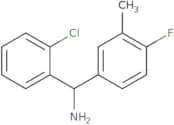
CAS:Versatile small molecule scaffoldFormula:C18H23NOPurity:Min. 95%Molecular weight:269.4 g/mol(2-Chlorophenyl)(4-fluoro-3-methylphenyl)methanamine
CAS:Versatile small molecule scaffoldFormula:C14H13ClFNPurity:Min. 95%Molecular weight:249.71 g/mol3-[(Propan-2-ylsulfanyl)methyl]aniline
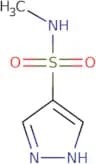
CAS:Versatile small molecule scaffoldFormula:C10H15NSPurity:Min. 95%Molecular weight:181.3 g/molN-Methyl-1H-pyrazole-4-sulfonamide
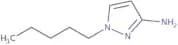
CAS:Versatile small molecule scaffoldFormula:C4H7N3O2SPurity:Min. 95%Molecular weight:161.19 g/mol1-Pentyl-1H-pyrazol-3-amine
CAS:Versatile small molecule scaffold
Formula:C8H15N3Purity:Min. 95%Molecular weight:153.22 g/mol4-[N-(2-Hydroxyethyl)prop-2-enamido]benzoic acid
CAS:Versatile small molecule scaffoldFormula:C12H13NO4Purity:Min. 95%Molecular weight:235.24 g/mol4-[2-(1H-Pyrazol-1-yl)propanamido]cyclohexane-1-carboxylic acid
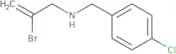
CAS:Versatile small molecule scaffoldFormula:C13H19N3O3Purity:Min. 95%Molecular weight:265.31 g/mol2-Bromo-N-(4-chlorobenzyl)prop-2-en-1-amine
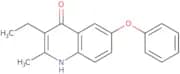
CAS:Versatile small molecule scaffoldFormula:C10H11BrClNPurity:Min. 95%Molecular weight:260.56 g/mol3-Ethyl-2-methyl-6-phenoxy-1,4-dihydroquinolin-4-one
CAS:Versatile small molecule scaffoldFormula:C18H17NO2Purity:Min. 95%Molecular weight:279.3 g/mol


![7-Hydrazinyl-5-(trifluoromethyl)-[1,2,4]triazolo[1,5-a]pyrimidine](/_next/image/?url=https%3A%2Fstatic.cymitquimica.com%2Fproducts%2F3D%2Fthumb-webp%2FDXB36604.webp&w=3840&q=75)
![4-Bromo-1-[(4-methoxyphenyl)methyl]-1H-pyrazole](/_next/image/?url=https%3A%2Fstatic.cymitquimica.com%2Fproducts%2F3D%2Fthumb-webp%2FDXB37193.webp&w=3840&q=75)
![1-[2-(4-Chlorophenyl)phenyl]ethan-1-amine](/_next/image/?url=https%3A%2Fstatic.cymitquimica.com%2Fproducts%2F3D%2Fthumb-webp%2FDXB37520.webp&w=3840&q=75)
![2-[4-(2,2-Difluoroethanesulfonyl)phenyl]acetic acid](/_next/image/?url=https%3A%2Fstatic.cymitquimica.com%2Fproducts%2F3D%2Fthumb-webp%2FDXB37942.webp&w=3840&q=75)
![Methyl(1-{3-[4-(propan-2-yloxy)phenyl]phenyl}ethyl)amine](/_next/image/?url=https%3A%2Fstatic.cymitquimica.com%2Fproducts%2F3D%2Fthumb-webp%2FDXB40239.webp&w=3840&q=75)
![3-[(Propan-2-ylsulfanyl)methyl]aniline](/_next/image/?url=https%3A%2Fstatic.cymitquimica.com%2Fproducts%2F3D%2Fthumb-webp%2FDXB43080.webp&w=3840&q=75)
![4-[N-(2-Hydroxyethyl)prop-2-enamido]benzoic acid](/_next/image/?url=https%3A%2Fstatic.cymitquimica.com%2Fproducts%2F3D%2Fthumb-webp%2FDXB43406.webp&w=3840&q=75)
![4-[2-(1H-Pyrazol-1-yl)propanamido]cyclohexane-1-carboxylic acid](/_next/image/?url=https%3A%2Fstatic.cymitquimica.com%2Fproducts%2F3D%2Fthumb-webp%2FDXB43608.webp&w=3840&q=75)