


Building Blocks
Subcategories of "Building Blocks"
- Boronic Acids & Boronic Acid Derivatives(5,805 products)
- Chiral Building Blocks(1,248 products)
- Hydrocarbon Building Blocks(6,118 products)
- Organic Building Blocks(61,447 products)
Found 208422 products of "Building Blocks"
3,5-Dimethyl-1-(propan-2-yl)-1H-pyrazol-4-amine
CAS:Versatile small molecule scaffoldFormula:C8H15N3Purity:Min. 95%Molecular weight:153.22 g/mol2,3,5,6-Tetramethylbenzenesulfonyl chloride
CAS:Versatile small molecule scaffoldFormula:C10H13ClO2SPurity:Min. 95%Molecular weight:232.73 g/mol4-Benzyloxydiphenylamine
CAS:Versatile small molecule scaffoldFormula:C19H17NOPurity:Min. 95%Molecular weight:275.3 g/mol2-Methyl-3-(methylsulfanyl)aniline
CAS:Versatile small molecule scaffoldFormula:C8H11NSPurity:Min. 95%Molecular weight:153.25 g/mol(1-Benzyl-piperidin-3-yl)-methyl-amine
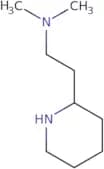
CAS:Versatile small molecule scaffoldFormula:C13H20N2Purity:Min. 95%Molecular weight:204.32 g/molN,N-Dimethyl-2-(2-piperidinyl)-1-ethanaminedihydrochloride
CAS:Versatile small molecule scaffoldFormula:C9H22Cl2N2Purity:Min. 95%Molecular weight:229.2 g/molDimethyl-piperidin-2-ylmethyl-amine
CAS:Dimethyl-piperidin-2-ylmethyl-amine (DMPM) is a chemical compound that is known to inhibit activation pathways of NF-κB. DMPM is a selective inhibitor of the activation pathway of NF-κB, and has been shown to reduce inflammation in mouse models. It also inhibits receptor-mediated pathways, which are involved in the activation of antigen presenting cells. DMPM has been shown to be effective in inhibiting chronic inflammation and autoimmunity. This drug has been found to inhibit the inflammatory response by preventing the production of cytokines such as TNF-α, IL1β, IL6, and IFNγ. The chemical structure of DMPM has been shown to be stable enough for screening purposes.
Formula:C8H18N2Purity:Min. 95%Molecular weight:142.25 g/mol2-Cyanobicyclo[2.2.1]hept-5-ene-2-carboxylic acid
CAS:Versatile small molecule scaffoldFormula:C9H9NO2Purity:Min. 95%Molecular weight:163.17 g/mol1-(2-Hydroxyphenyl)-2-(1H-1,2,3,4-tetrazol-5-yl)ethan-1-one
CAS:Versatile small molecule scaffoldFormula:C9H8N4O2Purity:Min. 95%Molecular weight:204.19 g/mol2-(2-Phenyl-1,3-benzoxazol-4-yl)acetic acid
CAS:Versatile small molecule scaffoldFormula:C15H11NO3Purity:Min. 95%Molecular weight:253.25 g/mol3-Bromo-5-chlorothiophene-2-carboxylic acid
CAS:Versatile small molecule scaffold
Formula:C5H2BrClO2SPurity:Min. 95%Molecular weight:241.48 g/mol1-Phenyl-1H-pyrazole-4-sulfonamide
CAS:Versatile small molecule scaffold
Formula:C9H9N3O2SPurity:Min. 95%Molecular weight:223.25 g/mol[1-(2-Phenylethyl)pyrrolidin-2-yl]methanamine
CAS:Versatile small molecule scaffoldFormula:C13H20N2Purity:Min. 95%Molecular weight:204.31 g/mol3-Methyl-5-phenylcyclohexan-1-one
CAS:Versatile small molecule scaffold
Formula:C13H16OPurity:Min. 95%Molecular weight:188.26 g/molMethyl 3-[(3-methoxy-3-oxopropyl)sulfanyl]butanoate
CAS:Versatile small molecule scaffoldFormula:C9H16O4SPurity:Min. 95%Molecular weight:220.29 g/mol2-Methylthian-4-amine
CAS:Versatile small molecule scaffoldFormula:C6H13NSPurity:Min. 95%Molecular weight:131.24 g/mol4,6-Dimethylisothiazolo[5,4-b]pyridin-3(2H)-one
CAS:4,6-Dimethylisothiazolo[5,4-b]pyridin-3(2H)-one is a crystalline compound that belongs to the group of p2 molecules. This molecule has an electron density of 0.071 e/Å and a molecular weight of 172.14 g/mol. The tautomeric form is the most stable, with a geometry of C2v and a density of 1.8 g/cm3. The substituents are phenyl rings and methyl groups that have a molecular structure with the following constants: Torsion angle (χ) = -7°; Diameter (D) = 2.8 Å; Distance (d) = 2.4 Å; Length (l) = 3.9 Å; Angle (θ) = -57°; Distance to plane (a) = 2.0 ÅFormula:C8H8N2OSPurity:Min. 95%Molecular weight:180.23 g/mol1-Amino-3-(2-methylpropoxy)propan-2-ol
CAS:Versatile small molecule scaffoldFormula:C7H17NO2Purity:Min. 95%Molecular weight:147.22 g/molEthyl 2,2-difluorobut-3-enoate
CAS:Versatile small molecule scaffoldFormula:C6H8F2O2Purity:Min. 95%Molecular weight:150.12 g/mol3-ethoxy-4-hydroxybenzonitrile
CAS:3-ethoxy-4-hydroxybenzonitrile is a chemical compound that is found in many plants, such as eucalyptus and lavender. It has been shown to have an attractant effect on Diptera, especially Drosophila dorsalis. The structure of 3-ethoxy-4-hydroxybenzonitrile is similar to that of veratrole and methyl eugenol, both compounds that are known to be chemically attractive to flies. In the laboratory, 3-ethoxy-4-hydroxybenzonitrile has been shown to be more effective than either veratrole or methyl eugenol at attracting Drosophila dorsalis. This chemical can also cause damage when irradiated with ultraviolet light.Formula:C9H9NO2Purity:Min. 95%Molecular weight:163.18 g/mol



![2-Cyanobicyclo[2.2.1]hept-5-ene-2-carboxylic acid](/_next/image/?url=https%3A%2Fstatic.cymitquimica.com%2Fproducts%2F3D%2Fthumb-webp%2FKCA72214.webp&w=3840&q=75)


![[1-(2-Phenylethyl)pyrrolidin-2-yl]methanamine](/_next/image/?url=https%3A%2Fstatic.cymitquimica.com%2Fproducts%2F3D%2Fthumb-webp%2FKCA73745.webp&w=3840&q=75)

![Methyl 3-[(3-methoxy-3-oxopropyl)sulfanyl]butanoate](/_next/image/?url=https%3A%2Fstatic.cymitquimica.com%2Fproducts%2F3D%2Fthumb-webp%2FKCA74324.webp&w=3840&q=75)

![4,6-Dimethylisothiazolo[5,4-b]pyridin-3(2H)-one](/_next/image/?url=https%3A%2Fstatic.cymitquimica.com%2Fproducts%2F3D%2Fthumb-webp%2FKCA75075.webp&w=3840&q=75)


