Building Blocks
Subcategories of "Building Blocks"
- Boronic Acids & Boronic Acid Derivatives(5,780 products)
- Chiral Building Blocks(1,241 products)
- Hydrocarbon Building Blocks(6,100 products)
- Organic Building Blocks(61,017 products)
Found 205265 products of "Building Blocks"
5H,6H,7H,8H,9H-[1,2,4]Triazolo[4,3-a]azepine-3-thiol
CAS:Versatile small molecule scaffold
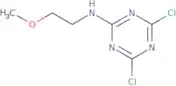
Formula:C7H11N3SPurity:Min. 95%Molecular weight:169.25 g/mol4,6-Dichloro-N-(2-methoxyethyl)-1,3,5-triazin-2-amine
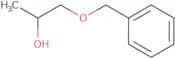
CAS:Versatile small molecule scaffoldFormula:C6H8Cl2N4OPurity:Min. 95%Molecular weight:223.06 g/mol1-Benzyloxy-2-propanol
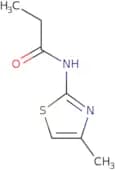
CAS:1-Benzyloxy-2-propanol is a synthetic compound that has been used to synthesize a variety of compounds. It is an alkylating agent that reacts with the nucleophilic centers on DNA, RNA, and proteins, leading to the formation of crosslinks between these molecules. 1-Benzyloxy-2-propanol can be used as a monomer in the synthesis of polymers with perfluorinated side chains. This compound also has anti-inflammatory properties due to its ability to inhibit lipase activity and phosphodiesterase activity.Formula:C10H14O2Purity:Min. 95%Molecular weight:166.22 g/molN-(4-Methylthiazol-2-yl)propionamide
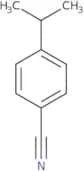
CAS:N-(4-methylthiazol-2-yl)propionamide is an activator of the amp-activated protein kinase (AMPK) signaling pathway, which has been shown to regulate glucose and fatty acid metabolism. In vitro studies have demonstrated that N-(4-methylthiazol-2-yl)propionamide activates AMPK, leading to increased uptake of glucose and fatty acids by cells. This drug has been shown to increase insulin sensitivity in mice by activation of the phosphatidylinositol 3 kinase signaling pathway. N-(4-Methylthiazol-2-yl)propionamide has also been shown to inhibit influenza virus replication in cell culture studies.Formula:C7H10N2OSPurity:Min. 95%Molecular weight:170.23 g/mol4-Isopropylbenzonitrile
CAS:4-Isopropylbenzonitrile (4IPB) is a reactive molecule that can be used to generate nitro radicals. It is a good candidate for the generation of nitro radicals because it has a redox potential that is near the center of the range encompassed by reactions with hydrogen peroxide. 4IPB also reacts with halogenated compounds, such as haloalkyls, which are efficient methods for generating nitro radicals. The reactivity of 4IPB can be demonstrated through assays using nitro and radical chain reactions. Hyperbolic plots of c1-6 alkyl and c1-4 alkyl in acidic media show that 4IPB is more reactive than other molecules in this class, such as mda-mb-231 cell and tyrosinase.
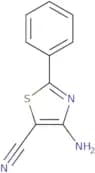
Formula:C10H11NPurity:Min. 95%Molecular weight:145.2 g/mol4-Amino-2-phenyl-1,3-thiazole-5-carbonitrile
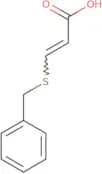
CAS:Versatile small molecule scaffoldFormula:C10H7N3SPurity:Min. 95%Molecular weight:201.25 g/mol(2Z)-3-(Benzylsulfanyl)prop-2-enoic acid
CAS:Versatile small molecule scaffoldFormula:C10H10O2SPurity:Min. 95%Molecular weight:194.25 g/mol1-(2-Bromoethoxy)-3-nitrobenzene
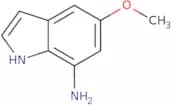
CAS:Versatile small molecule scaffoldFormula:C8H8BrNO3Purity:Min. 95%Molecular weight:246.06 g/mol5-Methoxy-1H-indol-7-amine
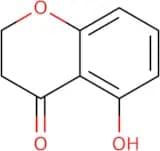
CAS:Versatile small molecule scaffoldFormula:C9H10N2OPurity:Min. 95%Molecular weight:162.19 g/mol5-Hydroxy-3,4-dihydro-2H-1-benzopyran-4-one
CAS:5-Hydroxy-3,4-dihydro-2H-1-benzopyran-4-one is a bioactive compound that is produced by microorganisms from indole alkaloids. It has been shown to have antibacterial activity in the form of an enzyme cascade, which can be inhibited by other compounds. The 5-hydroxy group of this compound is believed to be responsible for its inhibitory effects on the enzyme monooxygenase. This compound has not been fully characterized and does not have a known biological function.Formula:C9H8O3Purity:Min. 95%Molecular weight:164.16 g/mol6,6-dimethylbicyclo[3.1.0]hexan-3-one
CAS:6,6-dimethylbicyclo[3.1.0]hexan-3-one is a test compound that has been shown to exhibit antidepressant properties in animal models of depression. It is a cyclic ketone that can be synthesized by the scalable method of reacting piperazine with acetyl chloride and diethyl malonate. 6,6-Dimethylbicyclo[3.1.0]hexan-3-one has been shown to produce a statistically significant increase in locomotor activity in mice, but not rats, suggesting its effects are mediated by central nervous system mechanisms. This compound also exhibits antinociceptive and anxiolytic properties in animals.
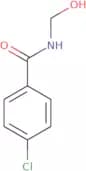
Formula:C8H12OPurity:Min. 95%Molecular weight:124.18 g/mol4-Chloro-N-(hydroxymethyl)benzamide
CAS:4-Chloro-N-(hydroxymethyl)benzamide is an electrophilic reactive compound. It can undergo biotransformation to the more reactive 4-chloro-N-(hydroxymethyl)benzoic acid, which has been shown to be mutagenic in bacteria and carcinogenic in rats. This compound reacts with hydronium ions and hydroxide ions to form a reactive electrophile. 4-Chloro-N-(hydroxymethyl)benzamide also reacts with ethanethiol, which may be carcinogenic as well. This compound was incubated with glutathione, an antioxidant that protects cells from oxidative stress caused by free radicals, but it was not able to protect cells from the mutagenicity of this compound.
Formula:C8H8ClNO2Purity:Min. 95%Molecular weight:185.61 g/mol1',2'-dihydrospiro[cyclopropane-1,3'-indol]-2'-one
CAS:Versatile small molecule scaffoldFormula:C10H9NOPurity:Min. 95%Molecular weight:159.19 g/molDodecan-2-amine
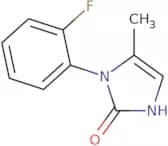
CAS:Versatile small molecule scaffoldFormula:C12H27NPurity:Min. 95%Molecular weight:185.35 g/mol1-(2-Fluorophenyl)-5-methyl-2,3-dihydro-1H-imidazol-2-one
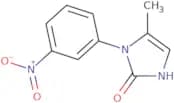
CAS:Versatile small molecule scaffoldFormula:C10H9FN2OPurity:Min. 95%Molecular weight:192.19 g/mol5-Methyl-1-(3-nitrophenyl)-2,3-dihydro-1H-imidazol-2-one
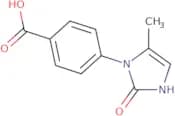
CAS:Versatile small molecule scaffoldFormula:C10H9N3O3Purity:Min. 95%Molecular weight:219.2 g/mol4-(5-Methyl-2-oxo-2,3-dihydro-1H-imidazol-1-yl)benzoic acid
CAS:Controlled Product4-(5-Methyl-2-oxo-2,3-dihydro-1H-imidazol-1-yl)benzoic acid is a ligand that binds to ion channels and is used as a research tool in pharmacological studies. It has been shown to activate a number of ion channels, including sodium and potassium channels. This compound has also been shown to bind to the GABA receptor, which regulates chloride levels in the brain. 4-(5-Methyl-2-oxo-2,3-dihydro-1H-imidazol-1y)benzoic acid may be used as an inhibitor for some ion channels and an activator for others. 4-(5 -methyl - 2 - oxo - 2 , 3 - dihydro - 1 H - imidazol - 1 yl) benzoic acid can be used in antibody production by conjugating it with other moleculesFormula:C11H10N2O3Purity:Min. 95%Molecular weight:218.21 g/mol5-Methyl-1-phenyl-2,3-dihydro-1H-imidazol-2-one
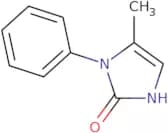
CAS:Versatile small molecule scaffoldFormula:C10H10N2OPurity:Min. 95%Molecular weight:174.2 g/mol1H-Pyrazolo[4,3-d]pyrimidin-7-amine
CAS:1H-Pyrazolo[4,3-d]pyrimidin-7-amine is a purine derivative that has been shown to have anti-leishmanial activity. It has been shown to be effective in the treatment of Leishmania donovani infections in mice without causing any adverse effects on the host. The previous studies show that 1H-pyrazolo[4,3-d]pyrimidin-7-amine inhibits the synthesis of purines, which are involved in nucleic acid and protein biosynthesis. This drug also appears to be more potent than other pyrazolopyrimidine derivatives because it targets ribonucleotide reductase. 1H-Pyrazolo[4,3-d]pyrimidin-7-amine is metabolized by cytochrome P450 enzymes and excreted as its metabolites in urine.
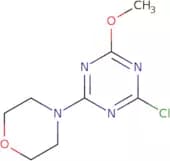
Formula:C5H5N5Purity:Min. 95%Molecular weight:135.13 g/mol2-Chloro-4-methoxy-6-(4-morpholinyl)-1,3,5-triazine
CAS:Versatile small molecule scaffoldFormula:C8H11ClN4O2Purity:Min. 95%Molecular weight:230.65 g/mol
![5H,6H,7H,8H,9H-[1,2,4]Triazolo[4,3-a]azepine-3-thiol](/_next/image/?url=https%3A%2Fstatic.cymitquimica.com%2Fproducts%2F3D%2Fthumb-webp%2FNAA80541.webp&w=3840&q=75)

![6,6-dimethylbicyclo[3.1.0]hexan-3-one](/_next/image/?url=https%3A%2Fstatic.cymitquimica.com%2Fproducts%2F3D%2Fthumb-webp%2FNAA85529.webp&w=3840&q=75)
![1',2'-dihydrospiro[cyclopropane-1,3'-indol]-2'-one](/_next/image/?url=https%3A%2Fstatic.cymitquimica.com%2Fproducts%2F3D%2Fthumb-webp%2FNAA86175.webp&w=3840&q=75)

![1H-Pyrazolo[4,3-d]pyrimidin-7-amine](/_next/image/?url=https%3A%2Fstatic.cymitquimica.com%2Fproducts%2F3D%2Fthumb-webp%2FNAA87756.webp&w=3840&q=75)