


Building Blocks
This section contains fundamental products for the synthesis of organic and biological compounds. Building blocks are the essential starting materials used to construct complex molecules through various chemical reactions. They play a critical role in drug discovery, material science, and chemical research. At CymitQuimica, we offer a diverse range of high-quality building blocks to support your innovative research and industrial projects, ensuring you have the essential components for successful synthesis.
Subcategories of "Building Blocks"
- Boronic Acids & Boronic Acid Derivatives(5,779 products)
- Chiral Building Blocks(1,238 products)
- Hydrocarbon Building Blocks(6,099 products)
- Organic Building Blocks(60,997 products)
Found 205208 products of "Building Blocks"
Sort by
Purity (%)
0
100
|
0
|
50
|
90
|
95
|
100
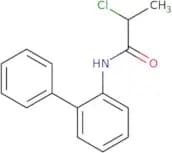
2-Chloro-N-(2-phenylphenyl)propanamide
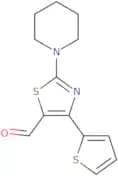
CAS:Versatile small molecule scaffoldFormula:C15H14ClNOPurity:Min. 95%Molecular weight:259.73 g/mol2-(Piperidin-1-yl)-4-(thiophen-2-yl)-1,3-thiazole-5-carbaldehyde
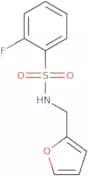
CAS:Versatile small molecule scaffoldFormula:C13H14N2OS2Purity:Min. 95%Molecular weight:278.4 g/mol2-Fluoro-N-(furan-2-ylmethyl)benzene-1-sulfonamide
CAS:Versatile small molecule scaffoldFormula:C11H10FNO3SPurity:Min. 95%Molecular weight:255.27 g/mol4-Hydrazinoquinoline hydrochloride
CAS:4-Hydrazinoquinoline hydrochloride is a cation with a molecular weight of 176.2. It is cytotoxic and inhibits cancer cell growth. 4-Hydrazinoquinoline hydrochloride has been shown to be effective against lymphoid, breast, colon, and prostate cancer cells in vitro with IC50 values of 0.5 to 2 μM. This drug has been shown to bind to DNA by forming a Schiff base with the amine group of guanine residues in the DNA backbone. This binding leads to changes in DNA conformation that inhibit transcription and replication as well as protein synthesis and cell division.Formula:C9H10ClN3Purity:Min. 95%Molecular weight:195.65 g/mol4-({4-Chloro-5-phenylthieno[2,3-d]pyrimidin-2-yl}methyl)morpholine
CAS:Versatile small molecule scaffoldFormula:C17H16ClN3OSPurity:Min. 95%Molecular weight:345.8 g/mol2-{2-[1-(Naphthalen-1-yl)ethylidene]hydrazin-1-yl}-4,5-dihydro-1,3-thiazol-4-one
CAS:Versatile small molecule scaffoldFormula:C15H13N3OSPurity:Min. 95%Molecular weight:283.4 g/mol4-Amino-5-[(2-fluorophenyl)methyl]-4H-1,2,4-triazole-3-thiol
CAS:Versatile small molecule scaffoldFormula:C9H9FN4SPurity:Min. 95%Molecular weight:224.26 g/mol5-Phenyl-1-[3-(trifluoromethyl)phenyl]-1H-1,2,4-triazole-3-carboxylic acid
CAS:Versatile small molecule scaffoldFormula:C16H10F3N3O2Purity:Min. 95%Molecular weight:333.26 g/mol2-(Chloromethyl)-6-methyl-5-phenyl-3H,4H-thieno[2,3-d]pyrimidin-4-one
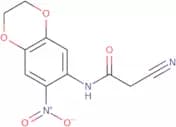
CAS:Versatile small molecule scaffoldFormula:C14H11ClN2OSPurity:Min. 95%Molecular weight:290.8 g/mol2-Cyano-N-(7-nitro-2,3-dihydro-1,4-benzodioxin-6-yl)acetamide
CAS:Versatile small molecule scaffoldFormula:C11H9N3O5Purity:Min. 95%Molecular weight:263.21 g/mol6-Amino-5-[(2-methoxyethyl)amino]-1-(2-methylpropyl)-1,2,3,4-tetrahydropyrimidine-2,4-dione
CAS:Versatile small molecule scaffold
Formula:C11H20N4O3Purity:Min. 95%Molecular weight:256.3 g/mol3-[Cyclohexyl(methyl)sulfamoyl]benzoic acid
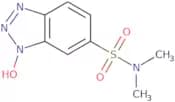
CAS:Versatile small molecule scaffoldFormula:C14H19NO4SPurity:Min. 95%Molecular weight:297.37 g/mol1-Hydroxy-N,N-dimethyl-1H-1,2,3-benzotriazole-6-sulfonamide
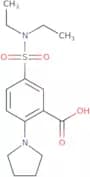
CAS:Versatile small molecule scaffoldFormula:C8H10N4O3SPurity:Min. 95%Molecular weight:242.26 g/mol5-(Diethylsulfamoyl)-2-(pyrrolidin-1-yl)benzoic acid
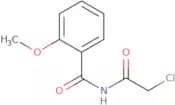
CAS:5-(Diethylsulfamoyl)-2-(pyrrolidin-1-yl)benzoic acid (DSPBA) is a synthetic chemical that inhibits microbial growth by inhibiting the synthesis of DNA. DSPBA has been used as an antiparasitic, antibiotic, and antibacterial agent in the treatment of various diseases. It is also used in chemotherapy to treat cancer and other diseases. DSPBA is effective against microorganisms such as viruses, fungi, and bacteria. This drug has been shown to be highly potent with low toxicity and may be used for the treatment of infections caused by Mycobacterium tuberculosis or Mycobacterium avium complex.Formula:C15H22N2O4SPurity:Min. 95%Molecular weight:326.4 g/molN-(2-chloroacetyl)-2-methoxybenzamide
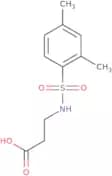
CAS:Versatile small molecule scaffoldFormula:C10H10ClNO3Purity:Min. 95%Molecular weight:227.64 g/mol3-(2,4-Dimethylbenzenesulfonamido)propanoic acid
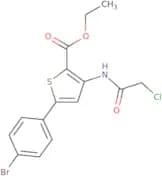
CAS:Versatile small molecule scaffoldFormula:C11H15NO4SPurity:Min. 95%Molecular weight:257.31 g/molEthyl 5-(4-bromophenyl)-3-(2-chloroacetamido)thiophene-2-carboxylate
CAS:Versatile small molecule scaffold
Formula:C15H13BrClNO3SPurity:Min. 95%Molecular weight:402.7 g/mol5-[2-(Thiophen-2-yl)quinolin-4-yl]-1,3,4-oxadiazole-2-thiol
CAS:Versatile small molecule scaffoldFormula:C15H9N3OS2Purity:Min. 95%Molecular weight:311.4 g/mol4-(5-Formylfuran-2-yl)-N-methylbenzene-1-sulfonamide
CAS:4-(5-Formylfuran-2-yl)-N-methylbenzene-1-sulfonamide is a synthetic, antiparasitic and antibiotic drug that has been shown to possess antiviral and antifungal properties. It is an inhibitor of DNA synthesis and RNA transcription by blocking the enzyme RNA polymerase II, and also inhibits protein synthesis by inhibiting the enzyme ribosomal protein S12. 4-(5-Formylfuran-2-yl)-N-methylbenzene-1-sulfonamide is effective against both Gram positive and Gram negative bacteria, as well as yeast. The compound has been shown to be active against bacteria such as Escherichia coli, Pseudomonas aeruginosa, Salmonella enterica serovar Typhi, Staphylococcus aureus (MRSA), Mycobacterium tuberculosis, Mycobacterium avium complex, Candida albFormula:C12H11NO4SPurity:Min. 95%Molecular weight:265.29 g/mol7-Methyl-2-(trifluoromethyl)-[1,2,4]triazolo[1,5-a]pyrimidin-5-amine
CAS:Versatile small molecule scaffoldFormula:C7H6F3N5Purity:Min. 95%Molecular weight:217.15 g/mol


![4-({4-Chloro-5-phenylthieno[2,3-d]pyrimidin-2-yl}methyl)morpholine](/_next/image/?url=https%3A%2Fstatic.cymitquimica.com%2Fproducts%2F3D%2Fthumb-webp%2FEXA43699.webp&w=3840&q=75)
![2-{2-[1-(Naphthalen-1-yl)ethylidene]hydrazin-1-yl}-4,5-dihydro-1,3-thiazol-4-one](/_next/image/?url=https%3A%2Fstatic.cymitquimica.com%2Fproducts%2F3D%2Fthumb-webp%2FEXA43697.webp&w=3840&q=75)
![4-Amino-5-[(2-fluorophenyl)methyl]-4H-1,2,4-triazole-3-thiol](/_next/image/?url=https%3A%2Fstatic.cymitquimica.com%2Fproducts%2F3D%2Fthumb-webp%2FEXA43695.webp&w=3840&q=75)
![5-Phenyl-1-[3-(trifluoromethyl)phenyl]-1H-1,2,4-triazole-3-carboxylic acid](/_next/image/?url=https%3A%2Fstatic.cymitquimica.com%2Fproducts%2F3D%2Fthumb-webp%2FEXA43693.webp&w=3840&q=75)
![2-(Chloromethyl)-6-methyl-5-phenyl-3H,4H-thieno[2,3-d]pyrimidin-4-one](/_next/image/?url=https%3A%2Fstatic.cymitquimica.com%2Fproducts%2F3D%2Fthumb-webp%2FEXA43689.webp&w=3840&q=75)
![6-Amino-5-[(2-methoxyethyl)amino]-1-(2-methylpropyl)-1,2,3,4-tetrahydropyrimidine-2,4-dione](/_next/image/?url=https%3A%2Fstatic.cymitquimica.com%2Fproducts%2F3D%2Fthumb-webp%2FEXA42728.webp&w=3840&q=75)
![3-[Cyclohexyl(methyl)sulfamoyl]benzoic acid](/_next/image/?url=https%3A%2Fstatic.cymitquimica.com%2Fproducts%2F3D%2Fthumb-webp%2FEXA42645.webp&w=3840&q=75)
![5-[2-(Thiophen-2-yl)quinolin-4-yl]-1,3,4-oxadiazole-2-thiol](/_next/image/?url=https%3A%2Fstatic.cymitquimica.com%2Fproducts%2F3D%2Fthumb-webp%2FEXA42326.webp&w=3840&q=75)

![7-Methyl-2-(trifluoromethyl)-[1,2,4]triazolo[1,5-a]pyrimidin-5-amine](/_next/image/?url=https%3A%2Fstatic.cymitquimica.com%2Fproducts%2F3D%2Fthumb-webp%2FEXA40852.webp&w=3840&q=75)