Building Blocks
This section contains fundamental products for the synthesis of organic and biological compounds. Building blocks are the essential starting materials used to construct complex molecules through various chemical reactions. They play a critical role in drug discovery, material science, and chemical research. At CymitQuimica, we offer a diverse range of high-quality building blocks to support your innovative research and industrial projects, ensuring you have the essential components for successful synthesis.
Subcategories of "Building Blocks"
- Boronic Acids & Boronic Acid Derivatives(5,778 products)
- Chiral Building Blocks(1,242 products)
- Hydrocarbon Building Blocks(6,098 products)
- Organic Building Blocks(61,059 products)
Found 199580 products of "Building Blocks"
Sort by
Purity (%)
0
100
|
0
|
50
|
90
|
95
|
100
3-Azatricyclo[7.3.1.0,5,13]trideca-5,7,9(13)-triene hydrochloride
CAS:<p>Versatile small molecule scaffold</p>Formula:C12H16ClNPurity:Min. 95%Molecular weight:209.71 g/mol2-Azatricyclo[7.3.1.0,5,13]trideca-1(12),9(13),10-triene hydrochloride
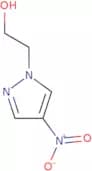
CAS:<p>Versatile small molecule scaffold</p>Formula:C12H16ClNPurity:Min. 95%Molecular weight:209.71 g/mol2-(4-Nitro-pyrazol-1-yl)-ethanol
CAS:<p>2-(4-Nitro-pyrazol-1-yl)-ethanol is a cyclic anion that has been shown to be damaging to DNA. It has been studied by the kinetic methods of anion exchange chromatography and solvent extraction. 2-(4-Nitro-pyrazol-1-yl)-ethanol was found to be a weak base, with a pKb value of 10.2. The compound reacts with glutathione to form 2-(4-nitro-pyrazol-1-yl)-ethanesulfonic acid, which is in equilibrium with the corresponding alcohol. This reaction can be measured by monitoring the changes in absorbance at 260 nm and 280 nm. The nitro group on 2-(4-nitro-pyrazol-1-yl)-ethanol shifts the potentials of methylene blue and methyl green toward more positive values, making them more sensitive to this type of damage.</p>Formula:C5H7N3O3Purity:Min. 95%Molecular weight:157.13 g/mol2-[(2-Hydroxy-2-phenylethyl)amino]propan-1-ol
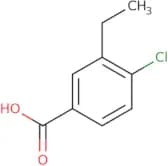
CAS:<p>Versatile small molecule scaffold</p>Formula:C11H17NO2Purity:Min. 95%Molecular weight:195.26 g/mol4-Chloro-3-ethylbenzoic acid
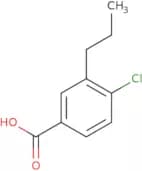
CAS:Versatile small molecule scaffoldFormula:C9H9ClO2Purity:Min. 95%Molecular weight:184.62 g/mol4-Chloro-3-propylbenzoic acid
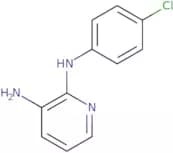
CAS:<p>Versatile small molecule scaffold</p>Formula:C10H11ClO2Purity:Min. 95%Molecular weight:198.64 g/mol2-N-(4-Chlorophenyl)pyridine-2,3-diamine
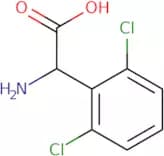
CAS:Versatile small molecule scaffoldFormula:C11H10ClN3Purity:Min. 95%Molecular weight:219.67 g/mol2-Amino-2-(2,6-dichlorophenyl)acetic acid
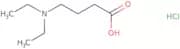
CAS:<p>Versatile small molecule scaffold</p>Formula:C8H7Cl2NO2Purity:Min. 95%Molecular weight:220.05 g/mol4-(Diethylamino)butyric acid hydrochloride
CAS:4-(Diethylamino)butyric acid hydrochloride is a potent antimalarial drug that belongs to the group of benzothiopyrans. It has been shown to be an effective treatment for malaria. This compound is a phenolic compound, which contains a phenol group in its chemical structure. The esterification of 4-(diethylamino)butyric acid hydrochloride with water-soluble derivatives such as acetyl chloride or acetic anhydride yields water-soluble derivatives.Formula:C8H18ClNO2Purity:Min. 95%Molecular weight:195.69 g/molN-[(4-Methoxyphenyl)Methyl]Methanesulfonamide
CAS:<p>Versatile small molecule scaffold</p>Formula:C9H13NO3SPurity:Min. 95%Molecular weight:215.27 g/mol4-[4-(Propan-2-yl)benzoyl]piperidine hydrochloride
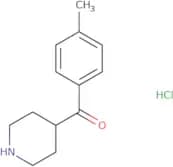
CAS:Versatile small molecule scaffoldFormula:C15H22ClNOPurity:Min. 95%Molecular weight:267.8 g/mol4-(4-Methylbenzoyl)piperidine hydrochloride
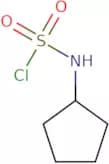
CAS:<p>Versatile small molecule scaffold</p>Formula:C13H18ClNOPurity:Min. 95%Molecular weight:239.74 g/molN-Cyclopentylsulfamoyl chloride
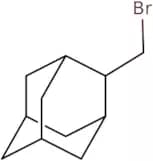
CAS:<p>N-Cyclopentylsulfamoyl chloride is a diuretic drug that is used in veterinary medicine. It has been shown to increase fertility in animals. N-Cyclopentylsulfamoyl chloride also has aliphatic, sulfamates, and sulfamoyl chloride properties.</p>Formula:C5H10ClNO2SPurity:Min. 95%Molecular weight:183.66 g/mol2-(Bromomethyl)adamantane
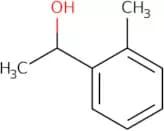
CAS:<p>Versatile small molecule scaffold</p>Formula:C11H17BrPurity:Min. 95%Molecular weight:229.16 g/mol(1R)-1-(2-Methylphenyl)ethan-1-ol
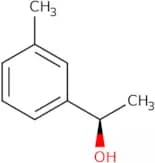
CAS:<p>Versatile small molecule scaffold</p>Formula:C9H12OPurity:Min. 95%Molecular weight:136.19 g/mol(1R)-1-(3-methylphenyl)ethanol
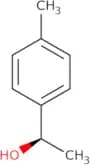
CAS:Versatile small molecule scaffoldFormula:C9H12OPurity:Min. 95%Molecular weight:136.19 g/mol(R)-1-(p-tolyl)ethan-1-ol
CAS:<p>(R)-1-(p-tolyl)ethan-1-ol is a chiral alcohol that can be synthesized through the reduction of p-chlorobenzaldehyde with sodium borohydride. It has been shown to have an inhibitory effect on bacterial growth, but not mammalian cells. The hydroxyl group on the (R)-1-(p-tolyl)ethan-1-ol molecule interacts with the cell membrane, which increases its permeability and thus allows for a greater substrate concentration. This reaction is stereoselective, so only one enantiomer will react with the enzyme. Preparative methods are employed to separate this compound from other enantiomers and purify it for use in biological experiments.</p>Formula:C9H12OPurity:Min. 95%Molecular weight:136.19 g/mol2-Methyl-1-(prop-2-yn-1-yl)-1H-1,3-benzodiazole
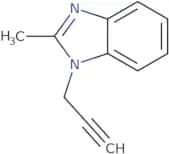
CAS:<p>Versatile small molecule scaffold</p>Formula:C11H10N2Purity:Min. 95%Molecular weight:170.21 g/mol(2-Ethylcyclopentyl)methanamine
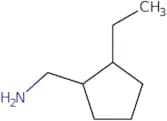
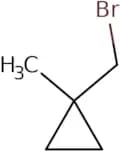
CAS:<p>Versatile small molecule scaffold</p>Formula:C8H17NPurity:Min. 95%Molecular weight:127.2 g/mol1-(Bromomethyl)-1-methylcyclopropane
CAS:Versatile small molecule scaffoldFormula:C5H9BrPurity:Min. 95%Molecular weight:149.03 g/mol
![3-Azatricyclo[7.3.1.0,5,13]trideca-5,7,9(13)-triene hydrochloride](/_next/image/?url=https%3A%2Fstatic.cymitquimica.com%2Fproducts%2F3D%2Fthumb-webp%2FSBA02542.webp&w=3840&q=75)

![2-Azatricyclo[7.3.1.0,5,13]trideca-1(12),9(13),10-triene hydrochloride](/_next/image/?url=https%3A%2Fstatic.cymitquimica.com%2Fproducts%2F3D%2Fthumb-webp%2FSBA02545.webp&w=3840&q=75)
![2-[(2-Hydroxy-2-phenylethyl)amino]propan-1-ol](/_next/image/?url=https%3A%2Fstatic.cymitquimica.com%2Fproducts%2F3D%2Fthumb-webp%2FSBA04241.webp&w=3840&q=75)
![N-[(4-Methoxyphenyl)Methyl]Methanesulfonamide](/_next/image/?url=https%3A%2Fstatic.cymitquimica.com%2Fproducts%2F3D%2Fthumb-webp%2FSBA06031.webp&w=3840&q=75)
![4-[4-(Propan-2-yl)benzoyl]piperidine hydrochloride](/_next/image/?url=https%3A%2Fstatic.cymitquimica.com%2Fproducts%2F3D%2Fthumb-webp%2FSBA06082.webp&w=3840&q=75)