Building Blocks
This section contains fundamental products for the synthesis of organic and biological compounds. Building blocks are the essential starting materials used to construct complex molecules through various chemical reactions. They play a critical role in drug discovery, material science, and chemical research. At CymitQuimica, we offer a diverse range of high-quality building blocks to support your innovative research and industrial projects, ensuring you have the essential components for successful synthesis.
Subcategories of "Building Blocks"
- Boronic Acids & Boronic Acid Derivatives(5,778 products)
- Chiral Building Blocks(1,242 products)
- Hydrocarbon Building Blocks(6,098 products)
- Organic Building Blocks(61,084 products)
Found 198714 products of "Building Blocks"
Sort by
Purity (%)
0
100
|
0
|
50
|
90
|
95
|
100
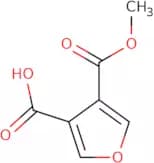
4-(Methoxycarbonyl)furan-3-carboxylic acid
CAS:4-(Methoxycarbonyl)furan-3-carboxylic acid is a fluorescent compound that can be used as an efficient hydrogenation reagent. It is also a versatile and efficient synthetic intermediate for the synthesis of bicyclic and heterocycled amines. 4-(Methoxycarbonyl)furan-3-carboxylic acid is generated from the reduction of 4-(methoxycarbonyl)pyrazole with lithium aluminum hydride, followed by hydrolysis. This method has been shown to yield high yields and functionalized products.Formula:C7H6O5Purity:Min. 95%Molecular weight:170.12 g/mol2,4-Furandicarboxylic acid
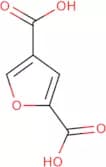
CAS:<p>2,4-Furandicarboxylic acid is a type of organic compound with the chemical formula C6H2O4. It is an acid that has optical properties and can be used as a reagent in organic synthesis. 2,4-Furandicarboxylic acid is biosynthesized by lactam dehydration, catalyzed by the enzyme 5-hmf. Furan rings are known to form when this compound undergoes oxidation reactions. The presence of furan rings can be detected through magnetic resonance spectroscopy and can be used to determine the concentration of 2,4-furandicarboxylic acid in urine samples.</p>Formula:C6H4O5Purity:Min. 95%Molecular weight:156.09 g/mol4-(Methoxycarbonyl)thiophene-3-carboxylic acid
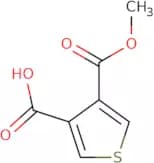
CAS:4-(Methoxycarbonyl)thiophene-3-carboxylic acid is a colorless liquid with a boiling point of 104-106 degrees Celsius. It can be obtained by alkaline hydrolysis of 4-(methoxycarbonyl)thiophene-2,5-dicarboxylic acid, or by the action of methanol on thiophene. The solubility of this compound in solvents depends on the polarity and the hydrogen bonding capability of the solvent. The kinetics of hydrolysis are dependent on temperature and pH. This compound has a pKa value of 10.5 and an ionization constant (pKb) value of 10.1. The thermodynamic parameters for this compound are calculated to be -9.4 kcal/mol for enthalpy, -8.4 kcal/mol for entropy, and -7.6 kcal/mol for free energy change at 298 K andFormula:C7H6O4SPurity:Min. 95%Molecular weight:186.19 g/molDimethyl Thiophene-3,4-dicarboxylate
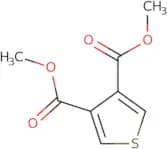
CAS:<p>Dimethyl Thiophene-3,4-dicarboxylate is a bioactive molecule that can be synthesized in a cross-coupling reaction. Dimethyl Thiophene-3,4-dicarboxylate has also been shown to have cytotoxic properties. This compound is able to alkylate DNA and RNA, which may account for its cytotoxic effects. The interactions of this compound with the acceptor molecules are still unknown. There is no information about the modification of this compound or the diffraction pattern obtained from it.</p>Formula:C8H8O4SPurity:Min. 95%Molecular weight:200.21 g/mol1-Iodononane (stabilized with Copper chip)
CAS:1-Iodononane is a reactive chemical species that can be used in the synthesis of amides and other important organic molecules. It has been used in asymmetric syntheses to produce molecules with different stereoisomers. 1-Iodononane has been found to have cancer-fighting properties, and it can be used as an eye drop for eye disorders such as conjunctivitis. This compound is also able to react with human liver cells, which may be due to its alkyl group. The magnesium salt of 1-iodonane may be able to inhibit the production of glycerin in the body, and its carbonyl group could lead to structural analysis of this molecule.Formula:C9H19IPurity:Min. 95%Molecular weight:254.16 g/mol9-(Prop-2-yn-1-yl)-9H-carbazole
CAS:<p>9-(Prop-2-yn-1-yl)-9H-carbazole is a monomer that has been shown to be insoluble, diffraction, and regioselective. Its copolymerization with 1,3-diphenylpropane yields polymers with high molecular weight. 9-(Prop-2-yn-1-yl)-9H-carbazole can be polymerized by the addition of sulfate ions, which can also act as a catalyst for the polymerization process. Copolymers of 9-(Prop-2-yn-1-yl)-9H-carbazole have been shown to possess photoconductive properties. This monomer has also been shown to be an effective catalyst for the 1,3 dipolar cycloaddition reaction.</p>Formula:C15H11NPurity:Min. 95%Molecular weight:205.26 g/molN-Methyl-N-(prop-2-yn-1-yl)aniline
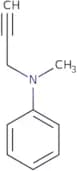
CAS:N-Methyl-N-(prop-2-yn-1-yl)aniline, also known as NMPAA, is a processable monomer. It has a high solubility in water and organic solvents. The methyl groups allow it to be oxidized easily, which can be used for the synthesis of other compounds. This monomer can be used to make polymers with terminal alkynes or azides. It is also able to undergo tricyanovinylation and bond cleavage reactions. Its main use is in the production of polymers with chromophores and dyes for plastics.Formula:C10H11NPurity:Min. 95%Molecular weight:145.2 g/molN-(4-Bromophenyl)methanesulfonamide
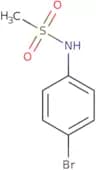
CAS:<p>N-(4-Bromophenyl)methanesulfonamide, also known as bromfenac, is a nonsteroidal anti-inflammatory drug (NSAID) of the sulfonanilide class. It binds to the COX enzyme and inhibits prostaglandin synthesis. The COX enzyme catalyzes the conversion of arachidonic acid to prostaglandins. This inhibition leads to reduction in inflammation and pain. Bromfenac has been shown to inhibit the production of pro-inflammatory cytokines such as TNF-α and IL-1β in vitro. Bromfenac is a crystalline compound with a molecular weight of 285.2 Da and consists of one chain with two hydrogen bonds that are both ionic and covalent in nature.</p>Formula:BrC6H4NHSO2CH3Purity:Min. 95%Molecular weight:250.11 g/mol2-Methanesulfonyl-4-methylaniline
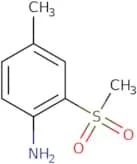
CAS:Versatile small molecule scaffoldFormula:C8H11NO2SPurity:Min. 95%Molecular weight:185.25 g/mol2-(2,5-Dimethylphenoxymethyl)oxirane
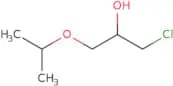
CAS:<p>Versatile small molecule scaffold</p>Formula:C11H14O2Purity:Min. 95%Molecular weight:178.23 g/mol1-Chloro-3-(propan-2-yloxy)propan-2-ol
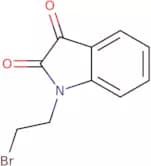
CAS:<p>Versatile small molecule scaffold</p>Formula:C6H13ClO2Purity:Min. 95%Molecular weight:152.62 g/mol1-(2-Bromoethyl)-1H-indole-2,3-dione
CAS:<p>1-(2-Bromoethyl)-1H-indole-2,3-dione is a planar molecule with hydrogen bonds and is a member of the isatin class of compounds. It has been used to evaluate the surface of inorganic materials, such as silicon wafers, which are made from sand or quartz. The bromine atom in this molecule can be replaced by chlorine or iodine atoms to create other isatin derivatives.</p>Formula:C10H8BrNO2Purity:Min. 95%Molecular weight:254.08 g/mol1-(2-Propynyl)-1H-indole-2,3-dione
CAS:<p>1-(2-Propynyl)-1H-indole-2,3-dione is a hydrophobic molecule that has been shown to have anticancer activity in vitro. It causes cancer cells to undergo programmed cell death by interacting with the cellular mitochondria and triggering apoptosis. The molecule also interacts with serum albumin, which may be related to its ability to enter cells. 1-(2-Propynyl)-1H-indole-2,3-dione has been shown to cause DNA damage by binding to the x-ray crystallography of microbial strains, as well as by irradiation in the presence of azides. This molecule has a fluorescent substructure that can be detected using bovine serum albumin fluorescence.</p>Formula:C11H7NO2Purity:Min. 95%Molecular weight:185.18 g/mol4-Chloro-2-methoxyquinoline
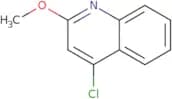
CAS:<p>4-Chloro-2-methoxyquinoline is a chemical compound that has been extensively studied for its nucleophilic substitution reactions. It can be used to study the effects of substituents on the kinetics and reactivity of nucleophilic substitution reactions. 4-Chloro-2-methoxyquinoline is a mesomeric compound, which means that it can exist as two different structures: an anion (electron donor) or a cation (electron acceptor). 4-Chloro-2-methoxyquinoline can also interact with thiolates, which are reactive groups found in biomolecules. This interaction allows for the study of the effects of substituents on the kinetics and reactivity of nucleophilic substitution reactions.</p>Formula:C10H8ClNOPurity:Min. 95%Molecular weight:193.63 g/mol2-[(2,3-Dichlorophenyl)amino]benzoic acid
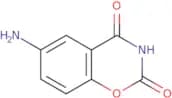
CAS:<p>2-[(2,3-Dichlorophenyl)amino]benzoic acid is a nonsteroidal anti-inflammatory drug that binds to the receptor for prostaglandin E2. It has been shown to have anti-inflammatory and analgesic effects in animal models of inflammatory bowel disease and microbial infection. 2-[(2,3-Dichlorophenyl)amino]benzoic acid inhibits the release of inflammatory mediators such as leukotrienes (LTs), prostaglandins, histamine, and cytokines from mast cells and eosinophils. It also inhibits the production of proinflammatory cytokines by macrophages and T lymphocytes. This drug can be used in treatment of autoimmune diseases because it blocks the action of COX enzymes that produce prostaglandins involved in inflammation. 2-[(2,3-Dichlorophenyl)amino]benzoic acid has been shown to inhibit water vapor</p>Formula:C13H9Cl2NO2Purity:Min. 95%Molecular weight:282.12 g/mol6-Amino-3,4-dihydro-2H-1,3-benzoxazine-2,4-dione
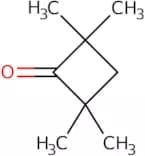
CAS:Versatile small molecule scaffoldFormula:C8H6N2O3Purity:Min. 95%Molecular weight:178.14 g/mol2,2,4,4-Tetramethylcyclobutan-1-one
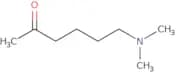
CAS:<p>2,2,4,4-Tetramethylcyclobutan-1-one (TMCB) is an organic compound that is synthesized by the thermal decomposition of isobutene. TMCB can be used as a starting material for the synthesis of other chemicals. It has been shown to react with nucleophiles in a spontaneous reaction that forms an acylium ion intermediate. The carbonyl group on TMCB reacts with anions to form adducts such as cyclobutanecarbonyl chloride and tetrahydrofuran-1,1-dicarbonyl chloride. The crystallography of TMCB has been studied using x-ray diffraction data collected at various temperatures. The kinetic parameters for TMCB were determined from the results of the filtration study.</p>Formula:C8H14OPurity:Min. 95%Molecular weight:126.2 g/mol6-(Dimethylamino)hexan-2-one
CAS:Versatile small molecule scaffoldFormula:C8H17NOPurity:Min. 95%Molecular weight:143.23 g/mol1H-1,2,3-Triazole-1-acetic acid ethyl ester
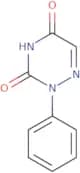
CAS:Versatile small molecule scaffoldFormula:C6H9N3O2Purity:Min. 95%Molecular weight:155.15 g/mol2-Phenyl-2,3,4,5-tetrahydro-1,2,4-triazine-3,5-dione
CAS:<p>2-Phenyl-2,3,4,5-tetrahydro-1,2,4-triazine-3,5-dione (Toltrazuril) is a coccidiostatic drug that inhibits the growth of coccidia by inhibiting the synthesis of adenosine triphosphate. It has been used for chemotherapy in veterinary medicine. Toltrazuril acts as a competitive inhibitor of ATP synthase and is effective against Eimeria tenella and Eimeria acervulina.</p>Formula:C9H7N3O2Purity:Min. 95%Molecular weight:189.17 g/mol





![2-[(2,3-Dichlorophenyl)amino]benzoic acid](/_next/image/?url=https%3A%2Fstatic.cymitquimica.com%2Fproducts%2F3D%2Fthumb-webp%2FEAA29555.webp&w=3840&q=75)