Building Blocks
This section contains fundamental products for the synthesis of organic and biological compounds. Building blocks are the essential starting materials used to construct complex molecules through various chemical reactions. They play a critical role in drug discovery, material science, and chemical research. At CymitQuimica, we offer a diverse range of high-quality building blocks to support your innovative research and industrial projects, ensuring you have the essential components for successful synthesis.
Subcategories of "Building Blocks"
- Boronic Acids & Boronic Acid Derivatives(5,756 products)
- Chiral Building Blocks(1,242 products)
- Hydrocarbon Building Blocks(6,095 products)
- Organic Building Blocks(61,055 products)
Found 199650 products of "Building Blocks"
Sort by
Purity (%)
0
100
|
0
|
50
|
90
|
95
|
100
8-Bromo-5-methoxy-1,2,3,4-tetrahydroisoquinoline
CAS:<p>Versatile small molecule scaffold</p>Formula:C10H12BrNOPurity:Min. 95%Molecular weight:242.11 g/mol2-(Furan-2-yl)imidazo[1,2-a]pyridin-3-amine
CAS:<p>Versatile small molecule scaffold</p>Formula:C11H9N3OPurity:Min. 95%Molecular weight:199.21 g/mol7-Bromo-2-chloro-4H-pyrido[1,2-a]pyrimidin-4-one
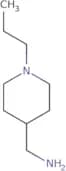
CAS:<p>Versatile small molecule scaffold</p>Formula:C8H4BrClN2OPurity:Min. 95%Molecular weight:259.49 g/molC-(1-Propyl-piperidin-4-yl)-methylamine
CAS:<p>Versatile small molecule scaffold</p>Formula:C9H20N2Purity:Min. 95%Molecular weight:156.27 g/mol{4-[2-(2-Methoxyethoxy)ethoxy]phenyl}methanol
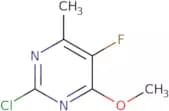
CAS:<p>Versatile small molecule scaffold</p>Formula:C12H18O4Purity:Min. 95%Molecular weight:226.27 g/mol2-Chloro-5-fluoro-4-methoxy-6-methylpyrimidine
CAS:<p>2-Chloro-5-fluoro-4-methoxy-6-methylpyrimidine is a drug candidate that has been optimized for potency and selectivity. It has been shown to have high affinity for the BACE1 enzyme in nonhuman primates, with a time-dependent profile. This compound has also been validated in monkeys and is being considered for medicinal chemistry optimization by Pfizer.</p>Formula:C6H6N2OFClPurity:Min. 95%Molecular weight:176.57 g/molN-Boc-4-(bromomethyl)-2,2-dimethyloxazolidine
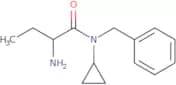
CAS:<p>Versatile small molecule scaffold</p>Formula:C11H20BrNO3Purity:Min. 95%Molecular weight:294.19 g/mol2-Amino-N-benzyl-N-cyclopropylbutanamide
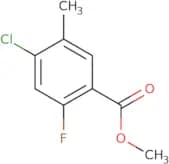
CAS:<p>Versatile small molecule scaffold</p>Formula:C14H20N2OPurity:Min. 95%Molecular weight:232.32 g/molMethyl 4-chloro-2-fluoro-5-methylbenzoate
CAS:<p>Versatile small molecule scaffold</p>Formula:C9H8ClFO2Purity:Min. 95%Molecular weight:202.61 g/mol2-[3-Fluoro-2-(trifluoromethyl)phenyl]-4,4,5,5-tetramethyl-1,3,2-dioxaborolane
CAS:<p>Versatile small molecule scaffold</p>Formula:C13H15BO2F4Purity:Min. 95%Molecular weight:290.06 g/molMethyl 2-Chloroquinoline-5-carboxylate
CAS:<p>Versatile small molecule scaffold</p>Formula:C11H8NO2ClPurity:Min. 95%Molecular weight:221.63 g/mol2-(2,5-Difluorophenyl)-2-(methylamino)acetic acid
CAS:<p>Versatile small molecule scaffold</p>Formula:C9H9F2NO2Purity:Min. 95%Molecular weight:201.17 g/mol3-Amino-1H-indole-2-carbonitrile
CAS:<p>3-Amino-1H-indole-2-carbonitrile (3AIC) is a chemical compound that is a byproduct of the production of indigo dye. It can be used as an efficient and inexpensive reagent for the synthesis of organic compounds, such as amino acid derivatives. 3AIC is soluble in water at high temperatures, but insoluble in water at low temperatures. The solubility of 3AIC in water can be increased by adding ionic liquids to the solution.</p>Formula:C9H7N3Purity:Min. 95%Molecular weight:157.17 g/molMethyl 3-(2-methyl-1,3-oxazol-5-yl)propanoate
CAS:<p>Versatile small molecule scaffold</p>Formula:C8H11NO3Purity:Min. 95%Molecular weight:169.2 g/mol2-Methyl-3-[4-(trifluoromethyl)phenyl]propanoic acid
CAS:<p>Versatile small molecule scaffold</p>Formula:C11H11F3O2Purity:Min. 95%Molecular weight:232.2 g/mol2-(Difluoromethoxy)-5-nitropyridine
CAS:<p>2-(Difluoromethoxy)-5-nitropyridine is a reagent that is used in organic synthesis. This compound is synthesized by the reaction of 2-fluoro-5-nitrobenzaldehyde with difluoromethylmagnesium bromide. The yields for this compound are high and it can be used as a starting material for various chemical reactions, such as formylations, nucleophilic aromatic substitutions, or sulfonylations. The synthesis of 2-(difluoromethoxy)-5-nitropyridine involves an electrophilic substitution at the C2 position of the pyridine ring with the trifluoromethyl group to produce a fluorine atom. The mechanism of this reaction is catalysed by strong bases, such as potassium fluoride.</p>Formula:C6H4F2N2O3Purity:Min. 95%Molecular weight:190.1 g/mol5,6-dichloropyridin-2-amine
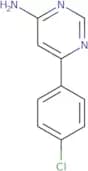
CAS:<p>Versatile small molecule scaffold</p>Formula:C5H4Cl2N2Purity:Min. 95%Molecular weight:163 g/mol6-(4-Chlorophenyl)pyrimidin-4-amine
CAS:<p>Versatile small molecule scaffold</p>Formula:C10H8ClN3Purity:Min. 95%Molecular weight:205.64 g/mol3-chloro-4-(difluoromethoxy)benzoic acid
CAS:<p>Versatile small molecule scaffold</p>Formula:C8H5ClF2O3Purity:Min. 95%Molecular weight:222.57 g/mol2-(2-Bromoethyl)-1-chloro-3-fluorobenzene
CAS:<p>Versatile small molecule scaffold</p>Formula:C8H7BrClFPurity:Min. 95%Molecular weight:237.49 g/mol


![2-(Furan-2-yl)imidazo[1,2-a]pyridin-3-amine](/_next/image/?url=https%3A%2Fstatic.cymitquimica.com%2Fproducts%2F3D%2Fthumb-webp%2FSQA66369.webp&w=3840&q=75)
![7-Bromo-2-chloro-4H-pyrido[1,2-a]pyrimidin-4-one](/_next/image/?url=https%3A%2Fstatic.cymitquimica.com%2Fproducts%2F3D%2Fthumb-webp%2FSQA66385.webp&w=3840&q=75)
![{4-[2-(2-Methoxyethoxy)ethoxy]phenyl}methanol](/_next/image/?url=https%3A%2Fstatic.cymitquimica.com%2Fproducts%2F3D%2Fthumb-webp%2FSQA71113.webp&w=3840&q=75)

![2-[3-Fluoro-2-(trifluoromethyl)phenyl]-4,4,5,5-tetramethyl-1,3,2-dioxaborolane](/_next/image/?url=https%3A%2Fstatic.cymitquimica.com%2Fproducts%2F3D%2Fthumb-webp%2FSXB54805.webp&w=3840&q=75)


![2-Methyl-3-[4-(trifluoromethyl)phenyl]propanoic acid](/_next/image/?url=https%3A%2Fstatic.cymitquimica.com%2Fproducts%2F3D%2Fthumb-webp%2FSXB77271.webp&w=3840&q=75)