Building Blocks
This section contains fundamental products for the synthesis of organic and biological compounds. Building blocks are the essential starting materials used to construct complex molecules through various chemical reactions. They play a critical role in drug discovery, material science, and chemical research. At CymitQuimica, we offer a diverse range of high-quality building blocks to support your innovative research and industrial projects, ensuring you have the essential components for successful synthesis.
Subcategories of "Building Blocks"
- Boronic Acids & Boronic Acid Derivatives(5,756 products)
- Chiral Building Blocks(1,242 products)
- Hydrocarbon Building Blocks(6,095 products)
- Organic Building Blocks(61,055 products)
Found 199650 products of "Building Blocks"
Sort by
Purity (%)
0
100
|
0
|
50
|
90
|
95
|
100
1-Benzyl-4-[(4-methoxyphenyl)methylidene]-2-sulfanyl-4,5-dihydro-1H-imidazol-5-one
CAS:<p>Versatile small molecule scaffold</p>Formula:C18H16N2O2SPurity:Min. 95%Molecular weight:324.4 g/mol9-Phenyl-2H,3H-[1,4]dioxino[2,3-G]quinoline-7-thiol
CAS:<p>Versatile small molecule scaffold</p>Formula:C17H13NO2SPurity:Min. 95%Molecular weight:295.4 g/mol4-Bromo-1-ethyl-1H-imidazole
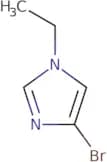
CAS:<p>4-Bromo-1-ethyl-1H-imidazole is a halogenating agent that reacts with ethyl formate to produce 4-bromo-1,2,3,4-tetrahydroimidazole. It has been used in the synthesis of imidazoles and can be used to synthesize compounds such as 1,4,9,10-tetrahydroacridine. This chemical is also a low yield product that is difficult to synthesize. The lithiation reaction with dinitrate produces an ethyl formate derivative that reacts with methyl iodide in the presence of trihydrochloride to produce 4-bromo-1H-imidazole. The Grignard reaction with ethyl formate yields a mixture of products including 4-(N,N dimethylamino)benzaldehyde.</p>Formula:C5H7BrN2Purity:Min. 95%Molecular weight:175.03 g/mol3-[(tert-Butyldimethylsilanyl)oxy]azetidine
CAS:<p>Versatile small molecule scaffold</p>Formula:C9H21NOSiPurity:Min. 95%Molecular weight:187.35 g/mol7-Chloro-1-methyl-1H-pyrrolo[2,3-c]pyridine
CAS:<p>Versatile small molecule scaffold</p>Formula:C8H7ClN2Purity:Min. 95%Molecular weight:166.61 g/mol4-chlorothieno[3,2-d]pyrimidine-6-carbaldehyde
CAS:<p>Versatile small molecule scaffold</p>Formula:C7H3ClN2OSPurity:Min. 95%Molecular weight:198.62 g/mol1-[2-(2-Chlorophenyl)cyclopropyl]ethan-1-one
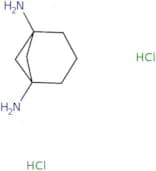
CAS:<p>Versatile small molecule scaffold</p>Formula:C11H11ClOPurity:Min. 95%Molecular weight:194.66 g/molNorpinane-1,5-diamine dihydrochloride
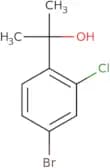
CAS:<p>Norpinane-1,5-diamine dihydrochloride is a cytosolic Ca2+ antagonist that is used to treat respiratory and allergic symptoms. This drug inhibits the activation of phospholipase A2, which is responsible for the release of arachidonic acid from membrane phospholipids. Norpinane-1,5-diamine dihydrochloride also has anti-cancer effects on squamous cell carcinoma and histidine decarboxylase cells. It is metabolized by carboxylesterases and CYP450 enzymes to form norpinane-1,5-diaminium dihydrogen citrate, which can be detected in urine using chromatography. Norpinane-1,5-diamine dihydrochloride binds to fatty acids in the mitochondrial membrane and inhibits mitochondrial respiration.</p>Formula:C7H16Cl2N2Purity:Min. 95%Molecular weight:199.12 g/mol2-(4-Bromo-2-chlorophenyl)propan-2-ol
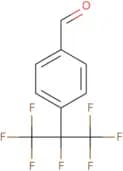
CAS:<p>Versatile small molecule scaffold</p>Formula:C9H10BrClOPurity:Min. 95%Molecular weight:249.53 g/mol4-(Heptafluoropropan-2-yl)benzaldehyde
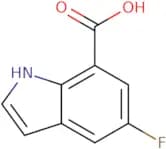
CAS:<p>Versatile small molecule scaffold</p>Formula:C10H5F7OPurity:Min. 95%Molecular weight:274.13 g/mol5-Fluoro-1H-indole-7-carboxylic acid
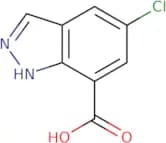
CAS:<p>Versatile small molecule scaffold</p>Formula:C9H6FNO2Purity:Min. 95%Molecular weight:179.15 g/mol5-chloro-1h-indazole-7-carboxylic acid
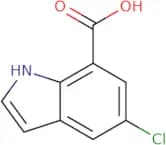
CAS:Versatile small molecule scaffoldFormula:C8H5ClN2O2Purity:Min. 95%Molecular weight:196.59 g/mol5-chloro-1h-indole-7-carboxylic acid
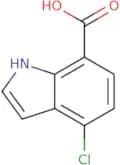
CAS:<p>5-Chloro-1H-indole-7-carboxylic acid is an anticholesterol agent that modulates plasma lipid levels. It is a pharmaceutical drug used in the treatment of high cholesterol and high triglyceride levels. 5-Chloro-1H-indole-7-carboxylic acid has been shown to decrease the level of total cholesterol, low density lipoprotein (LDL), and triglycerides in the blood by inhibiting the production of these lipids in the liver. 5-Chloro-1H-indole-7-carboxylic acid can be used as an adjuvant therapy for those with high cholesterol or hypercholesterolemia.</p>Formula:C9H6ClNO2Purity:Min. 95%Molecular weight:195.6 g/mol4-Chloro-1H-indole-7-carboxylic acid
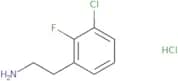
CAS:<p>Versatile small molecule scaffold</p>Formula:C9H6ClNO2Purity:Min. 95%Molecular weight:195.6 g/mol2-(3-Chloro-2-fluorophenyl)ethan-1-amine hydrochloride
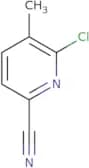
CAS:Controlled Product<p>Versatile small molecule scaffold</p>Formula:C8H10Cl2FNPurity:Min. 95%Molecular weight:210.07 g/mol6-Chloro-5-methylpyridine-2-carbonitrile
CAS:<p>Versatile small molecule scaffold</p>Formula:C7H5ClN2Purity:Min. 95%Molecular weight:152.58 g/moltert-butyl 4-[(tetramethyl-1,3,2-dioxaborolan-2-yl)methylidene]piperidine-1-carboxylate
CAS:<p>Versatile small molecule scaffold</p>Formula:C17H30BNO4Purity:Min. 95%Molecular weight:323.2 g/molEHT 1610
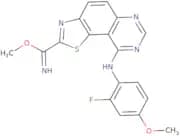
CAS:<p>EHT 1610 is a tyrosine kinase inhibitor that is designed to target the activity of the epidermal growth factor receptor (EGFR) and other members of the ErbB family. It has been shown to inhibit proliferation of glioblastoma cells and leukemia cells in vivo through transcriptional regulation. EHT 1610 has also been shown to suppress neurodegenerative diseases in mice by inhibiting the proliferation of hematopoietic cells. In addition, this drug can be used as a pharmacologic probe for investigating protein-protein interactions.</p>Formula:C18H14FN5O2SPurity:Min. 95%Molecular weight:383.4 g/mol2-Fluoro-4-(oxan-4-yl)aniline
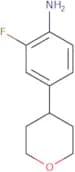
CAS:<p>Versatile small molecule scaffold</p>Formula:C11H14FNOPurity:Min. 95%Molecular weight:195.23 g/mol2-(Thietan-3-yl)acetic acid
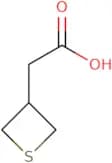
CAS:<p>Versatile small molecule scaffold</p>Formula:C5H8O2SPurity:Min. 95%Molecular weight:132.18 g/mol
![1-Benzyl-4-[(4-methoxyphenyl)methylidene]-2-sulfanyl-4,5-dihydro-1H-imidazol-5-one](/_next/image/?url=https%3A%2Fstatic.cymitquimica.com%2Fproducts%2F3D%2Fthumb-webp%2FAKB42421.webp&w=3840&q=75)

![9-Phenyl-2H,3H-[1,4]dioxino[2,3-G]quinoline-7-thiol](/_next/image/?url=https%3A%2Fstatic.cymitquimica.com%2Fproducts%2F3D%2Fthumb-webp%2FAKB41953.webp&w=3840&q=75)
![3-[(tert-Butyldimethylsilanyl)oxy]azetidine](/_next/image/?url=https%3A%2Fstatic.cymitquimica.com%2Fproducts%2F3D%2Fthumb-webp%2FAKB34081.webp&w=3840&q=75)
![7-Chloro-1-methyl-1H-pyrrolo[2,3-c]pyridine](/_next/image/?url=https%3A%2Fstatic.cymitquimica.com%2Fproducts%2F3D%2Fthumb-webp%2FAKB34057.webp&w=3840&q=75)
![4-chlorothieno[3,2-d]pyrimidine-6-carbaldehyde](/_next/image/?url=https%3A%2Fstatic.cymitquimica.com%2Fproducts%2F3D%2Fthumb-webp%2FAKB34014.webp&w=3840&q=75)
![1-[2-(2-Chlorophenyl)cyclopropyl]ethan-1-one](/_next/image/?url=https%3A%2Fstatic.cymitquimica.com%2Fproducts%2F3D%2Fthumb-webp%2FAKB32569.webp&w=3840&q=75)
![tert-butyl 4-[(tetramethyl-1,3,2-dioxaborolan-2-yl)methylidene]piperidine-1-carboxylate](/_next/image/?url=https%3A%2Fstatic.cymitquimica.com%2Fproducts%2F3D%2Fthumb-webp%2FAHC97061.webp&w=3840&q=75)