Building Blocks
This section contains fundamental products for the synthesis of organic and biological compounds. Building blocks are the essential starting materials used to construct complex molecules through various chemical reactions. They play a critical role in drug discovery, material science, and chemical research. At CymitQuimica, we offer a diverse range of high-quality building blocks to support your innovative research and industrial projects, ensuring you have the essential components for successful synthesis.
Subcategories of "Building Blocks"
- Boronic Acids & Boronic Acid Derivatives(5,756 products)
- Chiral Building Blocks(1,242 products)
- Hydrocarbon Building Blocks(6,095 products)
- Organic Building Blocks(61,055 products)
Found 199650 products of "Building Blocks"
Sort by
Purity (%)
0
100
|
0
|
50
|
90
|
95
|
100
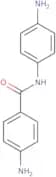
4,4²-Diaminobenzanilide
CAS:<p>4,4²-Diaminobenzanilide is a molecule that contains an amide group. It undergoes hydrogen bonding interactions with sodium carbonate and biphenyl. The thermal expansion coefficient of 4,4²-diaminobenzanilide is 1.5 x 10^5 K/mol. This substance has a molecular weight of 218.2 grams per mole and a density of 1.08 grams per cubic centimeter. The solubility of 4,4²-diaminobenzanilide in water at 20 degrees Celsius is 3.2 grams per 100 milliliters, and it does not dissolve in hydrochloric acid or water vapor at 20 degrees Celsius. The proton NMR spectroscopic data for this compound show the presence of hydroxyl groups and carbonyl groups in addition to the amine group found in the molecule's structure. FTIR spectroscopy confirms the presence of these functional groups as well</p>Formula:H2NC6H4CONHC6H4NH2Purity:Min. 95%Molecular weight:227.26 g/mol4-Oxo-4-(5,6,7,8-tetrahydronaphthalen-2-yl)butanoic acid
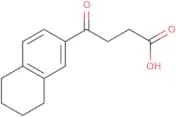
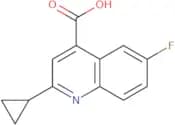
CAS:<p>Versatile small molecule scaffold</p>Formula:C14H16O3Purity:Min. 95%Molecular weight:232.27 g/mol2-Cyclopropyl-6-fluoroquinoline-4-carboxylic acid
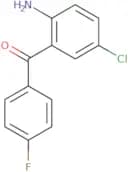
CAS:<p>Versatile small molecule scaffold</p>Formula:C13H10FNO2Purity:Min. 95%Molecular weight:231.22 g/mol4-Chloro-2-(4-fluorobenzoyl)aniline
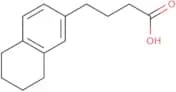
CAS:<p>Versatile small molecule scaffold</p>Formula:C13H9ClFNOPurity:Min. 95%Molecular weight:249.67 g/mol4-(5,6,7,8-Tetrahydronaphthalen-2-yl)butanoic acid
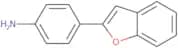
CAS:<p>Versatile small molecule scaffold</p>Formula:C14H18O2Purity:Min. 95%Molecular weight:218.29 g/mol4-(1-Benzofuran-2-yl)aniline
CAS:<p>Versatile small molecule scaffold</p>Formula:C14H11NOPurity:Min. 95%Molecular weight:209.24 g/mol1-chloro-4-[chloro(4-chlorophenyl)methyl]benzene
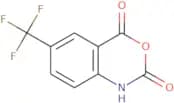
CAS:<p>Versatile small molecule scaffold</p>Formula:C13H9Cl3Purity:Min. 95%Molecular weight:271.57 g/mol6-(Trifluoromethyl)-2,4-dihydro-1H-3,1-benzoxazine-2,4-dione
CAS:<p>6-(Trifluoromethyl)-2,4-dihydro-1H-3,1-benzoxazine-2,4-dione is a potent inhibitor of tumor cell growth. It inhibits the stepwise oxidation of 4-chloro-5-methylisatin to 4-chloroimidazole. 6-(Trifluoromethyl)-2,4-dihydro-1H-3,1-benzoxazine-2,4-dione is an analog of the antitumor agent 5-(trifluoromethyl)isatin. The reaction mechanism involves the formation of an iminium ion that undergoes a condensation with a thiophene and subsequent bromination. This forms an intermediate that can be isolated and identified as 6-(trifluoromethyl)-N-[(6'-bromohexyl)oxy]-2,4'-d</p>Formula:C9H4F3NO3Purity:Min. 95%Molecular weight:231.13 g/mol2-Methoxy-5-trifluoromethanesulfonylaniline
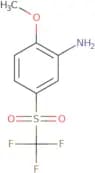
CAS:<p>Versatile small molecule scaffold</p>Formula:C8H8F3NO3SPurity:Min. 95%Molecular weight:255.22 g/molN-Isopropylterephthalamic acid
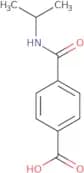
CAS:<p>N-Isopropylterephthalamic acid is a metabolite of terephthalic acid and is formed by the oxidation of isopropyl alcohol. The metabolism of N-isopropylterephthalamic acid in humans has been shown to be catalyzed by cytochrome P450 enzymes, which are expressed in the liver. This reaction occurs through a series of oxidation steps that convert the alcohol group to an aldehyde group and then to an acid group. The final product, N-isopropylterephthalamic acid, can be quantified using gas chromatography with electron capture detection or high performance liquid chromatography with fluorescence detection. These techniques can be used for monitoring human exposure to this metabolite.</p>Formula:C11H13NO3Purity:Min. 95%Molecular weight:207.23 g/mol2-Cyano-4-(trifluoromethyl)benzoic acid
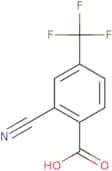
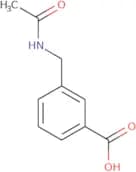
CAS:<p>Versatile small molecule scaffold</p>Formula:C9H4F3NO2Purity:Min. 95%Molecular weight:215.13 g/mol3-(Acetamidomethyl)benzoic acid
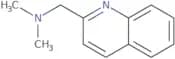
CAS:<p>Versatile small molecule scaffold</p>Formula:C10H11NO3Purity:Min. 95%Molecular weight:193.2 g/molDimethyl(quinolin-2-ylmethyl)amine
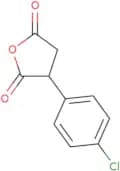
CAS:<p>Dimethyl(quinolin-2-ylmethyl)amine is a chemical compound that has shown anti-cancer activity in humans. It is a precursor of the drug quinacrine, which is used to treat some types of cancer. Dimethyl(quinolin-2-ylmethyl)amine and related compounds are believed to work by interfering with DNA synthesis, preventing the proliferation of cancer cells.</p>Formula:C12H14N2Purity:Min. 95%Molecular weight:186.25 g/mol3-(4-Chlorophenyl)oxolane-2,5-dione
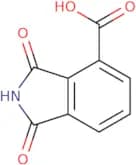
CAS:<p>3-(4-Chlorophenyl)oxolane-2,5-dione is a telechelic monomer with a hydroxyl group at one end and an alkynyl group at the other. This molecule has functional groups that can be used in polymerization reactions to create polymers. It is often used as a precursor for polyesters, polyurethanes, and polyamides. 3-(4-Chlorophenyl)oxolane-2,5-dione reacts with metal ions to form polymers that emit light when excited by light. The fatty acid component of this molecule makes it soluble in hydrocarbon solvents such as hexane and heptane. 3-(4-Chlorophenyl)oxolane-2,5-dione can also be used to produce biodegradable plastics from renewable resources such as vegetable oils or soybean oil.</p>Formula:C10H7ClO3Purity:Min. 95%Molecular weight:210.61 g/mol1,3-Dioxo-2,3-dihydro-1H-isoindole-4-carboxylic acid
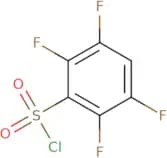
CAS:Versatile small molecule scaffoldFormula:C9H5NO4Purity:Min. 95%Molecular weight:191.14 g/mol2,3,5,6-Tetrafluorobenzenesulfonyl chloride
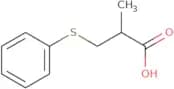
CAS:<p>Versatile small molecule scaffold</p>Formula:C6HClF4O2SPurity:Min. 95%Molecular weight:248.58 g/mol2-Methyl-3-(phenylsulfanyl)propanoic acid
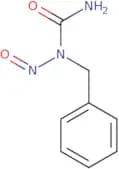
CAS:<p>Versatile small molecule scaffold</p>Formula:C10H12O2SPurity:Min. 95%Molecular weight:196.27 g/mol1-Benzyl-1-nitrosourea
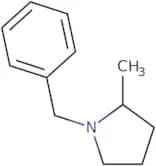
CAS:<p>1-Benzyl-1-nitrosourea is a nitrosourea alkylating agent that induces DNA methylation. It is hepatotoxic and carcinogenic in rats, but not in mice. This drug does not cause DNA methylation at high substrate concentrations, but does so at low concentrations. The carcinogenic effects of this drug have been observed in the liver, mammary glands, and other tissues. The carcinogenic activity of 1-Benzyl-1-nitrosourea has been shown to be dependent on the strain of animal used and the dose administered.</p>Formula:C8H9N3O2Purity:Min. 95%Molecular weight:179.18 g/mol1-Benzyl-2-methylpyrrolidine
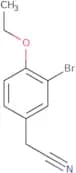
CAS:<p>1-Benzyl-2-methylpyrrolidine is a chemical reagent that is used in organic synthesis as an oxidant, dehydrogenation agent, and alkylation agent. 1-Benzyl-2-methylpyrrolidine is also used to generate amines from thioacetals and anilines. It can be used to synthesize carbonyl compounds via the oxidation of alcohols with hydroxylamine or sodium carbonate. This chemical reagent has been shown to catalyze the aromatization of benzene derivatives with Raney nickel or cyclic systems. Furthermore, it has been shown to inactivate various types of microorganisms such as bacteria and yeast cells by reacting with their enzymes.</p>Formula:C12H17NPurity:Min. 95%Molecular weight:175.27 g/mol2-(3-Bromo-4-ethoxyphenyl)acetonitrile
CAS:<p>Versatile small molecule scaffold</p>Formula:C10H10BrNOPurity:Min. 95%Molecular weight:240.1 g/mol

![1-chloro-4-[chloro(4-chlorophenyl)methyl]benzene](/_next/image/?url=https%3A%2Fstatic.cymitquimica.com%2Fproducts%2F3D%2Fthumb-webp%2FAAA78208.webp&w=3840&q=75)