Building Blocks
This section contains fundamental products for the synthesis of organic and biological compounds. Building blocks are the essential starting materials used to construct complex molecules through various chemical reactions. They play a critical role in drug discovery, material science, and chemical research. At CymitQuimica, we offer a diverse range of high-quality building blocks to support your innovative research and industrial projects, ensuring you have the essential components for successful synthesis.
Subcategories of "Building Blocks"
- Boronic Acids & Boronic Acid Derivatives(5,778 products)
- Chiral Building Blocks(1,242 products)
- Hydrocarbon Building Blocks(6,098 products)
- Organic Building Blocks(61,069 products)
Found 197521 products of "Building Blocks"
Sort by
Purity (%)
0
100
|
0
|
50
|
90
|
95
|
100
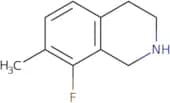
8-Fluoro-7-methyl-1,2,3,4-tetrahydroisoquinoline
CAS:<p>Versatile small molecule scaffold</p>Formula:C10H12FNPurity:Min. 95%Molecular weight:165.21 g/molRef: 3D-FWC69353
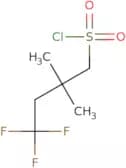
Discontinued product4,4,4-Trifluoro-2,2-dimethylbutane-1-sulfonyl chloride
CAS:<p>Versatile small molecule scaffold</p>Formula:C6H10ClF3O2SPurity:Min. 95%Molecular weight:238.66 g/molRef: 3D-FWC66938
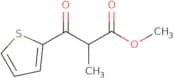
Discontinued productMethyl 2-methyl-3-oxo-3-(thiophen-2-yl)propanoate
CAS:<p>Versatile small molecule scaffold</p>Formula:C9H10O3SPurity:Min. 95%Molecular weight:198.24 g/molRef: 3D-KCA84831
Discontinued product4-{8-Nitro-2,4-dioxo-3-azatricyclo[7.3.1.0,5,13]trideca-1(13),5,7,9,11-pentaen-3-yl}benzoic acid
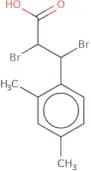
CAS:<p>Versatile small molecule scaffold</p>Formula:C19H10N2O6Purity:Min. 95%Molecular weight:362.3 g/mol2,3-Dibromo-3-(2,4-dimethylphenyl)propanoic acid
CAS:<p>Versatile small molecule scaffold</p>Formula:C11H12Br2O2Purity:Min. 95%Molecular weight:336.02 g/molRef: 3D-DPD33993
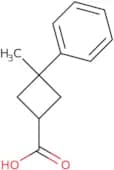
Discontinued product3-Methyl-3-phenylcyclobutane-1-carboxylic acid
CAS:<p>Versatile small molecule scaffold</p>Formula:C12H14O2Purity:Min. 95%Molecular weight:190.2 g/molRef: 3D-CVD03637
Discontinued productMethyl 2-amino-2-(1-hydroxycyclohexyl)acetate hydrochloride
CAS:<p>Versatile small molecule scaffold</p>Formula:C9H18ClNO3Purity:Min. 95%Molecular weight:223.7 g/molRef: 3D-CWD82898
Discontinued product[1-(2-Methylpropyl)cyclohexyl]methanol
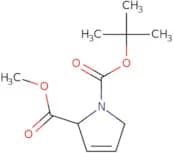
CAS:<p>Versatile small molecule scaffold</p>Formula:C11H22OPurity:Min. 95%Molecular weight:170.29 g/mol1-tert-Butyl 2-methyl 2,5-dihydro-1H-pyrrole-1,2-dicarboxylate
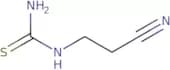
CAS:<p>Versatile small molecule scaffold</p>Formula:C11H17NO4Purity:Min. 95%Molecular weight:227.26 g/mol(2-Cyanoethyl)thiourea
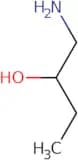
CAS:<p>(2-Cyanoethyl)thiourea is a carbonyl compound that is insoluble in water. It has a molecular weight of 180.2 and it contains two carbon atoms. The compound is crosslinked and lactate-modified, but not modified by lysine or unmodified. This compound reacts with the enzyme dehydrogenase to produce hydrogen peroxide and 2-cyanoethanol. The reaction mechanism for this process is as follows: <br>The substrate binds to the active site of the enzyme, forming an enzyme-substrate complex; the enzyme transfers electrons from NADH to the substrate; this results in a release of hydrogen peroxide, which then reacts with 2-cyanoethanol to form ethylene glycol and oxalic acid. The x-ray analysis showed that this molecule has a homologous structure with other enzymes.</p>Formula:C4H7N3SPurity:Min. 95%Molecular weight:129.19 g/mol(S)-1-Aminobutan-2-ol
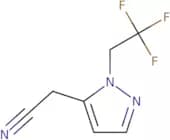
CAS:<p>Versatile small molecule scaffold</p>Formula:C4H11NOPurity:Min. 95%Molecular weight:89.14 g/mol2-(1-(2,2,2-Trifluoroethyl)-1H-pyrazol-5-yl)acetonitrile
CAS:<p>Versatile small molecule scaffold</p>Formula:C7H6F3N3Purity:Min. 95%Molecular weight:189.14 g/molRef: 3D-DFC83153
Discontinued product3-Chloro-N-methyl-2-nitroaniline
CAS:<p>3-Chloro-N-methyl-2-nitroaniline is an antibiotic that belongs to the group of quinolone antibiotics. It has a broad spectrum against Gram-positive and Gram-negative bacteria, including methicillin resistant Staphylococcus aureus (MRSA) and Pseudomonas aeruginosa. 3-Chloro-N-methyl-2-nitroaniline binds to bacterial DNA gyrase and topoisomerase IV, as well as human DNA gyrase and topoisomerase II, inhibiting their activity. This leads to cell death by interfering with the production of proteins vital for cell division. The optimal parameters for this drug have been found using isothermal titration calorimetry on the enzyme gyrase in the presence of different concentrations of 3CMA. Pharmacological targets for this drug include DNA gyrase and topoisomerase IV.</p>Formula:C7H7ClN2O2Purity:Min. 95%Molecular weight:186.59 g/mol2-[Bis(2-methoxyethyl)amino]-5-methylbenzoic acid
CAS:<p>Versatile small molecule scaffold</p>Formula:C14H21NO4Purity:Min. 95%Molecular weight:267.32 g/molRef: 3D-GCC60399
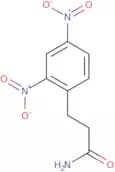
Discontinued product3-(2,4-Dinitrophenyl)propanamide
CAS:<p>Versatile small molecule scaffold</p>Formula:C9H9N3O5Purity:Min. 95%Molecular weight:239.18 g/molRef: 3D-GCB46646
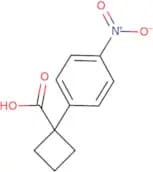
Discontinued product1-(4-Nitrophenyl)cyclobutanecarboxylic acid
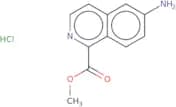
CAS:<p>Versatile small molecule scaffold</p>Formula:C11H11NO4Purity:Min. 95%Molecular weight:221.21 g/molMethyl 6-aminoisoquinoline-1-carboxylate hydrochloride
CAS:<p>Versatile small molecule scaffold</p>Formula:C11H11ClN2O2Purity:Min. 95%Molecular weight:238.7 g/molRef: 3D-DPD31324
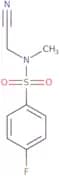
Discontinued product1-Cyano-S-(4-fluorophenyl)-N-methylmethanesulfonamido
CAS:<p>Versatile small molecule scaffold</p>Formula:C9H9FN2O2SPurity:Min. 95%Molecular weight:228.25 g/molRef: 3D-SAC04753
Discontinued product1-[4-(4-Chlorophenyl)-5-methyl-1,3-thiazol-2-yl]ethan-1-amine
CAS:<p>Versatile small molecule scaffold</p>Formula:C12H13ClN2SPurity:Min. 95%Molecular weight:252.76 g/molRef: 3D-SAB92946
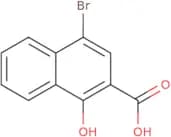
Discontinued product4-bromo-1-hydroxynaphthalene-2-carboxylic acid
CAS:<p>4-Bromo-1-hydroxynaphthalene-2-carboxylic acid (4BHN) is a spectroscopic compound that has been used as a radioligand to study the binding of dopamine and dopamine D3 receptors. This compound binds to the d3 receptor with high affinity and specificity, but it does not interact with the d1 or d2 receptors. 4BHN has been shown to act as an agonist at the dopamine D3 receptor. It also acts as an antagonist at the piperidine site of the dopamine D2 receptor. The effects of 4BHN are reversible, which means that it can be displaced by unlabeled 4BHN or other compounds that bind to the same site on the receptor. This technique is useful for studying drug interactions and for determining whether drugs have a subtype selectivity profile.</p>Formula:C11H7BrO3Purity:Min. 95%Molecular weight:267.1 g/mol

![4-{8-Nitro-2,4-dioxo-3-azatricyclo[7.3.1.0,5,13]trideca-1(13),5,7,9,11-pentaen-3-yl}benzoic acid](/_next/image/?url=https%3A%2Fstatic.cymitquimica.com%2Fproducts%2F3D%2Fthumb-webp%2FCIA34140.webp&w=3840&q=75)

![[1-(2-Methylpropyl)cyclohexyl]methanol](/_next/image/?url=https%3A%2Fstatic.cymitquimica.com%2Fproducts%2F3D%2Fthumb-webp%2FFHC75203.webp&w=3840&q=75)

![2-[Bis(2-methoxyethyl)amino]-5-methylbenzoic acid](/_next/image/?url=https%3A%2Fstatic.cymitquimica.com%2Fproducts%2F3D%2Fthumb-webp%2FGCC60399.webp&w=3840&q=75)
![1-[4-(4-Chlorophenyl)-5-methyl-1,3-thiazol-2-yl]ethan-1-amine](/_next/image/?url=https%3A%2Fstatic.cymitquimica.com%2Fproducts%2F3D%2Fthumb-webp%2FSAB92946.webp&w=3840&q=75)