


Building Blocks
This section contains fundamental products for the synthesis of organic and biological compounds. Building blocks are the essential starting materials used to construct complex molecules through various chemical reactions. They play a critical role in drug discovery, material science, and chemical research. At CymitQuimica, we offer a diverse range of high-quality building blocks to support your innovative research and industrial projects, ensuring you have the essential components for successful synthesis.
Subcategories of "Building Blocks"
- Boronic Acids & Boronic Acid Derivatives(5,778 products)
- Chiral Building Blocks(1,242 products)
- Hydrocarbon Building Blocks(6,098 products)
- Organic Building Blocks(61,034 products)
Found 199601 products of "Building Blocks"
Sort by
Purity (%)
0
100
|
0
|
50
|
90
|
95
|
100
2-[(2,2-Difluoroethyl)sulfanyl]-5-(trifluoromethyl)aniline
CAS:<p>Versatile small molecule scaffold</p>Formula:C9H8F5NSPurity:Min. 95%Molecular weight:257.23 g/molRef: 3D-IXB29341
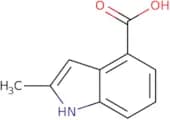
Discontinued product2-Methyl-1H-indole-4-carboxylic acid
CAS:<p>2-Methyl-1H-indole-4-carboxylic acid (2MICA) is a cyclic compound that is used in the synthesis of other compounds. It is obtained by reacting 2,3-dibromo-nitrobenzoic acid with sodium ethoxide in an alkaline solution. The yield of 2MICA can be increased by using catalytic acid anhydrides such as dimethyl sulphoxide or lactam. In the presence of reductive agents, 2MICA can be synthesized from the corresponding lactam or cyclised carboxylic acid.<br>2MICA reacts with sodium ethoxide to form a lactam and reduces 2-bromo-3-nitrobenzoic acid to yield 2MICA.</p>Formula:C10H9NO2Purity:Min. 95%Molecular weight:175 g/mol2-[(Piperazin-1-yl)methyl]-3H,4H-thieno[3,2-d]pyrimidin-4-one dihydrochloride
CAS:<p>Versatile small molecule scaffold</p>Formula:C11H16Cl2N4OSPurity:Min. 95%Molecular weight:323.2 g/mol2-Chloro-N-[2-(3-chlorophenyl)ethyl]acetamide
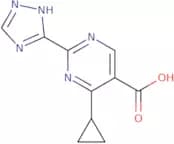
CAS:<p>Versatile small molecule scaffold</p>Formula:C10H11Cl2NOPurity:Min. 95%Molecular weight:232.1 g/mol4-Cyclopropyl-2-(4H-1,2,4-triazol-3-yl)pyrimidine-5-carboxylic acid
CAS:<p>Versatile small molecule scaffold</p>Formula:C10H9N5O2Purity:Min. 95%Molecular weight:231.21 g/molRef: 3D-JBC91477
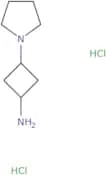
Discontinued productrac-(1S,3S)-3-(Pyrrolidin-1-yl)cyclobutan-1-amine dihydrochloride
CAS:<p>Versatile small molecule scaffold</p>Formula:C8H18Cl2N2Purity:Min. 95%Molecular weight:213.15 g/molRef: 3D-JBD28873
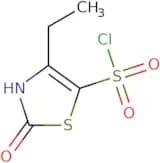
Discontinued product4-Ethyl-2-oxo-2,3-dihydro-1,3-thiazole-5-sulfonyl chloride
CAS:<p>Versatile small molecule scaffold</p>Formula:C5H6ClNO3S2Purity:Min. 95%Molecular weight:227.7 g/molRef: 3D-JBD30945
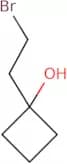
Discontinued product1-(2-Bromoethyl)cyclobutan-1-ol
CAS:<p>Versatile small molecule scaffold</p>Formula:C6H11BrOPurity:Min. 95%Molecular weight:179.05 g/molRef: 3D-JBD30961
Discontinued product[1-(1-Amino-2-methylpropyl)cyclopent-3-en-1-yl]methanol hydrochloride
CAS:<p>Versatile small molecule scaffold</p>Formula:C10H20ClNOPurity:Min. 95%Molecular weight:205.72 g/molRef: 3D-JBD31750
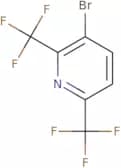
Discontinued product3-Bromo-2,6-bis(trifluoromethyl)pyridine
CAS:<p>Versatile small molecule scaffold</p>Formula:C7H2BrF6NPurity:Min. 95%Molecular weight:293.99 g/molRef: 3D-GXC37886
Discontinued product2-Amino-1-[3-(propan-2-yloxy)phenyl]ethan-1-ol
CAS:<p>Versatile small molecule scaffold</p>Formula:C11H17NO2Purity:Min. 95%Molecular weight:195.26 g/molRef: 3D-GXB58984
Discontinued product2-Cyclopropyl-9-methyl-5H,6H-[1,2,4]triazolo[1,5-c]quinazolin-5-one
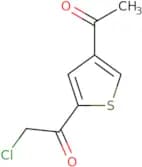
CAS:<p>Versatile small molecule scaffold</p>Formula:C13H12N4OPurity:Min. 95%Molecular weight:240.26 g/mol1-(4-Acetylthiophen-2-yl)-2-chloroethan-1-one
CAS:<p>Versatile small molecule scaffold</p>Formula:C8H7ClO2SPurity:Min. 95%Molecular weight:202.66 g/mol3-Methylbenzo[b]thiophene-2-carboxylic acid
CAS:<p>3-Methylbenzo[b]thiophene-2-carboxylic acid (MBTCA) is a heterocyclic compound that is an intermediate in the synthesis of 3-methylthiophene-2-carboxylic acid, a precursor to other drugs. MBTCA is an aerobic, nonpolar compound that has shown antimicrobial activity against some bacteria and fungi. It also has been shown to have practicality as a biomolecular probe for methyl groups in organic solvents. MBTCA can be synthesized by nitration of benzene in the presence of sulfur and sulfoxides. This reaction produces nitrobenzene, which can then be oxidized by potassium permanganate or hydrogen peroxide to produce MBTCA. The most common isomer of MBTCA is 2-(3,5-dimethoxybenzylidene)tetrahydrofuran, with three methyl groups on the</p>Formula:C10H8O2SPurity:Min. 95%Molecular weight:192.23 g/mol2-Bromo-3,3,3-trifluoro-1-propene
CAS:Controlled Product<p>2-Bromo-3,3,3-trifluoro-1-propene is a chemical compound that has been synthesized in an asymmetric reaction. The reactant is bromopropane and the product is 2,2,2-trifluoropropene. The methylene group on the propene molecule is activated by the nucleophilic attack of a fluoride ion from hydrogen fluoride to form a cavity with a highly strained bond. The kinetic study of this reaction revealed that the activation energy for the reaction is 42 kJ/mol. Palladium-catalyzed coupling reactions are catalyzed by palladium and require nonpolar solvents such as toluene or dichloromethane. This type of reaction has been shown to be exothermic with an isolated yield of 1%.</p>Formula:C3H2BrF3Purity:Min. 95%Color and Shape:Colorless PowderMolecular weight:174.95 g/mol3-(Methoxycarbonyl)pyridine-4-carboxylic acid
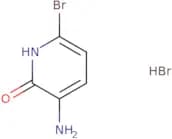
CAS:<p>Versatile small molecule scaffold</p>Formula:C8H7NO4Purity:Min. 95%Molecular weight:181.15 g/mol3-amino-6-bromopyridin-2-ol hydrobromide
CAS:<p>Versatile small molecule scaffold</p>Formula:C5H6Br2N2OPurity:Min. 95%Molecular weight:269.9 g/mol3-Boc-3-azabicyclo[3.2.1]octan-8-amine
CAS:<p>Versatile small molecule scaffold</p>Formula:C12H22N2O2Purity:Min. 95%Molecular weight:226.32 g/mol2-Bromo-4-(4-fluorophenyl)-1,3-thiazole
CAS:<p>Versatile small molecule scaffold</p>Formula:C9H5NFSBrPurity:Min. 95%Molecular weight:258.11 g/mol2-Acetylbenzoic acid
CAS:<p>2-Acetylbenzoic acid is a functional molecule that contains an acetyl group. It can form hydrogen bonds with other molecules and has been shown to induce apoptosis in cells. The reaction products of 2-acetylbenzoic acid are malonic acid, acetylsalicylic acid, and 2-benzoylbenzoic acid. These three compounds are made by the addition of hydrogen or hydroxide to the molecule 2-acetylbenzoic acid. The molecule has two functional groups: a carbonyl group and an acetyl group. The chemical structure of this molecule can be seen in the figure below.<br>2-Acetylbenzoic Acid</p>Formula:C9H8O3Purity:Min. 95%Color and Shape:PowderMolecular weight:164.16 g/molRef: 3D-FA05086
Discontinued product
![2-[(2,2-Difluoroethyl)sulfanyl]-5-(trifluoromethyl)aniline](/_next/image/?url=https%3A%2Fstatic.cymitquimica.com%2Fproducts%2F3D%2Fthumb-webp%2FIXB29341.webp&w=3840&q=75)

![2-[(Piperazin-1-yl)methyl]-3H,4H-thieno[3,2-d]pyrimidin-4-one dihydrochloride](/_next/image/?url=https%3A%2Fstatic.cymitquimica.com%2Fproducts%2F3D%2Fthumb-webp%2FHGD66526.webp&w=3840&q=75)
![2-Chloro-N-[2-(3-chlorophenyl)ethyl]acetamide](/_next/image/?url=https%3A%2Fstatic.cymitquimica.com%2Fproducts%2F3D%2Fthumb-webp%2FJBA16215.webp&w=3840&q=75)
![[1-(1-Amino-2-methylpropyl)cyclopent-3-en-1-yl]methanol hydrochloride](/_next/image/?url=https%3A%2Fstatic.cymitquimica.com%2Fproducts%2F3D%2Fthumb-webp%2FJBD31750.webp&w=3840&q=75)
![2-Amino-1-[3-(propan-2-yloxy)phenyl]ethan-1-ol](/_next/image/?url=https%3A%2Fstatic.cymitquimica.com%2Fproducts%2F3D%2Fthumb-webp%2FGXB58984.webp&w=3840&q=75)
![2-Cyclopropyl-9-methyl-5H,6H-[1,2,4]triazolo[1,5-c]quinazolin-5-one](/_next/image/?url=https%3A%2Fstatic.cymitquimica.com%2Fproducts%2F3D%2Fthumb-webp%2FGXB45812.webp&w=3840&q=75)
![3-Methylbenzo[b]thiophene-2-carboxylic acid](/_next/image/?url=https%3A%2Fstatic.cymitquimica.com%2Fproducts%2F3D%2Fthumb-webp%2FDAA13378.webp&w=3840&q=75)


![3-Boc-3-azabicyclo[3.2.1]octan-8-amine](/_next/image/?url=https%3A%2Fstatic.cymitquimica.com%2Fproducts%2F3D%2Fthumb-webp%2FFDC76351.webp&w=3840&q=75)

