Building Blocks
This section contains fundamental products for the synthesis of organic and biological compounds. Building blocks are the essential starting materials used to construct complex molecules through various chemical reactions. They play a critical role in drug discovery, material science, and chemical research. At CymitQuimica, we offer a diverse range of high-quality building blocks to support your innovative research and industrial projects, ensuring you have the essential components for successful synthesis.
Subcategories of "Building Blocks"
- Boronic Acids & Boronic Acid Derivatives(5,774 products)
- Chiral Building Blocks(1,237 products)
- Hydrocarbon Building Blocks(6,098 products)
- Organic Building Blocks(60,980 products)
Found 205158 products of "Building Blocks"
Sort by
Purity (%)
0
100
|
0
|
50
|
90
|
95
|
100
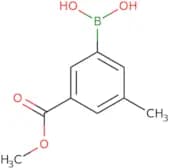
3-Methoxycarbonyl-5-methylphenylboronic acid
CAS:Versatile small molecule scaffold
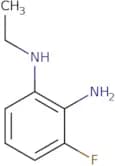
Formula:C9H11BO4Purity:Min. 95%Molecular weight:193.99 g/mol1-N-Ethyl-3-fluorobenzene-1,2-diamine
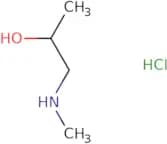
CAS:Versatile small molecule scaffoldFormula:C8H11FN2Purity:Min. 95%Molecular weight:154.18 g/mol(2R)-1-(Methylamino)propan-2-ol hydrochloride
CAS:Versatile small molecule scaffoldFormula:C4H12ClNOPurity:Min. 95%Molecular weight:125.6 g/molRef: 3D-EMB53364
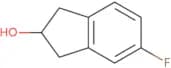
Discontinued product5-Fluoro-2,3-dihydro-1H-inden-2-ol
CAS:Versatile small molecule scaffold
Formula:C9H9FOPurity:Min. 95%Molecular weight:152.16 g/molRef: 3D-EMB53360
Discontinued product2-[(Benzylcarbamoyl)amino]-2-methylpropanoic acid
CAS:Versatile small molecule scaffoldFormula:C12H16N2O3Purity:Min. 95%Molecular weight:236.3 g/molRef: 3D-EMB47353
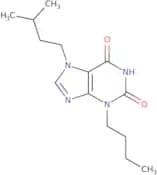
Discontinued product3-Butyl-7-(3-methylbutyl)-2,3,6,7-tetrahydro-1H-purine-2,6-dione
CAS:Controlled ProductVersatile small molecule scaffold
Formula:C14H22N4O2Purity:Min. 95%Molecular weight:278.35 g/molRef: 3D-EKB35185
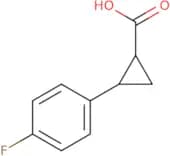
Discontinued product2-(4-Fluorophenyl)cyclopropanecarboxylic acid
CAS:Versatile small molecule scaffold
Formula:C10H9FO2Purity:Min. 95%Molecular weight:180.18 g/mol({2-[(4-Methylphenyl)sulfanyl]ethyl}carbamoyl)methyl 4-hydroxybenzoate
CAS:Versatile small molecule scaffold
Formula:C18H19NO4SPurity:Min. 95%Molecular weight:345.4 g/molRef: 3D-EKB32034
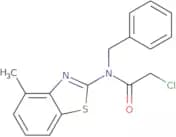
Discontinued productN-Benzyl-2-chloro-N-(4-methyl-1,3-benzothiazol-2-yl)acetamide
CAS:Versatile small molecule scaffoldFormula:C17H15ClN2OSPurity:Min. 95%Molecular weight:330.8 g/molRef: 3D-EKB31946
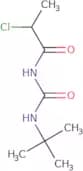
Discontinued product3-tert-Butyl-1-(2-chloropropanoyl)urea
CAS:Versatile small molecule scaffold
Formula:C8H15ClN2O2Purity:Min. 95%Molecular weight:206.67 g/mol2-Phenyl-5-(4,4,5,5-tetramethyl-1,3,2-dioxaborolan-2-yl)pyridine
CAS:Versatile small molecule scaffoldFormula:C17H20BNO2Purity:Min. 95%Molecular weight:281.17 g/molRef: 3D-EKB29127
Discontinued productBenzyl 2-amino-3-hydroxypropanoate hydrochloride
CAS:Benzyl 2-amino-3-hydroxypropanoate hydrochloride is a chiral molecule with a S configuration. It is the racemic mixture of two enantiomers, which are mirror images of each other. The compound has been shown to inhibit bacterial growth by binding to the 50S ribosomal subunit and inhibiting protein synthesis. This drug also inhibits the formation of siderophores and pseudobactin, which are involved in iron uptake. Benzyl 2-amino-3-hydroxypropanoate hydrochloride also has an anti-inflammatory effect and may be used as an adjuvant therapy for tuberculosis or cancer chemotherapy.Formula:C10H14ClNO3Purity:Min. 95%Molecular weight:231.67 g/molMethyl 2-ethyl-1H-pyrrole-3-carboxylate
CAS:Versatile small molecule scaffold
Formula:C8H11NO2Purity:Min. 95%Molecular weight:153.18 g/molRef: 3D-EKB21482
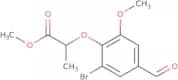
Discontinued productMethyl 2-(2-bromo-4-formyl-6-methoxyphenoxy)propanoate
CAS:Versatile small molecule scaffold
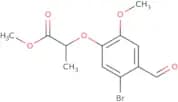
Formula:C12H13BrO5Purity:Min. 95%Molecular weight:317.13 g/molMethyl 2-(5-bromo-4-formyl-2-methoxyphenoxy)propanoate
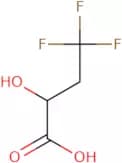
CAS:Versatile small molecule scaffoldFormula:C12H13BrO5Purity:Min. 95%Molecular weight:317.13 g/mol4,4,4-Trifluoro-2-hydroxybutanoic acid
CAS:4,4,4-Trifluoro-2-hydroxybutanoic acid is an alcohol that is used in the synthesis of benzaldehydes. This compound can be extracted from a variety of sources, including natural sources such as plants and animals. 4,4,4-Trifluoro-2-hydroxybutanoic acid has been shown to react with butyllithium to form a mixture of 2:1:1 (R:S:R) diastereomers. The reaction is carried out under conditions that favor the formation of the desired product. This process produces high yields and allows for chiral products to be synthesized in high optical purity.Formula:C4H5F3O3Purity:Min. 95%Molecular weight:158.08 g/molRef: 3D-EKB09039
Discontinued productPyrazolo[1,5-a]pyrimidine-3-carbaldehyde
CAS:Versatile small molecule scaffoldFormula:C7H5N3OPurity:Min. 95%Molecular weight:147.14 g/mol4-[(3-Hydroxypropyl)sulfanyl]benzoic acid
CAS:Versatile small molecule scaffold
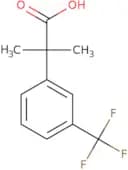
Formula:C10H12O3SPurity:Min. 95%Molecular weight:212.27 g/mol2-Methyl-2-(3-(trifluoromethylphenyl)propanoic acid
CAS:Versatile small molecule scaffold
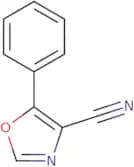
Formula:C11H11F3O2Purity:Min. 95%Molecular weight:232.2 g/mol5-Phenyl-1,3-oxazole-4-carbonitrile
CAS:5-Phenyl-1,3-oxazole-4-carbonitrile (5PO) is a reagent that can be used for the coupling of potassium with an anion. The radical mechanism of this reaction has been shown to use copper as a catalyst. 5PO is also useful for the preparation of cyanide salts from cyanides, such as potassium cyanide, ferricyanide, and hydrocyanic acid. 5PO is typically prepared in situ by coupling an alkyl halide with a phenylhydrazine.
Formula:C10H6N2OPurity:Min. 95%Molecular weight:170.17 g/molRef: 3D-EKA88028
Discontinued product

![2-[(Benzylcarbamoyl)amino]-2-methylpropanoic acid](/_next/image/?url=https%3A%2Fstatic.cymitquimica.com%2Fproducts%2F3D%2Fthumb-webp%2FEMB47353.webp&w=3840&q=75)
![({2-[(4-Methylphenyl)sulfanyl]ethyl}carbamoyl)methyl 4-hydroxybenzoate](/_next/image/?url=https%3A%2Fstatic.cymitquimica.com%2Fproducts%2F3D%2Fthumb-webp%2FEKB32034.webp&w=3840&q=75)


![Pyrazolo[1,5-a]pyrimidine-3-carbaldehyde](/_next/image/?url=https%3A%2Fstatic.cymitquimica.com%2Fproducts%2F3D%2Fthumb-webp%2FEKB07259.webp&w=3840&q=75)
![4-[(3-Hydroxypropyl)sulfanyl]benzoic acid](/_next/image/?url=https%3A%2Fstatic.cymitquimica.com%2Fproducts%2F3D%2Fthumb-webp%2FEKA91061.webp&w=3840&q=75)