Building Blocks
This section contains fundamental products for the synthesis of organic and biological compounds. Building blocks are the essential starting materials used to construct complex molecules through various chemical reactions. They play a critical role in drug discovery, material science, and chemical research. At CymitQuimica, we offer a diverse range of high-quality building blocks to support your innovative research and industrial projects, ensuring you have the essential components for successful synthesis.
Subcategories of "Building Blocks"
- Boronic Acids & Boronic Acid Derivatives(5,780 products)
- Chiral Building Blocks(1,241 products)
- Hydrocarbon Building Blocks(6,100 products)
- Organic Building Blocks(61,029 products)
Found 205306 products of "Building Blocks"
Sort by
Purity (%)
0
100
|
0
|
50
|
90
|
95
|
100
(3aR,4R,6aR)-tert-butyl 4-(hydroxymethyl)hexahydrocyclopenta[c]pyrrole-2(1H)-carboxylate
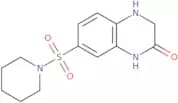
CAS:Versatile small molecule scaffoldFormula:C13H23NO3Purity:Min. 95%Molecular weight:241.33 g/mol7-(Piperidine-1-sulfonyl)-1,2,3,4-tetrahydroquinoxalin-2-one
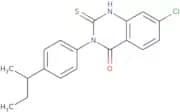
CAS:Versatile small molecule scaffoldFormula:C13H17N3O3SPurity:Min. 95%Molecular weight:295.36 g/mol3-(4-Sec-butyl-phenyl)-7-chloro-2-mercapto-3H-quinazolin-4-one
CAS:Controlled Product3-(4-Sec-butyl-phenyl)-7-chloro-2-mercapto-3H-quinazolin-4-one is a small molecule that binds to the extracellular domain of the human IgG1 and inhibits the binding of antibody to antigen. 3-(4-Sec-butyl-phenyl)-7-chloro-2-mercapto-3H-quinazolin-4 -one is a potent inhibitor of the binding of antibody to antigen. It can be used as a research tool for cell biology, pharmacology, and immunology. 3-(4 -sec -butyl -phenyl)-7 -chloro -2 mercapto -3H quinazolin 4 one is an activator of ligand, which has been shown to activate ion channels and receptors in vitro.Formula:C18H17ClN2OSPurity:Min. 95%Molecular weight:344.9 g/mol5-[(1,3-Dioxo-2,3-dihydro-1H-isoindol-2-yl)methyl]-2-methoxybenzoic acid
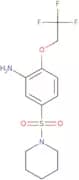
CAS:Versatile small molecule scaffoldFormula:C17H13NO5Purity:Min. 95%Molecular weight:311.29 g/mol5-(Piperidine-1-sulfonyl)-2-(2,2,2-trifluoroethoxy)aniline
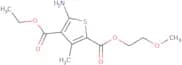
CAS:Versatile small molecule scaffoldFormula:C13H17F3N2O3SPurity:Min. 95%Molecular weight:338.35 g/mol4-Ethyl 2-(2-methoxyethyl) 5-amino-3-methylthiophene-2,4-dicarboxylate
CAS:Versatile small molecule scaffoldFormula:C12H17NO5SPurity:Min. 95%Molecular weight:287.33 g/mol2-Chloro-N-[4-(2-chloroacetamido)-3-nitrophenyl]acetamide
CAS:Versatile small molecule scaffold
Formula:C10H9Cl2N3O4Purity:Min. 95%Molecular weight:306.1 g/mol5-Methyl-10,13-dioxa-4,6-diazatricyclo[7.4.0.0,3,7]trideca-1(9),2,4,7-tetraene
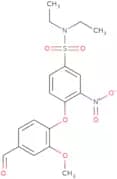
CAS:Versatile small molecule scaffoldFormula:C10H10N2O2Purity:Min. 95%Molecular weight:190.2 g/molN,N-Diethyl-4-(4-formyl-2-methoxy-phenoxy)-3-nitro-benzenesulfonamide
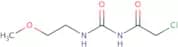
CAS:Controlled ProductN,N-Diethyl-4-(4-formyl-2-methoxy-phenoxy)-3-nitro-benzenesulfonamide is an inhibitor that binds to and inhibits the activity of various ion channels. This compound has been shown to inhibit the activation of acetylcholine receptors (AChRs), which are found in both the central and peripheral nervous systems. In addition, it can also be used as a reagent for identifying ligands or receptor proteins. N,N-Diethyl-4-(4-formyl-2-methoxy)-3 nitro benzenesulfonamide is a high purity chemical that can be used in research tools such as cell biology and pharmacology. It is also a CAS number 556020-33 8.Formula:C18H20N2O7SPurity:Min. 95%Molecular weight:408.4 g/mol3-(2-Chloroacetyl)-1-(2-methoxyethyl)urea
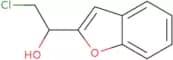
CAS:Versatile small molecule scaffoldFormula:C6H11ClN2O3Purity:Min. 95%Molecular weight:194.61 g/mol(1S)-1-(1-Benzofuran-2-yl)-2-chloroethan-1-ol
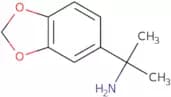
CAS:Versatile small molecule scaffoldFormula:C10H9ClO2Purity:Min. 95%Molecular weight:196.63 g/mol2-(1,3-Dioxaindan-5-yl)propan-2-amine
CAS:Versatile small molecule scaffoldFormula:C10H13NO2Purity:Min. 95%Molecular weight:179.22 g/mol5-Chloro-2-methylpyrido[3,4-b]pyrazine
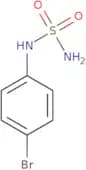
CAS:Versatile small molecule scaffoldFormula:C8H6ClN3Purity:Min. 95%Molecular weight:179.6 g/molN-(4-Bromophenyl)aminosulfonamide
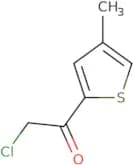
CAS:Versatile small molecule scaffoldFormula:C6H7BrN2O2SPurity:Min. 95%Molecular weight:251.1 g/mol2-Chloro-1-(4-methyl-2-thienyl)-ethanone
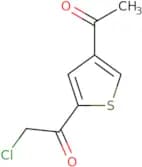
CAS:Versatile small molecule scaffoldFormula:C7H7ClOSPurity:Min. 95%Molecular weight:174.65 g/mol1-(4-Acetylthiophen-2-yl)-2-chloroethan-1-one
CAS:Versatile small molecule scaffold
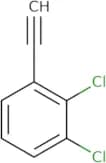
Formula:C8H7ClO2SPurity:Min. 95%Molecular weight:202.66 g/mol1,2-Dichloro-3-ethynylbenzene
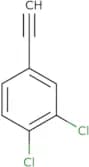
CAS:Versatile small molecule scaffoldFormula:C8H4Cl2Purity:Min. 95%Molecular weight:171.02 g/mol3,4-Dichlorophenylacetylene
CAS:3,4-Dichlorophenylacetylene is a chemical compound that belongs to the group of isoxazoles. It has been shown to inhibit glycogen phosphorylase by binding to the enzyme's active site and blocking the conversion of glucose-1-phosphate into glucose-6-phosphate. This inhibition leads to a reduction in the production of glucose and glycogen in liver cells. 3,4-Dichlorophenylacetylene has also been shown to inhibit other enzymes such as human liver, cytochrome p450, and xanthine oxidase. Research on this chemical is ongoing for its use as a possible treatment for diabetes mellitus type II.Formula:C8H4Cl2Purity:Min. 95%Molecular weight:171.02 g/mol1-Chloro-3-ethynyl-5-methoxybenzene
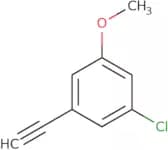
CAS:Versatile small molecule scaffoldFormula:C9H7ClOPurity:Min. 95%Molecular weight:166.6 g/mol4-Amino-3-bromo-5-nitrobenzoic acid
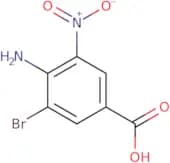
CAS:Versatile small molecule scaffoldFormula:C7H5BrN2O4Purity:Min. 95%Molecular weight:261.03 g/mol
![(3aR,4R,6aR)-tert-butyl 4-(hydroxymethyl)hexahydrocyclopenta[c]pyrrole-2(1H)-carboxylate](/_next/image/?url=https%3A%2Fstatic.cymitquimica.com%2Fproducts%2F3D%2Fthumb-webp%2FGWC98445.webp&w=3840&q=75)

![5-[(1,3-Dioxo-2,3-dihydro-1H-isoindol-2-yl)methyl]-2-methoxybenzoic acid](/_next/image/?url=https%3A%2Fstatic.cymitquimica.com%2Fproducts%2F3D%2Fthumb-webp%2FGXA01614.webp&w=3840&q=75)
![2-Chloro-N-[4-(2-chloroacetamido)-3-nitrophenyl]acetamide](/_next/image/?url=https%3A%2Fstatic.cymitquimica.com%2Fproducts%2F3D%2Fthumb-webp%2FGXA01658.webp&w=3840&q=75)
![5-Methyl-10,13-dioxa-4,6-diazatricyclo[7.4.0.0,3,7]trideca-1(9),2,4,7-tetraene](/_next/image/?url=https%3A%2Fstatic.cymitquimica.com%2Fproducts%2F3D%2Fthumb-webp%2FGXA02032.webp&w=3840&q=75)
![5-Chloro-2-methylpyrido[3,4-b]pyrazine](/_next/image/?url=https%3A%2Fstatic.cymitquimica.com%2Fproducts%2F3D%2Fthumb-webp%2FGXA05382.webp&w=3840&q=75)