Building Blocks
This section contains fundamental products for the synthesis of organic and biological compounds. Building blocks are the essential starting materials used to construct complex molecules through various chemical reactions. They play a critical role in drug discovery, material science, and chemical research. At CymitQuimica, we offer a diverse range of high-quality building blocks to support your innovative research and industrial projects, ensuring you have the essential components for successful synthesis.
Subcategories of "Building Blocks"
- Boronic Acids & Boronic Acid Derivatives(5,756 products)
- Chiral Building Blocks(1,242 products)
- Hydrocarbon Building Blocks(6,095 products)
- Organic Building Blocks(61,038 products)
Found 196817 products of "Building Blocks"
Sort by
Purity (%)
0
100
|
0
|
50
|
90
|
95
|
100
2-Chloro-N-[3-(propan-2-yloxy)propyl]acetamide
CAS:<p>Versatile small molecule scaffold</p>Formula:C8H16ClNO2Purity:Min. 95%Molecular weight:193.67 g/molN-Butylbutanamide
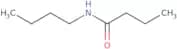
CAS:<p>N-Butylbutanamide is a colorless, volatile liquid that has a distinctive odor. It is used as an intermediate in the production of other chemicals and a solvent for coatings and adhesives. N-Butylbutanamide has been shown to react with amines and amides with high concentrations of primary alcohols to form diazirine. Diazirine can be detected by UV spectroscopy at 254 nm and by mass spectrometry. N-Butylbutanamide can be analyzed using on-line liquid chromatography or GCMS.</p>Formula:C8H17NOPurity:Min. 95%Molecular weight:143.23 g/molN-Cyclohexyl-3-phenylpropanamide
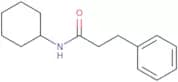
CAS:<p>Versatile small molecule scaffold</p>Formula:C15H21NOPurity:Min. 95%Molecular weight:231.33 g/molrac-(4aR,7aR)-Octahydro-1H-cyclopenta[C]pyridine
CAS:<p>Versatile small molecule scaffold</p>Formula:C8H15NPurity:Min. 95%Molecular weight:125.2 g/mol2-(2-Chlorophenyl)acetamide
CAS:<p>2-(2-Chlorophenyl)acetamide is a trisubstituted acetamide that has been shown to bind to the benzodiazepine receptor. This binding prevents the binding of GABA to the receptor and inhibits the ion channel, which leads to increased cell membrane permeability and cell death. 2-(2-Chlorophenyl)acetamide also binds to the anhydrase II isoform, which causes inhibition of carbonic anhydrase activity. This in turn leads to increased levels of carbon dioxide in some tissues, such as those found in the eye, leading to irritation and pain. The compound has also been shown to inhibit mitogen-activated protein kinase (MAPK), which is a protein involved in cellular signalling pathways that regulate growth and differentiation. It does this by preventing phosphorylation of MAPK at tyrosine residues.</p>Formula:C8H8ClNOPurity:Min. 95%Molecular weight:169.61 g/mol2-(Ethylsulfanyl)-1-phenylethan-1-one
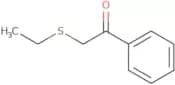
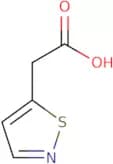
CAS:<p>Versatile small molecule scaffold</p>Formula:C10H12OSPurity:Min. 95%Molecular weight:180.27 g/mol2-(1,2-Thiazol-5-yl)acetic acid
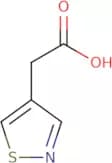
CAS:<p>Versatile small molecule scaffold</p>Formula:C5H5NO2SPurity:Min. 95%Molecular weight:143.17 g/mol2-(1,2-Thiazol-4-yl)acetic acid
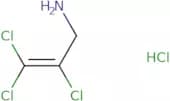
CAS:<p>Versatile small molecule scaffold</p>Formula:C5H5NO2SPurity:Min. 95%Molecular weight:143.17 g/mol2,3,3-Trichloroprop-2-en-1-amine hydrochloride
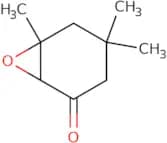
CAS:<p>Versatile small molecule scaffold</p>Formula:C3H5Cl4NPurity:Min. 95%Molecular weight:196.9 g/molIsophorone Oxide
CAS:<p>Isophorone Oxide is a molecule that contains a carbonyl group. It is unreactive and does not form hydrogen bonds or react with hydroxy groups. Isophorone oxide has two reactive groups, the hydroxyl group and amido group, which are responsible for its chemical properties. The electron reduction of the carbonyl group can be achieved by using deionized water as a reducing agent. In solution form, Isophorone Oxide is colorless to light yellow liquid with a molecular weight of 144.16 g/mol.</p>Formula:C9H14O2Purity:Min. 95%Molecular weight:154.21 g/mol2-Oxo-2-{4,7,7-trimethyl-3-oxobicyclo[2.2.1]heptan-2-yl}acetic acid
CAS:<p>Versatile small molecule scaffold</p>Formula:C12H16O4Purity:Min. 95%Molecular weight:224.25 g/mol({1,7,7-Trimethylbicyclo[2.2.1]heptan-2-ylidene}amino)urea
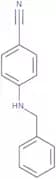
CAS:<p>Versatile small molecule scaffold</p>Formula:C11H19N3OPurity:Min. 95%Molecular weight:209.29 g/mol4-(Benzylamino)benzonitrile
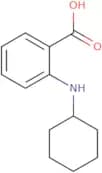
CAS:<p>Versatile small molecule scaffold</p>Formula:C14H12N2Purity:Min. 95%Molecular weight:208.26 g/mol2-(Cyclohexylamino)benzoic acid
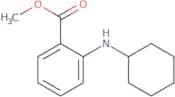
CAS:<p>2-(Cyclohexylamino)benzoic acid is a chemical compound that reacts with aryl halides to form cyclic amines. The reaction proceeds by the formation of an intermediate, which is then hydrolyzed and decarboxylated to form the product. This reaction can be used for the synthesis of amines from either aromatic or aliphatic aryl chlorides. This process is often used in screening experiments because it has been shown to be selective for aryl halides and yields high yields. The addition of cross-coupling reactions can also yield high yields and produce desired products with good chemo- and regioselectivity. 2-(Cyclohexylamino)benzoic acid is also useful for the synthesis of hyperpolarized molecules for imaging studies, as well as in ultrafast experiments where transfer rates are important.</p>Formula:C13H17NO2Purity:Min. 95%Molecular weight:219.28 g/molMethyl 2-(cyclohexylamino)benzoate
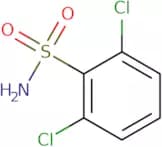
CAS:<p>Versatile small molecule scaffold</p>Formula:C14H19NO2Purity:Min. 95%Molecular weight:233.31 g/mol2,6-Dichlorobenzenesulfonamide
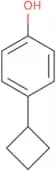
CAS:<p>Versatile small molecule scaffold</p>Formula:C6H5Cl2NO2SPurity:Min. 95%Molecular weight:226.08 g/mol4-Cyclobutylphenol
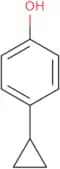
CAS:<p>Versatile small molecule scaffold</p>Formula:C10H12OPurity:Min. 95%Molecular weight:148.2 g/mol4-Cyclopropylphenol
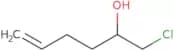
CAS:<p>4-Cyclopropylphenol is an antimicrobial agent that belongs to the group of phenols. It has been shown to have mutagenic properties and is used in chemical studies. 4-Cyclopropylphenol is activated by reaction with a benzene molecule, which binds to the functional groups on the phenol, forming a covalent bond. This activation process requires an input of energy in order to break the benzene ring and form the reactive species. The elimination of 4-cyclopropylfhenol from solution also requires energy input as it leaves as a gas. The mutagenic properties of 4-cyclopropylfhenol are due to its ability for interaction with DNA, which is based on thermodynamic and kinetic theory.</p>Formula:C9H10OPurity:Min. 95%Molecular weight:134.18 g/mol1-Chlorohex-5-en-2-ol
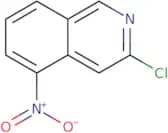
CAS:<p>Versatile small molecule scaffold</p>Formula:C6H11ClOPurity:Min. 95%Molecular weight:134.6 g/mol3-Chloro-5-nitroisoquinoline
CAS:<p>3-Chloro-5-nitroisoquinoline is a heterocyclic compound that belongs to the isoquinoline class. It can be synthesized by reacting 3,4,5-trichlorobenzaldehyde with ammonia and sodium nitrite in an aqueous solution. The synthesis of this compound has been shown to produce two isomers, thiazolo and thiazole. Spectroscopic data for this compound have been obtained in the solid state and in solution. The spectra show strong absorptions at about 250 nm and at about 590 nm. The heterocyclic ring has a nitrogen atom as one of its members, which is responsible for the absorption at around 250 nm. The absorption at 590 nm is due to the presence of an aromatic ring system.</p>Formula:C9H5ClN2O2Purity:Min. 95%Molecular weight:208.6 g/mol
![2-Chloro-N-[3-(propan-2-yloxy)propyl]acetamide](/_next/image/?url=https%3A%2Fstatic.cymitquimica.com%2Fproducts%2F3D%2Fthumb-webp%2FKAA26367.webp&w=3840&q=75)

![rac-(4aR,7aR)-Octahydro-1H-cyclopenta[C]pyridine](/_next/image/?url=https%3A%2Fstatic.cymitquimica.com%2Fproducts%2F3D%2Fthumb-webp%2FKAA26802.webp&w=3840&q=75)
![2-Oxo-2-{4,7,7-trimethyl-3-oxobicyclo[2.2.1]heptan-2-yl}acetic acid](/_next/image/?url=https%3A%2Fstatic.cymitquimica.com%2Fproducts%2F3D%2Fthumb-webp%2FKAA27734.webp&w=3840&q=75)
![({1,7,7-Trimethylbicyclo[2.2.1]heptan-2-ylidene}amino)urea](/_next/image/?url=https%3A%2Fstatic.cymitquimica.com%2Fproducts%2F3D%2Fthumb-webp%2FKAA28141.webp&w=3840&q=75)