Building Blocks
Subcategories of "Building Blocks"
- Boronic Acids & Boronic Acid Derivatives(5,778 products)
- Chiral Building Blocks(1,243 products)
- Hydrocarbon Building Blocks(6,099 products)
- Organic Building Blocks(61,038 products)
Found 205373 products of "Building Blocks"
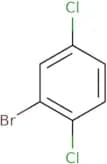
1-Bromo-2,5-dichlorobenzene
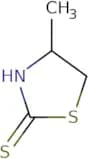
CAS:1-Bromo-2,5-dichlorobenzene is an anticancer drug that belongs to the class of brominated aromatic compounds. The vibrational spectra of 1-bromo-2,5-dichlorobenzene have been characterized by FTIR. The anticancer activity of 1-bromo-2,5-dichlorobenzene has been shown in in vitro and in vivo studies. It is orally active and has a low toxicity profile. The major metabolite of 1-Bromo-2,5-dichlorobenzene is 2,6 dichloropyridine, which can be detected by mass spectrometry. The metabolites are thought to be formed by dehydration or Friedel–Crafts acylation reactions.Formula:C6H3BrCl2Purity:Min. 95%Molecular weight:225.89 g/mol4-Methyl-1,3-thiazolidine-2-thione
CAS:4-Methyl-1,3-thiazolidine-2-thione is a selective disulfide reductase with metal halide and cycloaddition activity. It catalyzes the reaction of alkali metal with carbon disulfide to form aziridine. The reaction proceeds through two steps: in the first step, alkali metal is reduced by carbon disulfide to form an alkyl radical; in the second step, the alkyl radical reacts with carbon disulfide to form aziridine. 4-Methyl-1,3-thiazolidine-2-thione has been shown to be an efficient catalyst for this reaction and can also catalyze cycloadditions between urethane and aziridine.
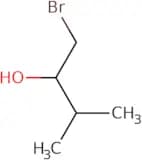
Formula:C4H7NS2Purity:Min. 95%Molecular weight:133.2 g/mol1-Bromo-3-methylbutan-2-ol
CAS:Versatile small molecule scaffold
Formula:C5H11BrOPurity:Min. 95%Molecular weight:167.04 g/mol3-Aminorhodanine
CAS:3-Aminorhodanine is an inhibitor molecule that can be used to inhibit enzymes and other molecules. It has been shown to have anti-inflammatory activity by inhibiting the enzyme cyclooxygenase (COX). 3-Aminorhodanine has been used in the development of microcapsules for drug delivery, as well as analytical chemistry methods such as particle size analysis and electrochemical impedance spectroscopy.
Formula:C3H4N2OS2Purity:Min. 95%Molecular weight:148.21 g/molN-Cyclohexyl-1,3-thiazol-2-amine
CAS:Versatile small molecule scaffold
Formula:C9H14N2SPurity:Min. 95%Molecular weight:182.29 g/molN-tert-Butyl-1,3-thiazol-2-amine
CAS:Versatile small molecule scaffoldFormula:C7H12N2SPurity:Min. 95%Molecular weight:156.25 g/molEthyl 5-(4-methoxyphenyl)-1,3-oxazole-2-carboxylate
CAS:Versatile small molecule scaffold
Formula:C13H13NO4Purity:Min. 95%Molecular weight:247.25 g/mol1-[2-(Methylsulfanyl)phenyl]ethan-1-one
CAS:Versatile small molecule scaffold
Formula:C9H10OSPurity:Min. 95%Molecular weight:166.24 g/mol1-[3-(Methylsulfanyl)phenyl]ethan-1-one
CAS:Versatile small molecule scaffold
Formula:C9H10OSPurity:Min. 95%Molecular weight:166.24 g/molEthyl 3-chloro-6-methylpyridazine-4-carboxylate
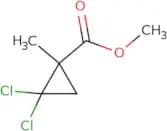
CAS:Versatile small molecule scaffoldFormula:C8H9ClN2O2Purity:Min. 95%Molecular weight:200.62 g/molMethyl 2,2-dichloro-1-methylcyclopropanecarboxylate
CAS:Methyl 2,2-dichloro-1-methylcyclopropanecarboxylate is a cyclic compound with an effective rate of 11.6 s−1. It has been shown to be an effective catalyst for the electrochemical reduction of anthracene and other aromatic compounds in metallocomplexes. The catalytic activity of Methyl 2,2-dichloro-1-methylcyclopropanecarboxylate is dependent on the concentration and type of anion present in solution. In homogeneous systems, this compound is catalytically active for the electrochemical reduction of radical anions and polarographic oxidation of pyridine. This chemical also shows high electrochemical reductive activity towards palladium.
Formula:C6H8Cl2O2Purity:Min. 95%Molecular weight:183.03 g/mol6-Methoxy-1,2,3,4-tetrahydro-naphthalen-2-ol
CAS:Versatile small molecule scaffoldFormula:C11H14O2Purity:Min. 95%Molecular weight:178.23 g/mol6-benzyl-2-methyl-5,6,7,8-tetrahydropyrido[4,3-d]pyrimidin-4(3H)-one
CAS:Versatile small molecule scaffold
Formula:C15H17N3OPurity:Min. 95%Molecular weight:255.32 g/molBenzyltriphenylphosphonium Bromide
CAS:Benzyltriphenylphosphonium Bromide is a quaternary ammonium compound that is used in the treatment of microbial infections. It is a white powder that has an unpleasant odor and is soluble in water. Benzyltriphenylphosphonium Bromide has been shown to be effective against bacterial species, such as those found in urine samples, and also exhibits physiological activities, such as sodium citrate. This chemical also has an analytical chemistry role in the determination of diamine tetraacetic acid (DTA) levels in cervical cancer cells. Benzyltriphenylphosphonium Bromide is known to form salts with fatty acids and hydroxyl groups.
Formula:C25H22BrPPurity:Min. 95%Molecular weight:433.33 g/mol4-Bromopentanoic acid
CAS:Versatile small molecule scaffold
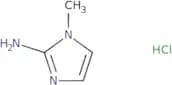
Formula:C5H9BrO2Purity:Min. 95%Molecular weight:181.03 g/mol1-Methyl-1H-imidazol-2-amine hydrochloride
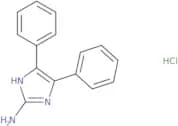
CAS:Versatile small molecule scaffoldFormula:C4H8ClN3Purity:Min. 95%Molecular weight:133.58 g/mol4,5-Diphenyl-1H-imidazol-2-amine hydrochloride
CAS:Versatile small molecule scaffoldFormula:C15H14ClN3Purity:Min. 95%Molecular weight:271.74 g/molIsothiazole-3-carbonitrile
CAS:Isothiazole-3-carbonitrile is a chemical compound that contains a nitrile group with two isothiazole rings. It is used in the synthesis of urea and in the production of carbon tetrachloride. This chemical has been shown to cause hypotoxicity mediated by cyano, epithelioma, disulfide, pyridine, carbon disulfide, dichloro, industrial, cutaneum and cancer. Isothiazole-3-carbonitrile has been shown to act as a signal molecule that can inhibit chlorine and cyanide reactions by acting as a competitive inhibitor.
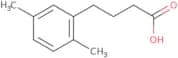
Formula:C2H2N2SPurity:Min. 95%Molecular weight:110.14 g/mol4-(2,5-Dimethylphenyl)butanoic acid
CAS:Versatile small molecule scaffoldFormula:C12H16O2Purity:Min. 95%Molecular weight:192.25 g/mol1-Phenyl-1H-1,2,3-triazole
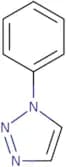
CAS:1-Phenyl-1H-1,2,3-triazole is an antiinflammatory agent that belongs to the group of amides. It has been shown to be effective against plant diseases and acarids in animals. 1-Phenyl-1H-1,2,3-triazole has been shown to have antibacterial activity against bacteria by inhibiting the synthesis of proteins essential for cell division. The enantiomer of 1-phenyl-1H-1,2,3-triazole has a greater antibacterial effect than the racemic mixture. The ethyl bromoacetate moiety of this molecule is responsible for its strong activity as an antibiotic.
Formula:C8H7N3Purity:Min. 95%Molecular weight:145.16 g/mol



![1-[2-(Methylsulfanyl)phenyl]ethan-1-one](/_next/image/?url=https%3A%2Fstatic.cymitquimica.com%2Fproducts%2F3D%2Fthumb-webp%2FBAA44197.webp&w=3840&q=75)
![1-[3-(Methylsulfanyl)phenyl]ethan-1-one](/_next/image/?url=https%3A%2Fstatic.cymitquimica.com%2Fproducts%2F3D%2Fthumb-webp%2FBAA44199.webp&w=3840&q=75)


![6-benzyl-2-methyl-5,6,7,8-tetrahydropyrido[4,3-d]pyrimidin-4(3H)-one](/_next/image/?url=https%3A%2Fstatic.cymitquimica.com%2Fproducts%2F3D%2Fthumb-webp%2FBAA44840.webp&w=3840&q=75)