


Building Blocks
This section contains fundamental products for the synthesis of organic and biological compounds. Building blocks are the essential starting materials used to construct complex molecules through various chemical reactions. They play a critical role in drug discovery, material science, and chemical research. At CymitQuimica, we offer a diverse range of high-quality building blocks to support your innovative research and industrial projects, ensuring you have the essential components for successful synthesis.
Subcategories of "Building Blocks"
- Boronic Acids & Boronic Acid Derivatives(5,756 products)
- Chiral Building Blocks(1,242 products)
- Hydrocarbon Building Blocks(6,095 products)
- Organic Building Blocks(61,038 products)
Found 196817 products of "Building Blocks"
Sort by
Purity (%)
0
100
|
0
|
50
|
90
|
95
|
100
6-Methyl-1H-pyrazolo[3,4-d]pyrimidin-4(7H)-one
CAS:<p>Versatile small molecule scaffold</p>Formula:C6H6N4OPurity:Min. 95%Molecular weight:150.14 g/molEthyl 3-bromo-2-oxocyclohexanecarboxylate
CAS:<p>3-Bromo-2-oxocyclohexanecarboxylate is a diterpene alkaloid that has been prepared by the Friedel-Crafts reaction of ethyl bromoacetate and cyclohexane. The product is an intramolecular arylation, which means that the two carbons in the ring are bonded to each other. This type of reaction usually produces a group specific functional group, such as an acid chloride or ester, but in this case it produces an alcohol. 3-Bromo-2-oxocyclohexanecarboxylate is used as a precursor for silver salts which are used to make photographic film.</p>Formula:C9H13BrO3Purity:Min. 95%Molecular weight:249.1 g/mol2-[(3-Phenylpropyl)sulfanyl]acetic acid
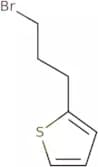
CAS:<p>Versatile small molecule scaffold</p>Formula:C11H14O2SPurity:Min. 95%Molecular weight:210.29 g/mol2-(3-Bromopropyl)-thiophene
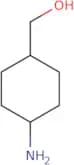
CAS:<p>Versatile small molecule scaffold</p>Formula:C7H9BrSPurity:Min. 95%Molecular weight:205.12 g/molCyclohexanemethanol, 4-amino-, cis-
CAS:<p>Versatile small molecule scaffold</p>Formula:C7H15NOPurity:Min. 95%Molecular weight:129.2 g/mol2-(4-Chlorobenzoyl)-1-methyl-1H-imidazole
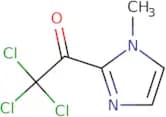
CAS:Controlled Product<p>Versatile small molecule scaffold</p>Formula:C11H9ClN2OPurity:Min. 95%Molecular weight:220.65 g/mol1-Methyl-2-(trichloroacetyl)imidazole
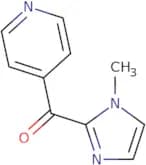
CAS:<p>1-Methyl-2-(trichloroacetyl)imidazole is a small molecule that is synthesized for the treatment of cancer. It interacts with dna and inhibits its function by binding to the minor groove in DNA, which causes conformational changes. 1-Methyl-2-(trichloroacetyl)imidazole has been shown to be effective against cancer cells that are resistant to other anticancer compounds. The molecular target for this compound is not fully understood, but it may work by inhibiting DNA synthesis or by inducing apoptosis. 1-Methyl-2-(trichloroacetyl)imidazole has shown some activity against leukemia and colon cancer cell lines in vitro and in vivo.</p>Formula:C6H5Cl3N2OPurity:Min. 95%Molecular weight:227.48 g/mol4-(1-Methyl-1H-imidazole-2-carbonyl)pyridine
CAS:<p>Versatile small molecule scaffold</p>Formula:C10H9N3OPurity:Min. 95%Molecular weight:187.2 g/mol2-(2-Chlorobenzoyl)-1-methyl-1H-imidazole
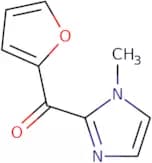
CAS:Controlled Product<p>Versatile small molecule scaffold</p>Formula:C11H9ClN2OPurity:Min. 95%Molecular weight:220.65 g/mol2-(Furan-2-carbonyl)-1-methyl-1H-imidazole
CAS:<p>Versatile small molecule scaffold</p>Formula:C9H8N2O2Purity:Min. 95%Molecular weight:176.17 g/mol3-[3-(4-Bromo-phenyl)-[1,2,4]oxadiazol-5-yl]-propionic acid
CAS:<p>Versatile small molecule scaffold</p>Formula:C11H9BrN2O3Purity:Min. 95%Molecular weight:297.1 g/mol4-Bromo-3-methylthiophene-2-carboxaldehyde
CAS:<p>Versatile small molecule scaffold</p>Formula:C6H5BrOSPurity:Min. 95%Molecular weight:205.07 g/mol4,5-Dibromo-3-methylthiophene-2-carbaldehyde
CAS:<p>Versatile small molecule scaffold</p>Formula:C6H4Br2OSPurity:Min. 95%Molecular weight:283.97 g/mol1-(Pyridin-2-yl)-2-(pyridin-4-yl)ethan-1-one
CAS:<p>Versatile small molecule scaffold</p>Formula:C12H10N2OPurity:Min. 95%Molecular weight:198.22 g/mol1-(3-Pyridyl)-2-thiourea
CAS:<p>1-(3-Pyridyl)-2-thiourea is an organic compound that belongs to the thiourea functional group. It is a white crystalline solid that has orthorhombic symmetry. 1-(3-Pyridyl)-2-thiourea has a protonated nitrogen atom on its pyridine ring, which gives it a positive charge. This functional group interacts with other molecules due to the presence of lone electron pairs on the nitrogen atom and the carbonyl oxygen atom. Crystal x-ray diffraction studies have shown that 1-(3-Pyridyl)-2-thiourea crystallizes in the group p2 space group and is oriented along [001]. The ligand coordinates are nitrate and solvent.</p>Formula:C6H7N3SPurity:Min. 95%Molecular weight:153.2 g/mol(Quinolin-3-yl)thiourea
CAS:<p>Versatile small molecule scaffold</p>Formula:C10H9N3SPurity:Min. 95%Molecular weight:203.27 g/mol2-(2-methyl-1H-imidazol-1-yl)acetic acid hydrochloride
CAS:<p>Versatile small molecule scaffold</p>Formula:C6H9ClN2O2Purity:Min. 95%Molecular weight:176.6 g/mol3-(5,6-Dimethyl-1H-1,3-benzodiazol-1-yl)propanoic acid hydrochloride
CAS:<p>Versatile small molecule scaffold</p>Formula:C12H15ClN2O2Purity:Min. 95%Molecular weight:254.71 g/mol2-[(Carboxymethyl)dimethylazaniumyl]acetate
CAS:<p>Versatile small molecule scaffold</p>Formula:C6H11NO4Purity:Min. 95%Molecular weight:161.16 g/mol3,6-Bis(3,5-dimethyl-1H-pyrazol-1-yl)-1,2,4,5-tetrazine
CAS:<p>3,6-Bis(3,5-dimethyl-1H-pyrazol-1-yl)-1,2,4,5-tetrazine is a group P2 molecule that diffracts well with x-rays. The compound has a molecular weight of 270.27 g/mol and the chemical formula is C12H11N5. 3,6-Bis(3,5-dimethyl-1H-pyrazol-1-yl)-1,2,4,5-tetrazine is soluble in acetonitrile but insoluble in water. The compound is stable at room temperature but will evaporate when heated to higher temperatures. 3,6bis(3,5dimethyl 1Hpyrazol 1yl) 1 2 4 5 tetrazine can be found in biochemical reactions as a nucleophile or can act as an inhibitor to enzymes such as cytochrome c oxidase or ATP synthase</p>Formula:C12H14N8Purity:Min. 95%Molecular weight:270.29 g/mol
![6-Methyl-1H-pyrazolo[3,4-d]pyrimidin-4(7H)-one](/_next/image/?url=https%3A%2Fstatic.cymitquimica.com%2Fproducts%2F3D%2Fthumb-webp%2FFBA12957.webp&w=3840&q=75)


![2-[(3-Phenylpropyl)sulfanyl]acetic acid](/_next/image/?url=https%3A%2Fstatic.cymitquimica.com%2Fproducts%2F3D%2Fthumb-webp%2FFBA13408.webp&w=3840&q=75)


![3-[3-(4-Bromo-phenyl)-[1,2,4]oxadiazol-5-yl]-propionic acid](/_next/image/?url=https%3A%2Fstatic.cymitquimica.com%2Fproducts%2F3D%2Fthumb-webp%2FFBA14994.webp&w=3840&q=75)


![2-[(Carboxymethyl)dimethylazaniumyl]acetate](/_next/image/?url=https%3A%2Fstatic.cymitquimica.com%2Fproducts%2F3D%2Fthumb-webp%2FFBA16390.webp&w=3840&q=75)
