Building Blocks
This section contains fundamental products for the synthesis of organic and biological compounds. Building blocks are the essential starting materials used to construct complex molecules through various chemical reactions. They play a critical role in drug discovery, material science, and chemical research. At CymitQuimica, we offer a diverse range of high-quality building blocks to support your innovative research and industrial projects, ensuring you have the essential components for successful synthesis.
Subcategories of "Building Blocks"
- Boronic Acids & Boronic Acid Derivatives(5,756 products)
- Chiral Building Blocks(1,242 products)
- Hydrocarbon Building Blocks(6,093 products)
- Organic Building Blocks(60,522 products)
Found 195533 products of "Building Blocks"
Sort by
Purity (%)
0
100
|
0
|
50
|
90
|
95
|
100
2-({[(9H-Fluoren-9-yl)methoxy]carbonyl}amino)-3-(1H-imidazol-4-yl)propanoic acid
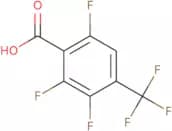
CAS:<p>Versatile small molecule scaffold</p>Formula:C21H19N3O4Purity:Min. 95%Molecular weight:377.4 g/mol2,3,6-Trifluoro-4-(trifluoromethyl)benzoic acid
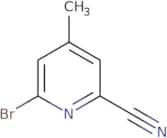
CAS:<p>Versatile small molecule scaffold</p>Formula:C8H2F6O2Purity:Min. 95%Molecular weight:244.09 g/mol6-Bromo-4-methylpyridine-2-carbonitrile
CAS:<p>Versatile small molecule scaffold</p>Formula:C7H5BrN2Purity:Min. 95%Molecular weight:197.03 g/mol1,4,5,6-Tetrahydropyrrolo[3,4-c]pyrazoledihydrochloride
CAS:<p>Versatile small molecule scaffold</p>Formula:C5H9Cl2N3Purity:Min. 95%Molecular weight:182.05 g/mol4,5,6,7-Tetrahydro-1H-pyrazolo[4,3-c]pyridine DiHCl
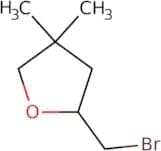
CAS:<p>Versatile small molecule scaffold</p>Formula:C6H9N3·2ClHPurity:Min. 95%Molecular weight:196.08 g/mol2-(Bromomethyl)-4,4-dimethyloxolane
CAS:<p>Versatile small molecule scaffold</p>Formula:C7H13BrOPurity:Min. 95%Molecular weight:193.08 g/molMethyl 5-aminoisoquinoline-8-carboxylate
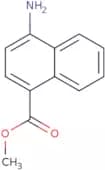
CAS:<p>Versatile small molecule scaffold</p>Formula:C11H10N2O2Purity:Min. 95%Molecular weight:202.21 g/molMethyl 4-Amino-1-naphthoate
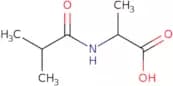
CAS:<p>Versatile small molecule scaffold</p>Formula:C12H11NO2Purity:Min. 95%Molecular weight:201.22 g/mol2-(2-Methylpropanamido)propanoic acid
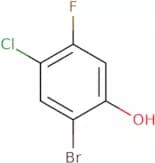
CAS:<p>Versatile small molecule scaffold</p>Formula:C7H13NO3Purity:Min. 95%Molecular weight:159.18 g/mol2-Bromo-4-chloro-5-fluorophenol
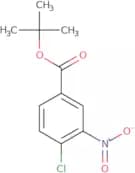
CAS:<p>Versatile small molecule scaffold</p>Formula:C6H3BrClFOPurity:Min. 95%Molecular weight:225.44 g/moltert-Butyl 4-chloro-3-nitrobenzoate
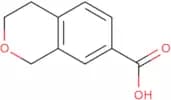
CAS:<p>Tert-butyl 4-chloro-3-nitrobenzoate is a molecule inhibitor that binds to the active site of peroxidase. Tert-butyl 4-chloro-3-nitrobenzoate has been shown to have an anti-cancer effect on cancer cells by inhibiting the production of reactive oxygen species and reducing their proliferation. The drug also inhibits the activity of kinases, which are enzymes that regulate cell division. Tert-butyl 4-chloro-3-nitrobenzoate has been shown to be clinically effective for the treatment of myocardial infarction in rats.</p>Formula:C11H12ClNO4Purity:Min. 95%Molecular weight:257.67 g/mol3,4-Dihydro-1H-2-benzopyran-7-carboxylic acid
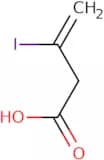
CAS:<p>Versatile small molecule scaffold</p>Formula:C10H10O3Purity:Min. 95%Molecular weight:178.18 g/mol3-Iodobut-3-enoic acid
CAS:<p>3-Iodobut-3-enoic acid is a nitro compound that is used for the synthesis of various organic compounds. It has been shown to be a versatile reagent in organic synthesis and can be used in both cross-coupling reactions and nucleophilic substitution reactions. 3-Iodobut-3-enoic acid may be used as a precursor to synthesize other nitro compounds, such as 1,1'-dinitrobenzene or 1,2,4-trinitrobenzene. This reagent is also useful for the preparation of halogenated aromatic compounds. 3-Iodobut-3-enoic acid has been shown to be an effective functional group modifier for palladium catalysis, due to its ability to bind strongly to palladium metal and form stable complexes with other ligands.</p>Formula:C4H5IO2Purity:Min. 95%Molecular weight:211.99 g/mol1-{1H,2H,3H,4H,9H-Pyrido[3,4-b]indol-1-yl}propan-2-one hydrochloride
CAS:<p>Versatile small molecule scaffold</p>Formula:C14H17ClN2OPurity:Min. 95%Molecular weight:264.8 g/mol4-[1,2,4]Triazol-4-yl-benzoic acid
CAS:<p>4-Triazol-4-ylbenzoic acid is a bifunctional molecule that can be used to activate carboxylate groups. 4-Triazol-4-ylbenzoic acid contains chloride and nitrogen atoms, which are necessary for the chemical stability of the compound. This molecule has been shown to have luminescence properties in the presence of various metals and metal ions, such as copper and silver ions. 4-Triazol-4-ylbenzoic acid is also stable in basic solutions due to its basic structure. The crystal x-ray diffraction of this molecule shows that it has a linker that can bind with water molecules and form an H2O tetramer.</p>Formula:C9H7N3O2Purity:Min. 95%Molecular weight:189.2 g/mol1-Phenylprop-2-yn-1-amine hydrochloride
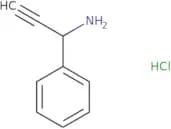
CAS:<p>Versatile small molecule scaffold</p>Formula:C9H10ClNPurity:Min. 95%Molecular weight:167.63 g/mol[1-(But-3-yn-1-yl)-3-methoxypyrrolidin-3-yl]methanol
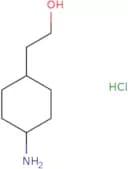
CAS:<p>Versatile small molecule scaffold</p>Formula:C10H17NO2Purity:Min. 95%Molecular weight:183.2 g/moltrans-4-amino-cyclohexaneethanol
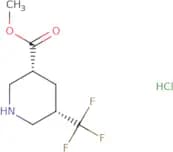
CAS:<p>Versatile small molecule scaffold</p>Formula:C8H17NOPurity:Min. 95%Molecular weight:143.23 g/molrac-methyl (3R,5S)-5-(trifluoromethyl)piperidine-3-carboxylate hydrochloride, cis
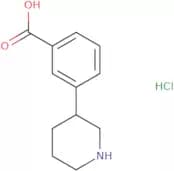
CAS:<p>Versatile small molecule scaffold</p>Formula:C8H13ClF3NO2Purity:Min. 95%Molecular weight:247.6 g/mol3-(Piperidin-3-yl)benzoic acid hydrochloride
CAS:<p>Versatile small molecule scaffold</p>Formula:C12H16ClNO2Purity:Min. 95%Molecular weight:241.71 g/mol
![2-({[(9H-Fluoren-9-yl)methoxy]carbonyl}amino)-3-(1H-imidazol-4-yl)propanoic acid](/_next/image/?url=https%3A%2Fstatic.cymitquimica.com%2Fproducts%2F3D%2Fthumb-webp%2FHGA35576.webp&w=3840&q=75)

![1,4,5,6-Tetrahydropyrrolo[3,4-c]pyrazoledihydrochloride](/_next/image/?url=https%3A%2Fstatic.cymitquimica.com%2Fproducts%2F3D%2Fthumb-webp%2FHGA32747.webp&w=3840&q=75)
![4,5,6,7-Tetrahydro-1H-pyrazolo[4,3-c]pyridine DiHCl](/_next/image/?url=https%3A%2Fstatic.cymitquimica.com%2Fproducts%2F3D%2Fthumb-webp%2FHGA32744.webp&w=3840&q=75)

![1-{1H,2H,3H,4H,9H-Pyrido[3,4-b]indol-1-yl}propan-2-one hydrochloride](/_next/image/?url=https%3A%2Fstatic.cymitquimica.com%2Fproducts%2F3D%2Fthumb-webp%2FHGA10326.webp&w=3840&q=75)
![4-[1,2,4]Triazol-4-yl-benzoic acid](/_next/image/?url=https%3A%2Fstatic.cymitquimica.com%2Fproducts%2F3D%2Fthumb-webp%2FHGA06948.webp&w=3840&q=75)
![[1-(But-3-yn-1-yl)-3-methoxypyrrolidin-3-yl]methanol](/_next/image/?url=https%3A%2Fstatic.cymitquimica.com%2Fproducts%2F3D%2Fthumb-webp%2FHFD95748.webp&w=3840&q=75)