


Building Blocks
This section contains fundamental products for the synthesis of organic and biological compounds. Building blocks are the essential starting materials used to construct complex molecules through various chemical reactions. They play a critical role in drug discovery, material science, and chemical research. At CymitQuimica, we offer a diverse range of high-quality building blocks to support your innovative research and industrial projects, ensuring you have the essential components for successful synthesis.
Subcategories of "Building Blocks"
- Boronic Acids & Boronic Acid Derivatives(5,756 products)
- Chiral Building Blocks(1,242 products)
- Hydrocarbon Building Blocks(6,095 products)
- Organic Building Blocks(61,037 products)
Found 196200 products of "Building Blocks"
Sort by
Purity (%)
0
100
|
0
|
50
|
90
|
95
|
100
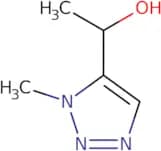
(1R)-1-(1-Methyl-1H-1,2,3-triazol-5-yl)ethan-1-ol
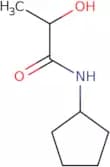
CAS:<p>Versatile small molecule scaffold</p>Formula:C5H9N3OPurity:Min. 95%Molecular weight:127.14 g/mol(2R)-N-Cyclopentyl-2-hydroxypropanamide
CAS:<p>Versatile small molecule scaffold</p>Formula:C8H15NO2Purity:Min. 95%Molecular weight:157.21 g/mol(2R,3S)-3-(3-Cyclopropyl-1,2,4-oxadiazol-5-yl)-2-methylmorpholine hydrochloride
CAS:<p>Versatile small molecule scaffold</p>Formula:C10H16ClN3O2Purity:Min. 95%Molecular weight:245.7 g/mol2,3,3-Trimethyl-4,5-benzo-3H-indole
CAS:<p>2,3,3-Trimethyl-4,5-benzo-3H-indole is a fine chemical that is used as a versatile building block for research chemicals and speciality chemicals. It can be used to synthesize drugs. 2,3,3-Trimethyl-4,5-benzo-3H-indole is also a reaction component in the synthesis of complex compounds with high quality.</p>Formula:C15H15NPurity:Min. 96 Area-%Molecular weight:209.29 g/molL-Tyrosine
CAS:<p>L-Tyrosine is a non-essential amino acid with versatile building block properties. It can be used as a reagent in organic synthesis, as a building block for complex compounds, and as a speciality chemical. L-Tyrosine is also useful as a reaction component in the synthesis of peptides and proteins. L-Tyrosine is an important intermediate in the production of pharmaceuticals, agrochemicals, dyes, flavors and fragrances. The CAS number for L-Tyrosine is 60-18-4.</p>Formula:C9H11NO3Molecular weight:181.19 g/molRef: 3D-T-9010
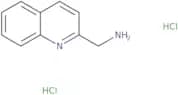
1kgTo inquire5kgTo inquire10kgTo inquire25kgTo inquire2500gTo inquire-Unit-kgkgTo inquire2-Aminomethylquinoline 2HCl
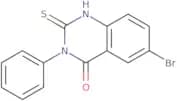
CAS:<p>Versatile small molecule scaffold</p>Formula:C10H11ClN2Purity:Min. 95%Molecular weight:194.66 g/mol6-Bromo-3-phenyl-2-sulfanyl-3,4-dihydroquinazolin-4-one
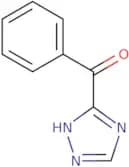
CAS:<p>Versatile small molecule scaffold</p>Formula:C14H9BrN2OSPurity:Min. 95%Molecular weight:333.2 g/mol3-Benzoyl-4H-1,2,4-triazole
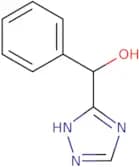
CAS:<p>3-Benzoyl-4H-1,2,4-triazole is an aryl ketone that can be used in the synthesis of triazoles. It is a strong acid, proton donor, and it can be used to synthesize ketones.</p>Formula:C9H7N3OPurity:Min. 95%Molecular weight:173.17 g/molPhenyl(4H-1,2,4-triazol-3-yl)methanol
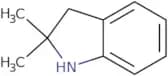
CAS:<p>Versatile small molecule scaffold</p>Formula:C9H9N3OPurity:Min. 95%Molecular weight:175.19 g/mol2,2-Dimethyl-2,3-dihydro-1H-indole
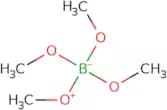
CAS:<p>Versatile small molecule scaffold</p>Formula:C10H13NPurity:Min. 95%Molecular weight:147.22 g/molSodium tetramethoxyboranuide
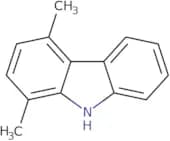
CAS:<p>Versatile small molecule scaffold</p>Formula:C4H12BO4•NaPurity:Min. 95%Color and Shape:PowderMolecular weight:157.94 g/mol1,4-dimethyl-9H-carbazole
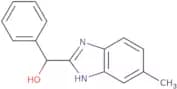
CAS:<p>1,4-dimethyl-9H-carbazole is a synthetic compound that is used in the study of the biological effects of nitro compounds. It has been shown to have antitumor and anti-HIV activities. 1,4-Dimethyl-9H-carbazole inhibits proliferation of human tumor cells and murine leukemia cell lines by affecting their DNA synthesis and thus inhibiting their growth. It also inhibits DNA replication in human T cells, which may be due to its ability to inhibit enzyme activity or interfere with cellular metabolism. This compound also inhibits the growth of HIV by interfering with the production of viral nucleic acids.</p>Formula:C14H13NPurity:Min. 95%Molecular weight:195.26 g/mol(5-Methyl-1H-1,3-benzodiazol-2-yl)(phenyl)methanol
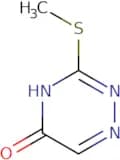
CAS:<p>Versatile small molecule scaffold</p>Formula:C15H14N2OPurity:Min. 95%Molecular weight:238.28 g/mol3-(Methylthio)-1,2,4-triazin-5(4H)-one
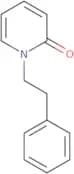
CAS:<p>3-(Methylthio)-1,2,4-triazin-5(4H)-one is an organic compound that belongs to the class of thiones. It is a ligand in coordination chemistry and can be used for the discovery of new lead compounds. 3-(Methylthio)-1,2,4-triazin-5(4H)-one binds to heavy metals such as lead or zinc by forming chelate complexes with them. This ligand also has nitro groups that are sensitive to oxidation and nitration under acidic conditions. The compound has been shown to have high chemical stability when exposed to air or moisture and heat. 3-(Methylthio)-1,2,4-triazin-5(4H)-one is not toxic when ingested orally and does not cause skin irritation or eye damage in animal studies.</p>Formula:C4H5N3OSPurity:Min. 95%Molecular weight:143.17 g/mol1-Phenethyl-2-pyridone-d5
CAS:<p>Versatile small molecule scaffold</p>Formula:C13H13NOPurity:Min. 95%Molecular weight:199.25 g/mol2-Phenylfuro[3,2-b]pyridine
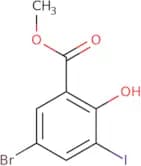
CAS:<p>2-Phenylfuro[3,2-b]pyridine (2PFBP) is a synthetic compound that has antibacterial activity. It is a stereoselective compound, which means it selectively binds to one of the two enantiomers of an enzyme. The selectivity of 2PFBP for methicillin-resistant Staphylococcus aureus (MRSA) was demonstrated in a study using mcf-7 cells, which are human cancer cells that have been transformed by the gene encoding methicillin resistance. The compound inhibited MRSA cell growth and induced apoptosis in MRSA cells. 2PFBP also has antibacterial activity against other bacteria such as S. aureus and S. epidermidis strains. 2PFBP inhibits bacterial growth by binding to DNA-dependent RNA polymerase, thereby preventing transcription and replication. The high frequency of human activity has been shown using a patch-clamp technique on human erythrocytes</p>Formula:C13H9NOPurity:Min. 95%Molecular weight:195.22 g/molMethyl 5-bromo-2-hydroxy-3-iodobenzenecarboxylate
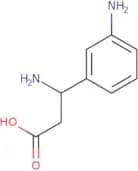
CAS:<p>Versatile small molecule scaffold</p>Formula:C8H6BrIO3Purity:Min. 95%Molecular weight:356.95 g/mol3-Amino-3-(3-aminophenyl)propanoic acid
CAS:<p>Versatile small molecule scaffold</p>Formula:C9H12N2O2Purity:Min. 95%Molecular weight:180.2 g/mol1,3-Bis[1-(2-hydroxyethyl)-4-piperidyl]propane
CAS:<p>Versatile small molecule scaffold</p>Formula:C17H34N2O2Purity:Min. 95%Molecular weight:298.47 g/mol2-Ethynylbicyclo[2.2.1]heptan-2-ol
CAS:<p>Versatile small molecule scaffold</p>Formula:C9H12OPurity:Min. 95%Molecular weight:136.19 g/mol



![2-Phenylfuro[3,2-b]pyridine](/_next/image/?url=https%3A%2Fstatic.cymitquimica.com%2Fproducts%2F3D%2Fthumb-webp%2FTAA06882.webp&w=3840&q=75)
![1,3-Bis[1-(2-hydroxyethyl)-4-piperidyl]propane](/_next/image/?url=https%3A%2Fstatic.cymitquimica.com%2Fproducts%2F3D%2Fthumb-webp%2FTAA07384.webp&w=3840&q=75)
![2-Ethynylbicyclo[2.2.1]heptan-2-ol](/_next/image/?url=https%3A%2Fstatic.cymitquimica.com%2Fproducts%2F3D%2Fthumb-webp%2FTAA08403.webp&w=3840&q=75)